





Question: Read the article below and answer ALL the questions that follow. Over the last few years, there has been a growing need to bring the
Read the article below and answer ALL the

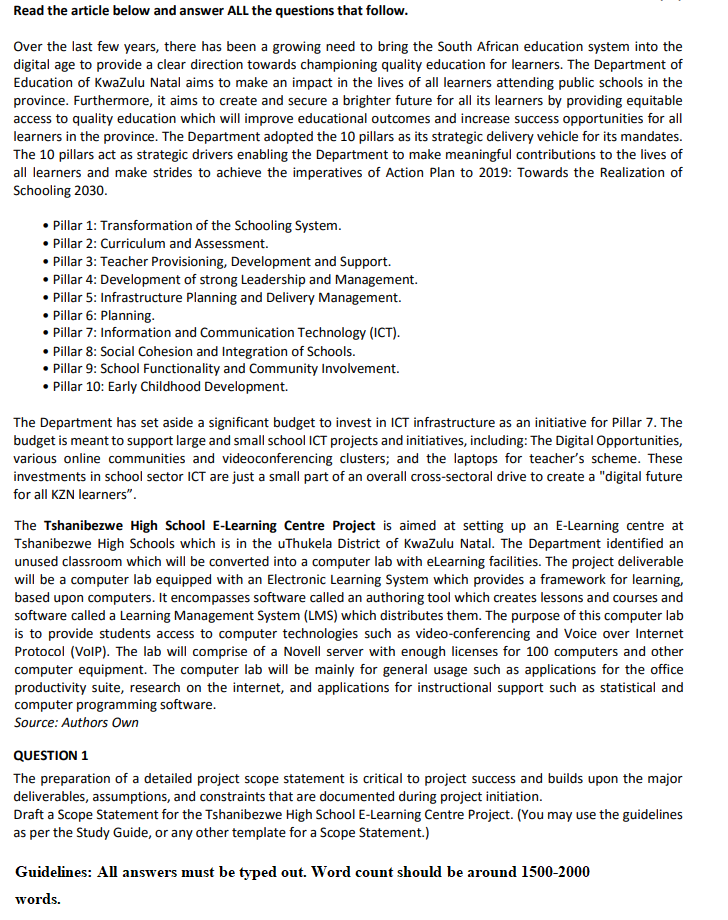
Read the article below and answer ALL the questions that follow. Over the last few years, there has been a growing need to bring the South African education system into the digital age to provide a clear direction towards championing quality education for learners. The Department of Education of KwaZulu Natal aims to make an impact in the lives of all learners attending public schools in the province. Furthermore, it aims to create and secure a brighter future for all its learners by providing equitable access to quality education which will improve educational outcomes and increase success opportunities for all learners in the province. The Department adopted the 10 pillars as its strategic delivery vehicle for its mandates. The 10 pillars act as strategic drivers enabling the Department to make meaningful contributions to the lives of all learners and make strides to achieve the imperatives of Action Plan to 2019: Towards the Realization of Schooling 2030 Pillar 1: Transformation of the Schooling System. Pillar 2: Curriculum and Assessment. Pillar 3: Teacher Provisioning, Development and Support. Pillar 4: Development of strong Leadership and Management. Pillar 5: Infrastructure Planning and Delivery Management. Pillar 6: Planning Pillar 7: Information and Communication Technology (ICT). Pillar 8: Social Cohesion and Integration of Schools. Pillar 9: School Functionality and Community Involvement. Pillar 10: Early Childhood Development. The Department has set aside a significant budget to invest in ICT infrastructure as an initiative for Pillar 7. The budget is meant to support large and small school ICT projects and initiatives, including: The Digital Opportunities, various online communities and videoconferencing clusters; and the laptops for teacher's scheme. These investments in school sector ICT are just a small part of an overall cross-sectoral drive to create a "digital future for all KZN learners". The Tshanibezwe High School E-Learning Centre Project is aimed at setting up an E-Learning centre at Tshanibezwe High Schools which is in the uThukela District of KwaZulu Natal. The Department identified an unused classroom which will be converted into a computer lab with eLearning facilities. The project deliverable will be a computer lab equipped with an Electronic Learning System which provides a framework for learning, based upon computers. It encompasses software called an authoring tool which creates lessons and courses and software called a Learning Management System (LMS) which distributes them. The purpose of this computer lab is to provide students access to computer technologies such as video conferencing and Voice over Internet Protocol (VoIP). The lab will comprise of a Novell server with enough licenses for 100 computers and other computer equipment. The computer lab will be mainly for general usage such as applications for the office productivity suite, research on the internet, and applications for instructional support such as statistical and computer programming software. Source: Authors Own QUESTION 1 The preparation of a detailed project scope statement is critical to project success and builds upon the major deliverables, assumptions, and constraints that are documented during project initiation. Draft a Scope Statement for the Tshanibezwe High School E-Learning Centre Project. (You may use the guidelines as per the Study Guide, or any other template for a Scope Statement.) Guidelines: All answers must be typed out. Word count should be around 1500-2000 words

Step by Step Solution

There are 3 Steps involved in it

1 Expert Approved Answer
Step: 1 Unlock blur-text-image

Question Has Been Solved by an Expert!

Get step-by-step solutions from verified subject matter experts

Step: 2 Unlock
Step: 3 Unlock

Students Have Also Explored These Related General Management Questions!