







Question: READ THE ARTICLE BELOW AND ANSWER THE QUESTIONS THAT FOLLOW: In the end, nostalgia couldnt save Toys R Us. The once mighty retailer, which has
READ THE ARTICLE BELOW AND ANSWER THE QUESTIONS THAT FOLLOW: In the end, nostalgia couldnt save Toys R Us. The once mighty retailer, which has struggled to keep up with changing trends in consumer behavior and childhood play, told a U.S. bankruptcy court on Thursday that it must liquidate its operations, meaning the likely closure of hundreds of stores. The former leader of the toy industry, Toys R Us filed for Chapter 11 bankruptcy in September after years of slipping sales and mounting debt. While intense price competition from mass retailers Walmart, Amazon and Target has contributed to the companys woes, experts place the blame squarely on the shoulders of management. They said Toys R Us has failed to innovate its business model, incorporate technology or adapt to changing consumer behavior. The day of reckoning may have been delayed through a $7.5 billion leveraged buyout in 2005 by private investors Bain Capital Partners, Kohlberg Kravis Roberts and Vornado Realty Trust. But the debt payments proved to be too much for the company, which hoped robust holiday sales would buoy its bottom line and keep it afloat a while longer. The company announced in January it would close 180 of its roughly 800 stores in the U.S. No buyers have stepped up to take over the chain, and the end seems to be in sight. Prior to the liquidation announcement, Toys R Us had announced that it would shutter all 100 of its stores in the United Kingdom. Wharton marketing professor Barbara Kahn, Denise Dahlhoff, research director at Whartons Jay H. Baker Retailing Center, and Mark Cohen, a former retail executive who is director of retail studies at Columbia Universitys Graduate School of Business, talked to Knowledge@Wharton about where Toys R Us went wrong. Dahlhoff and Cohen made their comments during a segment on the Knowledge@Wharton show, which airs on Wharton Business Radio on SiriusXM channel 111. The End Comes as No Surprise The dissolution of New Jersey-based Toys R Us, which traces its roots to a baby-furniture store opened in 1948, comes as no surprise to industry watchers. Thats because Toys R Us hasnt been able to tread water as the tides have shifted in the vast retail ocean. Cohen described the chain as guilty of serial mismanagement. Toys R Us has never been able to wrap their arms around the changes necessary, and this is the inevitable outcome.Mark A. Cohen Retailers today, especially in any kind of fashion or trend segment, have to progress, he said. They have to morph, they have to modify. They have to represent the changes in the marketplace and their customers behavior. Toys R Us has never been able to wrap their arms around the changes necessary, and this is the inevitable outcome. He said the stores were too big, jammed full of inventory, poorly merchandised, and customer service was virtually nonexistent. A poor shopping experience wont entice busy consumers who would rather grab a toy from Target while they fill their carts with groceries, school supplies and the rest of lifes necessities. Toys R Us never made a concerted effort to bring that experiential opportunity into the stores, Cohen said. I think once they went private, they could have cleaned up their act a little bit. But there was no consequential effort to re-imagine themselves, to present themselves in a more engaging and attractive way. Instead, he said, the company was still trading on the view that it was the center of the universe for the toy industry, which was no longer true. This failure began before they went private, Cohen noted. The company was doing poorly. Thats why the private equity trio swooped in thinking they could fundamentally improve their performance. Frankly, they put someone in the job who had no capacity to do that and didnt do that. Dahlhoff agreed with Cohens assessment, adding that Toys R Us didnt defend itself against a number of external threats. The competition has changed so much. Also, the consumer has changed so much, she said. Kids spend way more time playing online video games. You dont have to go to a Toys R Us store for those. In addition, the shopping experience has moved online, and Toys R Us hasnt been the strongest in that area. Competitors like Amazon, Walmart and Target have been very strong online, so that also added to the difficulties. Source: Wharton University of Pennsylvania, 2018 QUESTION ONE [10] The company announced in January it would close 180 of its roughly 800 stores in the U.S. No buyers have stepped up to take over the chain, and the end seems to be in sight. Prior to the liquidation announcement, Toys R Us had announced that it would shutter all 100 of its stores in the United Kingdom. Critically discuss the impacts of the abovementioned on the Toys R Us chain, staff, and business management.
READ THE ARTICLE BELOW AND ANSWER THE QUESTIONS THAT FOLLOW: In the end, nostalgia couldnt save Toys R Us. The once mighty retailer, which has struggled to keep up with changing trends in consumer behavior and childhood play, told a U.S. bankruptcy court on Thursday that it must liquidate its operations, meaning the likely closure of hundreds of stores. The former leader of the toy industry, Toys R Us filed for Chapter 11 bankruptcy in September after years of slipping sales and mounting debt. While intense price competition from mass retailers Walmart, Amazon and Target has contributed to the companys woes, experts place the blame squarely on the shoulders of management. They said Toys R Us has failed to innovate its business model, incorporate technology or adapt to changing consumer behavior. The day of reckoning may have been delayed through a $7.5 billion leveraged buyout in 2005 by private investors Bain Capital Partners, Kohlberg Kravis Roberts and Vornado Realty Trust. But the debt payments proved to be too much for the company, which hoped robust holiday sales would buoy its bottom line and keep it afloat a while longer. The company announced in January it would close 180 of its roughly 800 stores in the U.S. No buyers have stepped up to take over the chain, and the end seems to be in sight. Prior to the liquidation announcement, Toys R Us had announced that it would shutter all 100 of its stores in the United Kingdom. Wharton marketing professor Barbara Kahn, Denise Dahlhoff, research director at Whartons Jay H. Baker Retailing Center, and Mark Cohen, a former retail executive who is director of retail studies at Columbia Universitys Graduate School of Business, talked to Knowledge@Wharton about where Toys R Us went wrong. Dahlhoff and Cohen made their comments during a segment on the Knowledge@Wharton show, which airs on Wharton Business Radio on SiriusXM channel 111. The End Comes as No Surprise The dissolution of New Jersey-based Toys R Us, which traces its roots to a baby-furniture store opened in 1948, comes as no surprise to industry watchers. Thats because Toys R Us hasnt been able to tread water as the tides have shifted in the vast retail ocean. Cohen described the chain as guilty of serial mismanagement. Toys R Us has never been able to wrap their arms around the changes necessary, and this is the inevitable outcome.Mark A. Cohen Retailers today, especially in any kind of fashion or trend segment, have to progress, he said. They have to morph, they have to modify. They have to represent the changes in the marketplace and their customers behavior. Toys R Us has never been able to wrap their arms around the changes necessary, and this is the inevitable outcome. He said the stores were too big, jammed full of inventory, poorly merchandised, and customer service was virtually nonexistent. A poor shopping experience wont entice busy consumers who would rather grab a toy from Target while they fill their carts with groceries, school supplies and the rest of lifes necessities. Toys R Us never made a concerted effort to bring that experiential opportunity into the stores, Cohen said. I think once they went private, they could have cleaned up their act a little bit. But there was no consequential effort to re-imagine themselves, to present themselves in a more engaging and attractive way. Instead, he said, the company was still trading on the view that it was the center of the universe for the toy industry, which was no longer true. This failure began before they went private, Cohen noted. The company was doing poorly. Thats why the private equity trio swooped in thinking they could fundamentally improve their performance. Frankly, they put someone in the job who had no capacity to do that and didnt do that. Dahlhoff agreed with Cohens assessment, adding that Toys R Us didnt defend itself against a number of external threats. The competition has changed so much. Also, the consumer has changed so much, she said. Kids spend way more time playing online video games. You dont have to go to a Toys R Us store for those. In addition, the shopping experience has moved online, and Toys R Us hasnt been the strongest in that area. Competitors like Amazon, Walmart and Target have been very strong online, so that also added to the difficulties. Source: Wharton University of Pennsylvania, 2018 QUESTION ONE [10] The company announced in January it would close 180 of its roughly 800 stores in the U.S. No buyers have stepped up to take over the chain, and the end seems to be in sight. Prior to the liquidation announcement, Toys R Us had announced that it would shutter all 100 of its stores in the United Kingdom. Critically discuss the impacts of the abovementioned on the Toys R Us chain, staff, and business management.
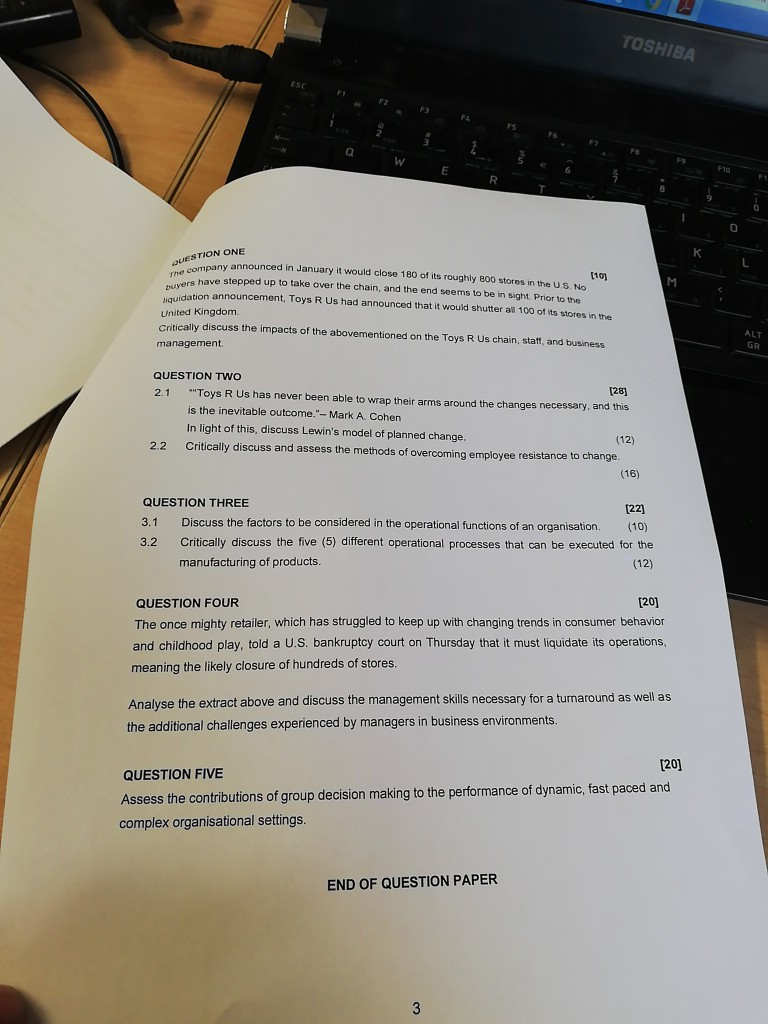
The company announced in January it would close 180 of its roughly 800 stores in the US. NO Buyers have stepped up to take over the chain, and the end seems to be in sight Prior to the TOSHIBA ESC F FE FO w E FID R T O K QUESTION ONE (10) liquidation announcement, Toys R Us had announced that it would shutter all 100 of its stores in the United Kingdom Critically discuss the impacts of the abovementioned on the Toys R Us chain, staff, and business management ALT GR QUESTION TWO 2.1 [28] Toys R Us has never been able to wrap their arms around the changes necessary, and this is the inevitable outcome."- Mark A. Cohen In light of this, discuss Lewin's model of planned change. (12) 2.2 Critically discuss and assess the methods of overcoming employee resistance to change (16) QUESTION THREE [22] 3.1 Discuss the factors to be considered in the operational functions of an organisation (10) 3.2 Critically discuss the five (5) different operational processes that can be executed for the manufacturing of products. (12) QUESTION FOUR [20] The once mighty retailer, which has struggled to keep up with changing trends in consumer behavior and childhood play, told a U.S. bankruptcy court on Thursday that it must liquidate its operations, meaning the likely closure of hundreds of stores. Analyse the extract above and discuss the management skills necessary for a turnaround as well as the additional challenges experienced by managers in business environments QUESTION FIVE [20] Assess the contributions of group decision making to the performance of dynamic, fast paced and complex organisational settings. END OF QUESTION PAPER 3 The company announced in January it would close 180 of its roughly 800 stores in the US. NO Buyers have stepped up to take over the chain, and the end seems to be in sight Prior to the TOSHIBA ESC F FE FO w E FID R T O K QUESTION ONE (10) liquidation announcement, Toys R Us had announced that it would shutter all 100 of its stores in the United Kingdom Critically discuss the impacts of the abovementioned on the Toys R Us chain, staff, and business management ALT GR QUESTION TWO 2.1 [28] Toys R Us has never been able to wrap their arms around the changes necessary, and this is the inevitable outcome."- Mark A. Cohen In light of this, discuss Lewin's model of planned change. (12) 2.2 Critically discuss and assess the methods of overcoming employee resistance to change (16) QUESTION THREE [22] 3.1 Discuss the factors to be considered in the operational functions of an organisation (10) 3.2 Critically discuss the five (5) different operational processes that can be executed for the manufacturing of products. (12) QUESTION FOUR [20] The once mighty retailer, which has struggled to keep up with changing trends in consumer behavior and childhood play, told a U.S. bankruptcy court on Thursday that it must liquidate its operations, meaning the likely closure of hundreds of stores. Analyse the extract above and discuss the management skills necessary for a turnaround as well as the additional challenges experienced by managers in business environments QUESTION FIVE [20] Assess the contributions of group decision making to the performance of dynamic, fast paced and complex organisational settings. END OF QUESTION PAPER 3
Step by Step Solution
There are 3 Steps involved in it

Get step-by-step solutions from verified subject matter experts
 Study Help