







Question: Read the articles posted in this week's module and write a one to two-page summary of the reading. Include any ideas that particularly excite or
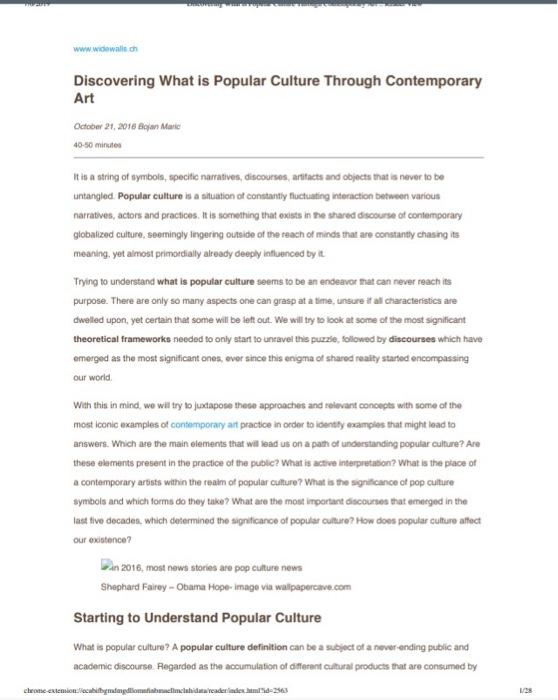
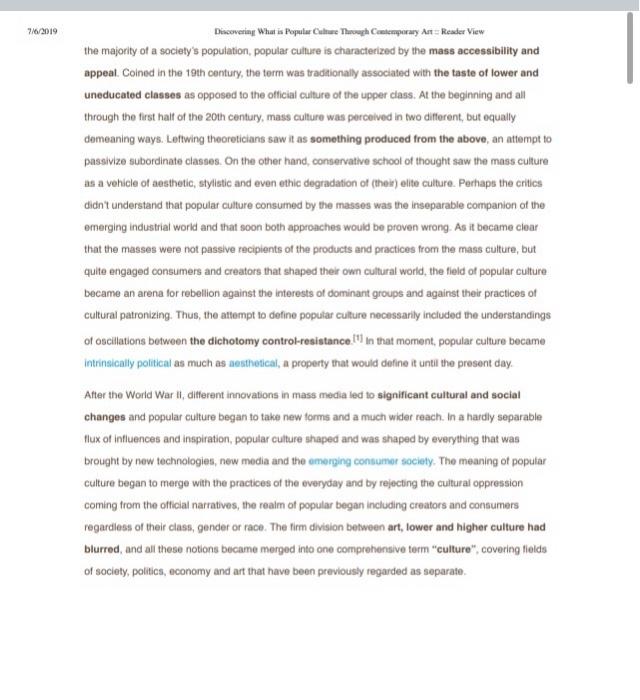
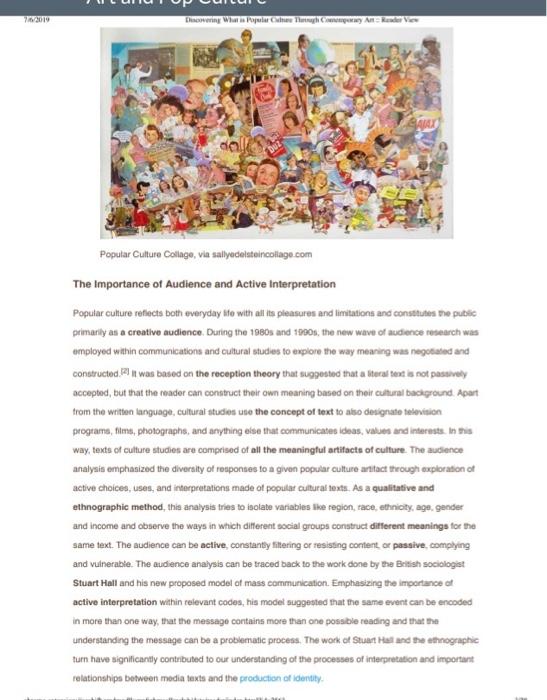
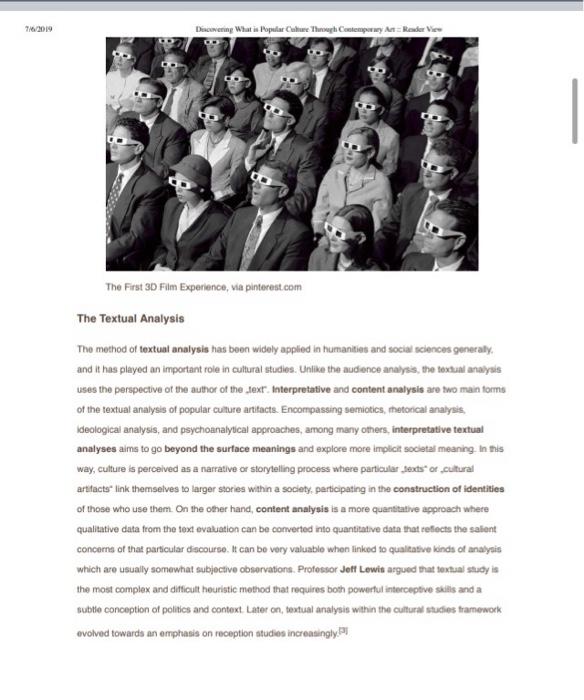
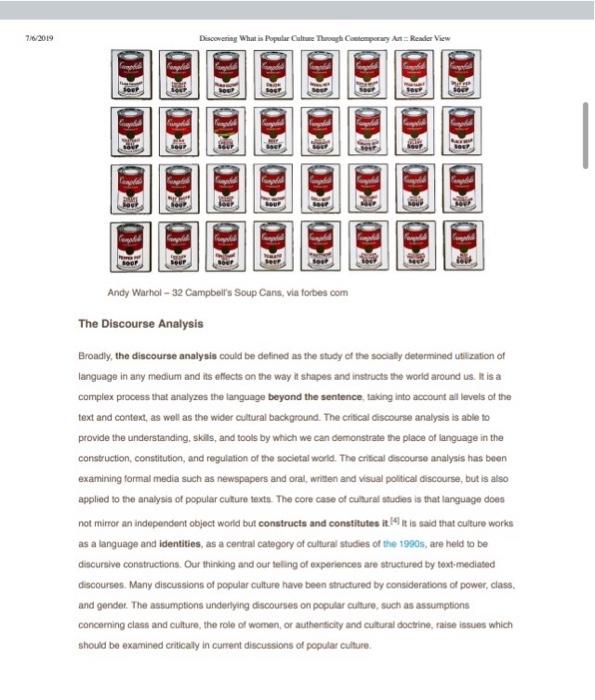
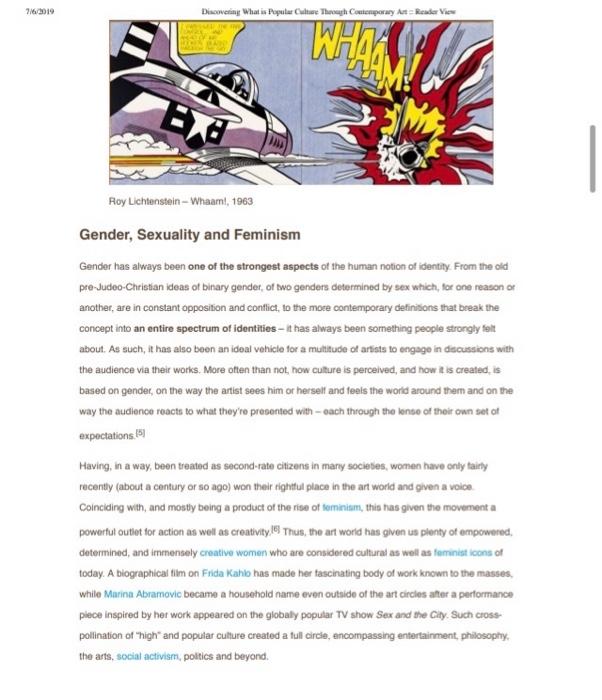
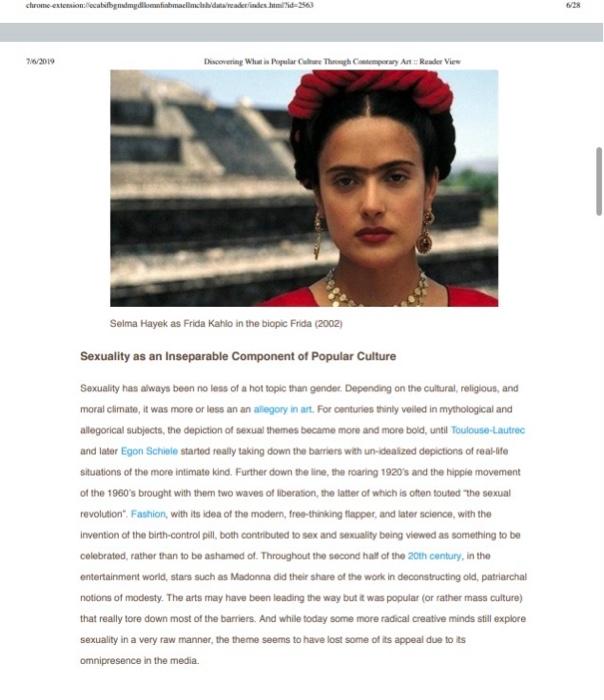
October 21, 2016 Bojan Maic 4050 mindes It is a string of aymbols, specitic namratives, discovirses, artifacts and objocts that is never to be untangled. Popular culture is a siltation of constantly fiuctuating interaction between various narratbes, actors and practices. If is something that oxists in the shared disosurse of contemporary globalized cuiture, seemingly irgering outside of the reach of minds that are constantly chasing its meaning. yet almost primoedially already deeply intivenced by it. Trying to understand what is popular culture seems to be an endeavor that can never reach its purpose. There are only so many aspects one can grasp at a time, unsure at all characteristics are dwelled upon, yet certain that some will be left out. We will try to look at some of the most significant theoretical frameworks needed to only start to untavel this puzzle, followed by discourses which have emergod as the most significant ones, evor since this enigma of shared realty started encompassing our world With this in mind, wo will try to juxtapose these approaches and relevant concepts with some of the most iconic examples of contemporary art practice in order to idently examples that might lead to answerf. Which age the main elements that will lead us on a path of understanding poputar culture? Are these elements present in the practice of the puble? What is active interpretabion? What is the place of a contemporary artists within the reaim of popular cullure? What is the signifcance of pop culture symbols and which forms do they take? What are the most irnoortant discourses that emerged in the last tive decaden. which determined the significance of populs culture? How does popular culfure affect our existence? Tan 2016, most news stories are pop cuiture news Shephard Fairey - Obama Hope- image via walpapercave.com Starting to Understand Popular Culture What is popular culture? A popular culture definition can be a subject of a never-ending public and academic discourse. Aegarded as the acoumulation of diffetent cultural products that are consumed by the majority of a society's population, popular culture is characterized by the mass accessibility and appeal. Coined in the 19th century, the term was tradaionally associated with the taste of lower and uneducated classes as opposed to the official culture of the upper class. At the beginning and all through the first half of the 20th century, mass culture was perceived in two different, but equally demeaning ways. Leftwing theoreticians saw it as something produced from the above, an attempt to passivize subordinate classes. On the other hand, conservative school of thought saw the mass culture as a vehicle of aesthetic, stylistic and even ethic degradation of (their) elite culture. Perhaps the critics didnt understand that popular culture consumed by the masses was the inseparable companion of the emerging industrial world and that soon both approaches would be proven wrong. As it became clear that the masses were not passive recipients of the products and practices from the mass culture, but quite engaged consumers and creators that shaped their own cultural world, the field of popular culture became an arena for rebellion against the interests of dominant groups and against their practices of cultural patronizing. Thus, the attempt to define popular culture necessarliy included the understandings of oscillations between the dichotomy control-resistance [1] In that moment, popular culture became intrinsically political as much as aesthetical, a property that would define it until the present day. After the World War H, ditferent innovabions in mass media led to significant cultural and social changes and popular culture began to take new forms and a much wider reach. In a hardly separable flux of influences and inspiration, popular culture shaped and was shaped by everything that was brought by new technologies, new media and the emerging consumer society. The meaning of popular culture began to merge with the practices of the everyday and by rejecting the cultural oppression coming from the official narratives, the reaim of popular began including creators and consumers regardless of their class, gender or race. The firm division between art, lower and higher culture had blurred, and all these notions became merged into one comprehensive term "culture", covering fields of society, politics, economy and art that have been previously regarded as separate. Popular Culture Collage, via sallyodelsteincollage com The Importance of Audience and Active Interpretation Popular cullure reflects both everyday ste with all its pleasures and limitations and constutes ne public primarly as a creative audience. During the 1980s and 1990s, the new wave of audience research was employed within communications and cultural studies to explore the way mearing was negotated and constructed. [I] I was based on the reception theory that sugpested that a literal text is not passely accepted, but that the neader can construct their own meaning based on their cultural background. Apart trom the written language, cultural studies use the concept of text to also designate televition programs, fims, pholographs, and anything else that communicates ideas, valves and interette. In this way, texts of culture studies are comprised of all the meaningful artifacts of culture. The audience analyais emphasized the diversity of rosponses to a given popular culture antact through oxploration of active choices, uses, and interpratations made of popular cultural lexts. As a qualitative and ethnographic method, this analysis tries to isolate variabies liwe region, race, ethnioty, age, gender and income and observe the ways in which different social groups construct different meanings for the same text. The audience can be active, constantly fillering or resisting content, or passive, complying and vuinerable. The audience analysis can be traced back to the work done by the British sociologist Stuart Hall and his new proposed model of mass communication. Emphasizing the importance of active interpretation within relevant codes, his model suggetted that the same event can be encoded in more than one way, that the message contains more than one possble reading and that the understanding the message can be a problematic process. The work of Stuat Hal and the ethnographic turn have significantly contrbuted to our understanding of the processes of interpretation and important relationships between media texts and the production of idendty. The First 30 Film Experience, via pinterest com The Textual Analysis The method of textual analysis has been widely appled in humanities and social sciences generally. and it has played an important role in cultural studies. Unlike the audence analysis, the toxlual analysis uses the perspective of the author of the flext. Interpretative and content analysis are two main forms of the textual analysis of popular culture artifacts. Encornpassing semiotics, thetonical analysis, ideological analysis, and psychoanalytical approaches, among many others, interpretative textual analyses aims to go beyond the surface meanings and explore more implicit sociatal meaning. in this way, culture is percelved as a narrative of storyleling process where particular texts" or cultural artfacts" link themselves to larger stories within a soclety, participating in the construction of identities of those who use them. On the other hand, content analysis is a more quantitative agproach where qualiative data from the text evaluation can be corverted into quantitative data that refocts the salient concerns of that parficular discourse. It can bo vory valuable when linked to qualeative kinds of analyeis which are usually somewhat subjective observations. Professor Jeft Lewis asgued that textual study is the most complex and difficult heuristic method that requires both powertul interceptive skills and a subtle conception of politics and context. Later on, textual analysis within the cultural studies framework evolved towards an emphasis on reception atudies increasingly Andy Warhol - 32 Campbeil's Soup Cans, via forbes com The Discourse Analysis Broadly, the discourse analysis could be delined as the study of the socialy determined utilization of language in any medium and its eflects on the way it shapes and instructs the world around us. It is a complex process that analyzes the language beyond the sentence, taking into account al levels of the text and context, as well as the wider cultural background. The critical ciscourse analysis is able to provide the understanding, skils, and tools by which we can demonstrate the place of language in the construction, constitution, and regulation of the societal world. The critcal discourse analysis has been examining formal media such as newspapers and oral, written and visual poltical discourse, but is also applied to the analysis of popular cuture texte. The core case of cularal atudies is that language does not mirror an independent object world but constructs and constitutes it 14 it is said that culture works as a language and identities, as a central category of cultural studies of the 1990s, are held to be discursive constructions. Our thinking and our leling of experiences are structured by toxt-mediated discourses. Many discussions of popular culture have been structured by considerations of power, class, and gender. The assumptions underlying discourses on popular culture, such as assumptions conceming class and culture, the role of women, or autherficly and cultural doctrine, raise issues which should be examined criticaly in current discussions of popular culture. Gender, Sexuality and Feminism Gender has always been one of the strongest aspects of the human notion of identify From the old pre-Judeo-Christian ideas of binary gender, of two genders determined by sex which, for one reason or another, are in constant opposition and conflict, to the more contemporary definisons that break the concept into an entire spectrum of identities - it has always been something people strongly felt about. As such, it has also been an ideal vehicle for a mulitude of artsts to engage in discussions with the audience via their works. More often than not, how culture is perceived, and how it is created, is based on gender, on the way the artist sees him or herself and feels the world around them and on the way the audience roacts to what they're presented with - each through the lense of their own set of expoctations (5] Having, in a way, been treated as second-rate citizens in mary socieses, women have only tairly recently (about a century or so ago) won their rightul place in the art world and given a voice. Coinciding with, and mostly being a product of the rive of leminism, this has given the movement a powerful outlet for action as well as creativity [6] Thus, the art world has given us plenty of empowered. determined, and imenensely creative women who are considered cultural as well as feminist icons of today. A biographical tilm on Frida Kahb has made her tascinating body of work known to the masses, while Marina Abramovic became a household name even outside of the art circles ahter a pertormance piece inspired by her work appeared on the globaly popular TV show Sex and the City. Such crosspolination of "high" and popular culture created a full circle, encompassing entertainment, philosophy, the arts, social activism, poltics and beyond. Seima Hayek as Frida Kahlo in the biopic Frida (2002) Sexuality as an Inseparable Component of Popular Culture Sexuality has always been no less of a hot topic than gender. Depending on the culturat, religious, and moral climate, it was more or less an an alegory in art. For centuries thinly velled in mythological and allegorical subjects, the depiction of sexual themes became more and more bold, until Toulouse-Lautrec and later Egon Schieie startod really taking down the barriers wth un-idealied depictions of real-afe situations of the more intimate kind. Further down the line, the roaring 1920's and the hippie movement of the 1960's brought with them two waves of liberason, the latter of which is otten touted the sexual revolution:. Fashion, with its idea of the modern, free-thinking flapper, and later science, with the invention of the birth-control pill, both contributed to sex and sexuality boing viewed as something to be celobrated, rather than to be ashamed of. Throughout the second hall of the 2oth century, in the entertainment world, stars such as Madonna did their share of the work in deconstructing old, patriarchal notions of modesty. The arts may have been leading the way but it was popular (or tather mass cuiture) that really tore down most of the barriers. And while today some more radical creative minds still explore sexuality in a very raw manner, the theme seems to have lost some of its appeal due to is omnipresence in the media. Dhoconering What is Popular Calture Through Contestporary Ant :: Reader Vicw human issues. In a nutshell, the notion of race was originally based on physical traits while culture on various beliets and values, but due to globalization, the processes of cultural and racial mixing have achieved complex outcomes. People of the same race adopted diflerent cultures, while people with the same culture may belong to difterent races. This phenomenon of blurred lines between race and culture is prominent especially in the United States, the very epicenter of globalization and immigration. [10] Being Different in America Racial and ethnic discrimination have been common in the United States ever since the colonial era and the slave era. White Americans were given exclusive privileges when it comes to education, voting rights and citizenships, while Native Americans, African-Americans, Asian Americans, and Hispanic and Latino-Americans suffered exclusion and various forms of racial and ethnical discrimination. Such conditions formally lasted from the 17th century until the 1960 s and they are well-documented in various propaganda posters and documentary photographs. Racism reappears even in today's popular culture, usually in the form of hate speech or discriminating visual materials. As a natural response to various forms of social inequalities, anti-racism was born in the United States to promote the idea of an egalitarian society. By its very nature, anti-racism tends to promote the idea that racism is dangerous, socially pervasive and that it has to be completely eliminated for the sake of global weltare. Just like there have been numberless examples of racism in contemporary culture and arts, the same goes for antj-racism and famous people who have been promoting it. These supporters of egalitarian society come from the most versatile backgrounds, otten related to popular culture, politics and sports and their work along with their personaily and appearance got immortalized in the form of photographs, posters and memorable quotes. Let us have a look at some of the most iconic ones
Step by Step Solution
There are 3 Steps involved in it

Get step-by-step solutions from verified subject matter experts
 Study Help