







Question: Read the attached article.Answer the question below. 1. What is main point being made here? 2. Do you agree?Explain your answer 3. Why do you
Read the attached article.Answer the question below.
1. What is main point being made here?
2. Do you agree?Explain your answer
3. Why do you think it will help reduce corruption if Government deals are made public?
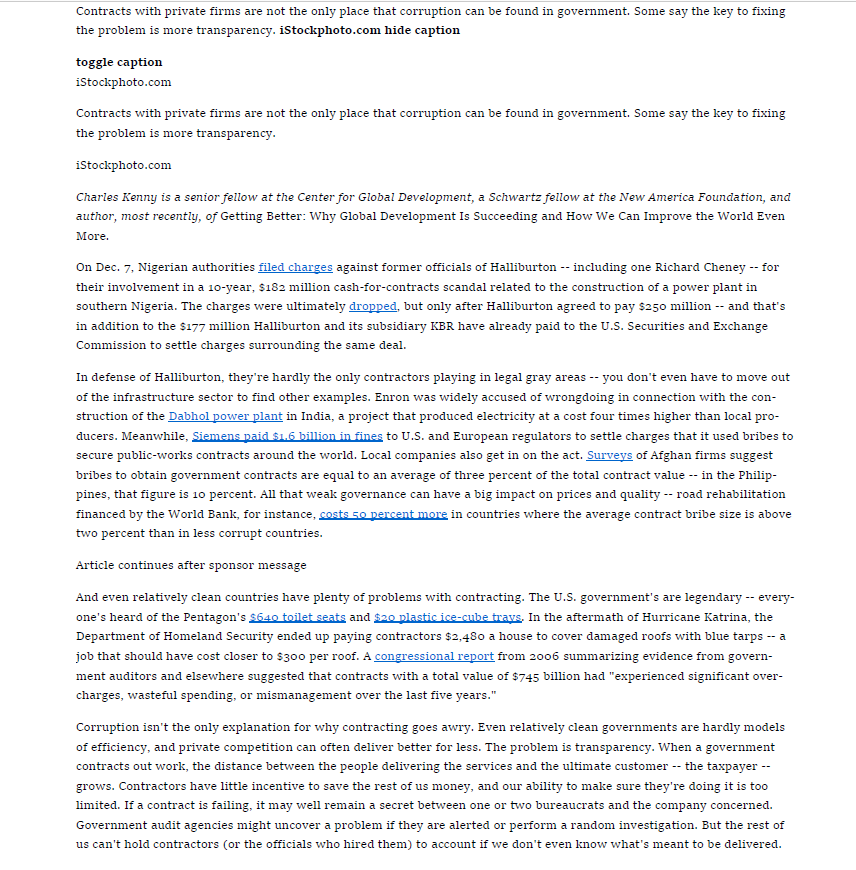
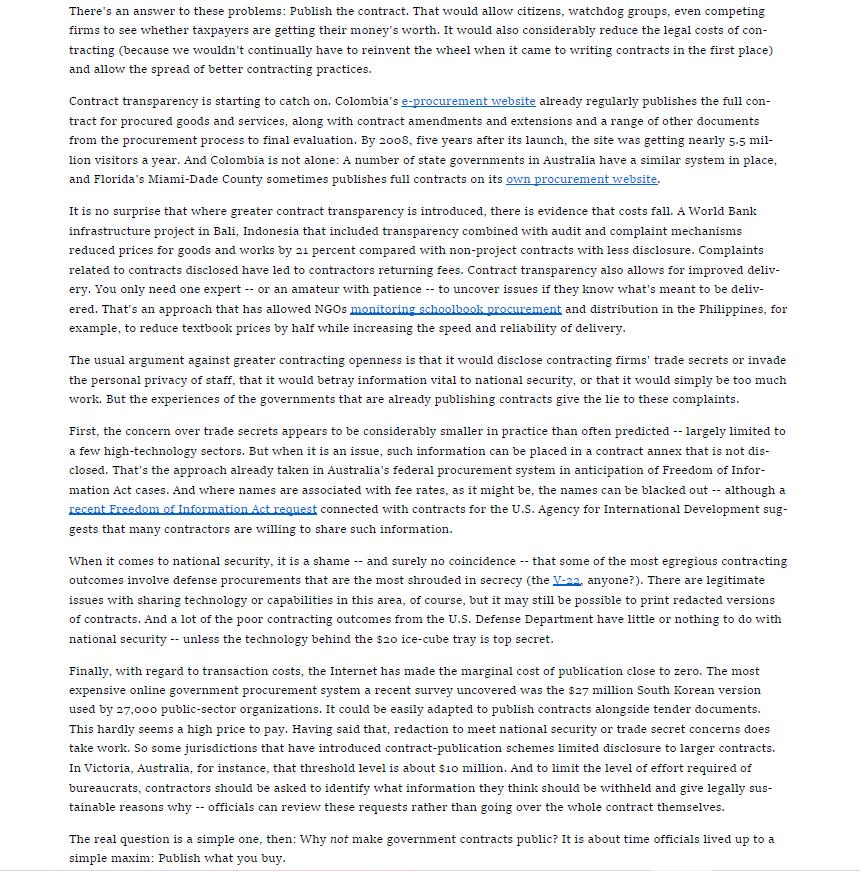
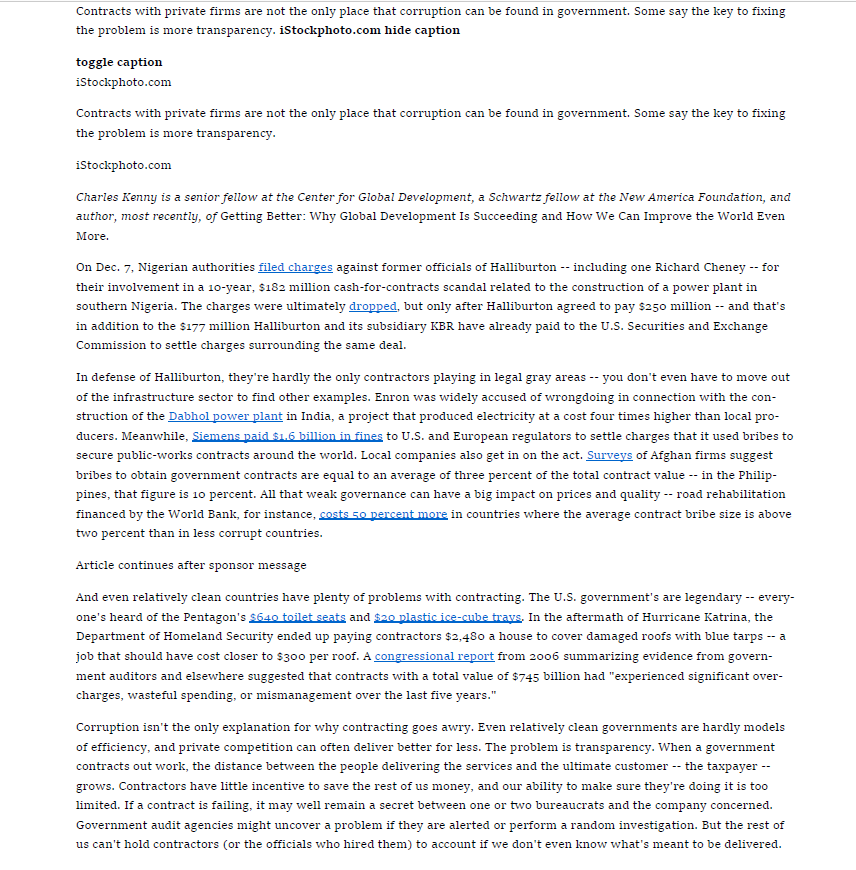
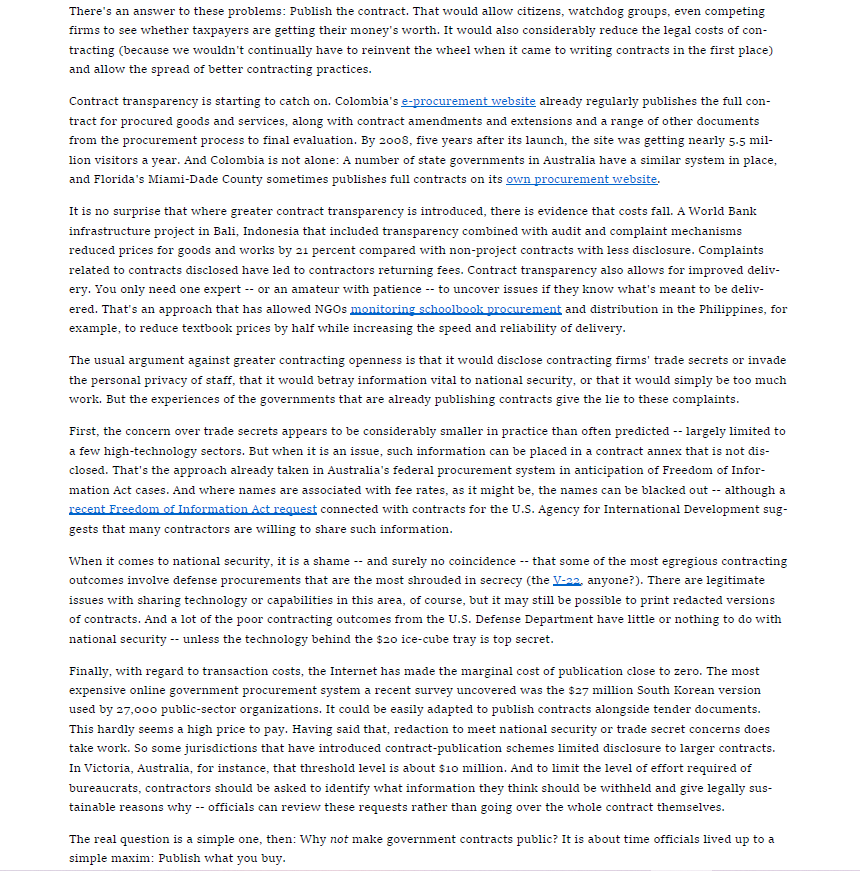
Contracts with private firms are not the only place that corruption can be found in government. Some say the key to fixing the problem is more transparency. iStockphoto.com hide caption toggle caption iStockphoto.com Contracts with private firms are not the only place that corruption can be found in government. Some say the key to fixing the problem is more transparency. iStockphoto.com Charles Kenny is a senior fellow at the Center for Global Development, a Schwartz fellow at the New America Foundation, and author, most recently, of Getting Better: Why Global Development Is Succeeding and How We Can Improve the World Even More. On Dec. 7, Nigerian authorities filed charges against former officials of Halliburton -- including one Richard Cheney -- for their involvement in a 10-year, $182 million cash-for-contracts scandal related to the construction of a power plant in southern Nigeria. The charges were ultimately dropped, but only after Halliburton agreed to pay $250 million -- and that's in addition to the $177 million Halliburton and its subsidiary KBR have already paid to the U.S. Securities and Exchange Commission to settle charges surrounding the same deal. In defense of Halliburton, they're hardly the only contractors playing in legal gray areas -- you don't even have to move out of the infrastructure sector to find other examples. Enron was widely accused of wrongdoing in connection with the con- struction of the Dabhol power plant in India, a project that produced electricity at a cost four times higher than local pro- ducers. Meanwhile, Siemens paid $1.6 billion in fines to U.S. and European regulators to settle charges that it used bribes to secure public-works contracts around the world. Local companies also get in on the act. Surveys of Afghan firms suggest bribes to obtain government contracts are equal to an average of three percent of the total contract value -- in the Philip- pines, that figure is 10 percent. All that weak governance can have a big impact on prices and quality -- road rehabilitation financed by the World Bank, for instance, costs so percent more in countries where the average contract bribe size is above two percent than in less corrupt countries. Article continues after sponsor message And even relatively clean countries have plenty of problems with contracting. The U.S. government's are legendary -- every- one's heard of the Pentagon's $640 toilet seats and sao plastic ice-cube trays. In the aftermath of Hurricane Katrina, the Department of Homeland Security ended up paying contractors $2,480 a house to cover damaged roofs with blue tarps -- a job that should have cost closer to $300 per roof. A congressional report from 2006 summarizing evidence from govern- ment auditors and elsewhere suggested that contracts with a total value of $745 billion had "experienced significant over- charges, wasteful spending, or mismanagement over the last five years." Corruption isn't the only explanation for why contracting goes awry. Even relatively clean governments are hardly models of efficiency, and private competition can often deliver better for less. The problem is transparency. When a government contracts out work, the distance between the people delivering the services and the ultimate customer -- the taxpayer -- grows. Contractors have little incentive to save the rest of us money, and our ability to make sure they're doing it is too limited. If a contract is failing, it may well remain a secret between one or two bureaucrats and the company concerned. Government audit agencies might uncover a problem if they are alerted or perform a random investigation. But the rest of us can't hold contractors (or the officials who hired them) to account if we don't even know what's meant to be delivered.There's an answer to these problems: Publish the contract. That would allow citizens, watchdog groups, even competing firms to see whether taxpayers are getting their money's worth. It would also considerably reduce the legal costs of con tracting (because we wouldn't continually have to reinvent the wheel when it came to writing contracts in the first place} and allow the spread of better contracting practices. Contract transparency is starting to catch on. Colombia's epnocurenient website already regularly publishes the full con tract for procured goods and services, along with contract amendments and extensions and a range of other documents from the procurement process to final evaluation. By sooB, five years after its launch, the site was getting nearly 5.5 mil lion visitors a year. And Colombia is not alone: A number of state governments in Australia have a similar system in placeI and Florida's Miami-Bade County sometimes publishes full contracts on its own procurement website. It is no surprise that where greater contract transparency is introduced, there is evidence that costs fall. A World Bank infrastructure project in Bali, Indonesia that included transparency combined with audit and complaint mechanisms reduced prices for goods and works by 21 percent compared with nonproject contracts with less disclosure. Complaints related to contracts disclosed have led to contractors returning fees. Contract transparency also allows for improved deliv- ery. You only need one expert -- or an amateur with patience -- to uncover is sues if they know what's meant to be deliv- ered. That's an approach that has allowed NGOs WW and distribution in the Philippines, for exampleI to reduce textbook prices by half while increasing the speed and reliability of delivery. The usual argument against greater contracting openness is that it would disclose contracting rms' trade secrets or invade the personal privacy of staff, that it would betray information vital to national security, or that it would simply be too much work. But the experiences of the governments that are already publishing contracts give the lie to these complaints. First, the concern over trade secrets appears to be considerably smaller in practice than often predicted -- largely limited to a few high-technology sectors. But when it is an issue, such information can be placed in a contract annex that is not dis- closed. That's the approach already taken in Australia's federal procurement system in anticipation of Freedom of Infor- mation Act cases. And where names are associated with fee rates, as it might be, the names can be blacked out -- although a W; connected with contracts for the U.S. Agency for International Development sug- gests that many contractors are willing to share such information. When it comes to national security, it is a shame -- and surely no coincidence -- that some of the most egregious contracting outcomes involve defense procurements that are the most shrouded in secrecy [the Lag, anyone?]. There are legitimate issues with sharing technology or capabilities in this area, of course, but it may still be possible to print redacted versions of contracts. And a lot of the poor contracting outcomes from the U.S. Defense Department have little or nothing to do with national security -- unless the technology behind the Mo ice-cube tray is top secret. Finally, with regard to transaction costs, the Internet has made the marginal cost of publication close to zero. The most expensive online government procurement system a recent survey uncovered was the $2? million South Korean version used by 2?,ooo public-sector organizations. It could be easily adapted to publish contracts alongside tender documents. This hardly seems a high price to pay. Having said that, redaction to meet national security or trade secret concerns does take work. So some jurisdictions that have introduced contract-publication schemes limited disclosure to larger contracts. In 1vi-'ictoria, Australia, for instance, that threshold level is about 5.1.0 million. And to limit the level of effort required of bureaucrats, contractors should be asked to identify what information they think should be withheld and give legally sus- tainable reasons why -- ofcials can review these requests rather than going over the whole contract themselves. The real question is a simple one, then: Why not make government contracts public? It is about time ofcials lived up to a simple maxim: Publish what you buy
Step by Step Solution
There are 3 Steps involved in it

Get step-by-step solutions from verified subject matter experts
 Study Help