



Question: Read the attached case study and analyze it from the Certified Quality Engineer's ( CQE ) perspective . Examine the background information, show the factors
Read the attached case study and analyze it from the Certified Quality Engineer's CQEperspective Examine the background information, show the factors that were considered, and describe the overall view of the case.
I would like to also see your own personal views of the case.
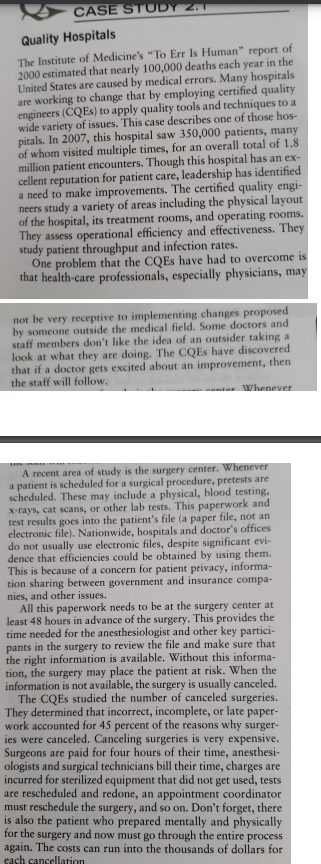
Quality Hospitals
The Institute of Medicine's To Err Is Human" report of
estimated that nearly deaths each year in the
United States are caused by medical errors. Many hospitals
are working to change that by employing certified quality
engineers CQEs to apply quality tools and techniques to a
wide variety of issues. This case describes one of those hos
pitals. In this hospital saw patients, many
of whom visited multiple times, for an overall total of
million patient encounters. Though this hospital has an ex
cellent reputation for patient care, leadership has identified
a need to make improvements. The certified quality engi
neers study a variety of areas including the physical layout
of the hospital, its treatment rooms, and operating rooms.
They assess operational efficiency and effectiveness. They
study patient throughput and infection rates.
One problem that the CQEs have had to overcome is
that healthcare professionals, especially physicians, may
not be very receptive to implementing changes proposed
by someone outside the medical field. Some doctors and
staff members don't like the idea of an outsider taking a
look at what they are doing. The CQEs have discovered
that if a docter gets excited about an improvement, then
the staff will follow.
A recent area of study is the surgery center. Whenever
a patient is scheduled for a surgical procedure, pretests are
scheduled. These may include a physical, blood testing,
xrays, cat scans, or other lab tests. This paperwork and
test results goes into the patient's file a paper file, not an
electronic file Nationwide, hospitals and doctor's offices
do not usually use electronic files, despite significant evi
dence that efficiencies could be obtained by using them.
This is because of a concern for patient privacy, informa
tion sharing between government and insurance compa
nies, and other issues.
All this paperwork needs to be at the surgery center at
least hours in advance of the surgery. This provides the
time needed for the anesthesiologist and other key partici
pants in the surgery to review the file and make sure that
the right information is available. Without this informa
tion, the surgery may place the patient at risk. When the
information is not available, the surgery is usually canceled.
The CQEs studied the number of canceled surgeries.
They determined that incorrect, incomplete, or late paper
work accounted for percent of the reasons why surger
ies were canceled. Canceling surgeries is very expensive.
Surgeons are paid for four hours of their time, anesthesi
ologists and surgical technicians bill their time, charges are
incurred for sterilized equipment that did not get used, tests
are rescheduled and redone, an appointment coordinator
must reschedule the surgery, and so on Don't forget, there
is also the patient who prepared mentally and physically
for the surgery and now must go through the entire process
again. The costs can run into the thousands of dollars for each cancellation.
Step by Step Solution
There are 3 Steps involved in it
1 Expert Approved Answer
Step: 1 Unlock

Question Has Been Solved by an Expert!
Get step-by-step solutions from verified subject matter experts
Step: 2 Unlock
Step: 3 Unlock