







Question: Read the background information for Videopolis and outline the overarching key issues. Be sure to put yourself in the shoes of each of the roles
Read the background information for Videopolis and outline the overarching key issues. Be sure to put yourself in the shoes of each of the roles discussed in the case. Then, write a synopsis of the issues from the each of the roles viewpoint. In your synopses, be sure to include the key issues, a proposed resolution, and the pros and cons of your resolution(s) to the crisis.
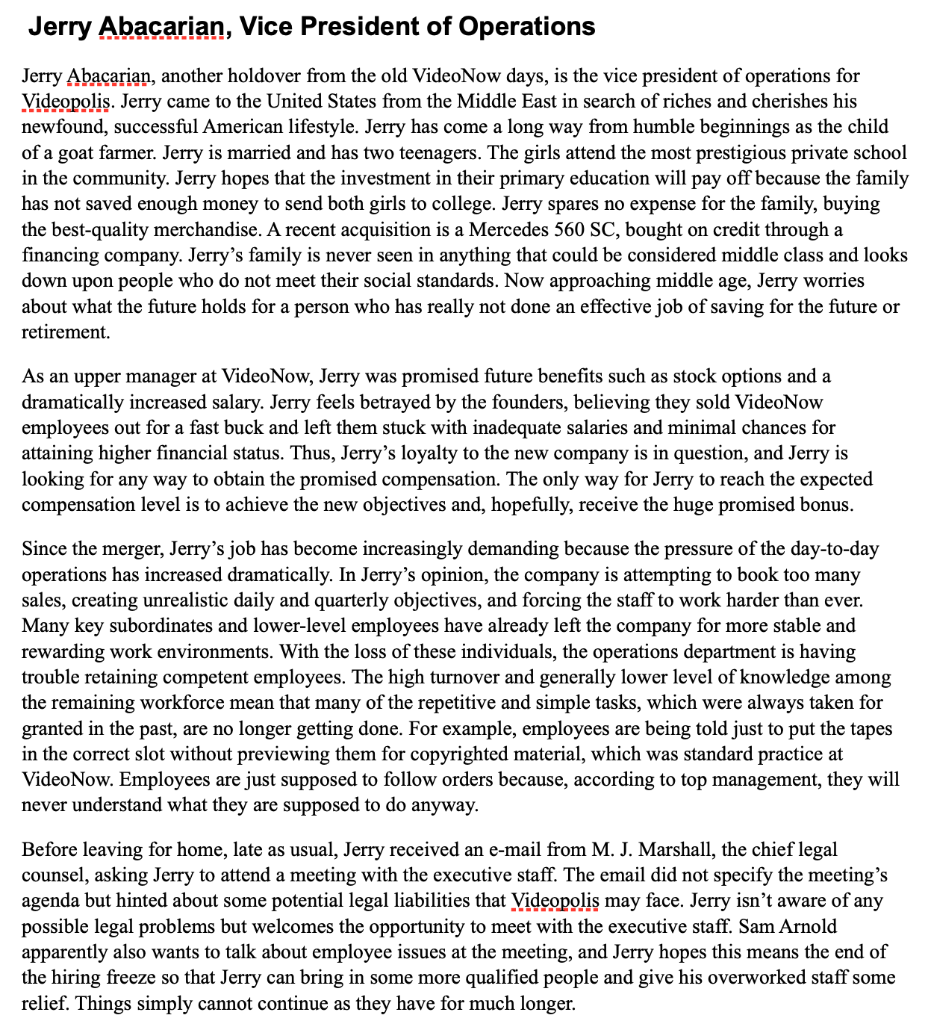
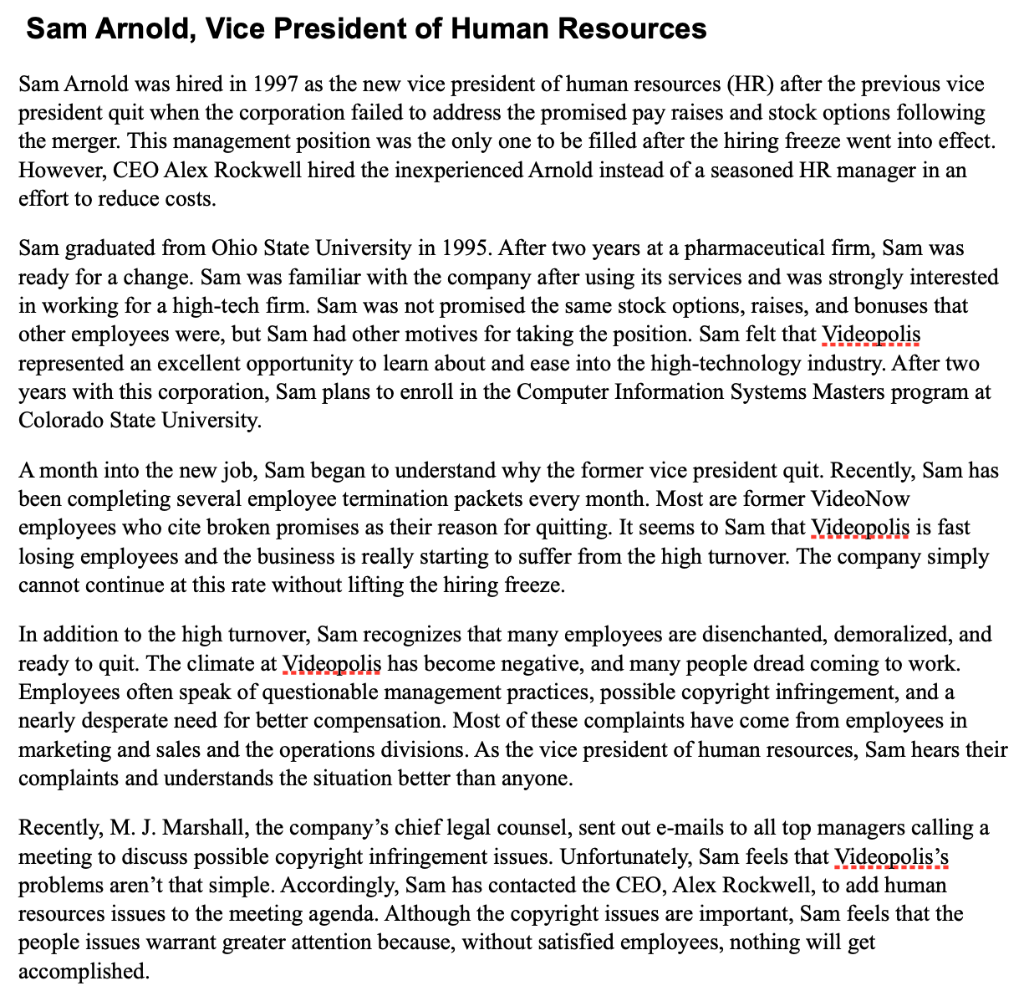
VIDEOPOLIS BACKGROUND Videopolis was founded as Video Now in 1993 by two former employees of RCA, where they had learned television broadcasting, electrical engineering, satellite downlinking, and telephone networking applications. Today, Videopolis is a communications company that specializes in connecting videoconferencing equipment over digital telephone lines to cities around the world. The company does not produce meetings, conferences, or programs, but instead facilitates the videoconferencing process. Videopolis's most profitable product, the Broadcast Series, involves storing and playing prerecorded programs on its DVD player and broadcasting them through its computer equipment to clients' meeting rooms around the world. If a remote site is not immediately available to view a meeting or program from Videopolis, the client can record the program by connecting a DVD player to a television monitor. Videopolis does not explicitly state that recording programs is forbidden. Company policy is that all viewing sites must obtain their own permissions from the owners of the content to record any copyrighted materials. There are some concerns that this policy may be facilitating the copying and distribution of copyrighted material. Video Now became Videopolis after it was acquired by Tele Wide Corporation fifteen months ago. When Video Now was started, the founders had a clear vision for growth, hiring only the best employees and purchasing the best equipment in more than sufficient quantities to ensure a high level of service and plenty of reserves for growth. Many of Video Now's original employees joined the firm with high hopes of stock options, promotions, and bonuses based on future growth prospects. Many employees had purchased expensive homes and cars in anticipation of these bonuses and promotions. Unfortunately, the founding partners sold out directly to Tele Wide before granting any options or bonuses to Video Now employees. After the merger, Tele Wide immediately instituted a hiring and equipment-purchasing freeze and virtually froze all salaries. The new corporate parent also set aggressive sales and growth goals for Videopolis and developed a highly incentive-based pay structure for upper managers who achieved their goals. This resulted in a considerable amount of turnover because those employees who could afford to leave promptly did so, placing tremendous stress on those who stayed and had to take up the slack. Many of the employees who remained after the buyout believe that promises have been broken and that they were misled about advancement opportunities. Videopolis's chief legal counsel has sent an e-mail message to arrange a meeting with the CEO, vice president of operations, vice president of human resources, and the vice president of marketing and sales to discuss a number of legal and ethical issues concerning potential legal issues at the company. Bryce Kerwin, Vice President of Marketing and Sales Bryce Kerwin is the vice president of sales and marketing for Videopolis. One of the first employees hired by the Video Now founders, Bryce was among the core group of employees who were promised stock options and promotions if the company ever went public. Bryce is middle-aged, divorced, and has two children. Bryce drives an old beat-up car and has used all the family's financial resources to get into a new, larger house. Relying on the promised stock options, raises, and bonuses, Bryce is now stretched to the limit and is beginning to deeply resent the company because the promised money may never materialize. Alex Rockwell, Videopolis's CEO, has told Bryce that the marketing and sales department can make the difference in helping the company achieve its objectives. Rockwell has implemented a very attractive bonus plan for Bryce if the department achieves its objectives, but the numbers are so aggressive that Bryce feels they are unattainable. Bryce has been concerned recently by reports that operations can't handle the current workload and rumors that Videopolis has lost its edge. Bryce wonders if this is indeed the case and whether the company can grow at all, let alone by 100 percent, the target number set by the new CEO. Bryce's sales force is also young, inexperienced, and not very familiar with the company's products. Bryce has been driving the sales force very hard in an effort to reach the company's goals (and because Alex has made several threats referring to Bryce's lack of motivation). Bryce senses the tension in employee morale but doesn't know how to address the issues. Bryce was a pivotal employee who helped make the company successful through hard work and wonders why, instead of rewards and recognition, the new management delivers orders to work even harder. In response to Bryce's incessant pushing, the sales reps are stretching the truth and making promises that the company can't keep in order to book sales. Although Bryce personally hates this practice, it does bring in customers who later learn what Videopolis can actually do, and they usually stay (once Bryce meets with them to do damage control and to pacify them). Videopolis has also started doing business with unfamiliar companies that have high demands for secrecy and privacy. Unfortunately, promises to satisfy their demands remain unfulfilled due to limitations in current technology. Videopolis's most profitable product is the Broadcast Series, which involves playing feature-length videotapes and broadcasting the signal around the world. Unlike many of the company's other products, the Broadcast Series is not interactive, so aside from equipment costs, it's virtually pure profit for Videopolis. Yesterday Bryce received an e-mail from M. J. Marshall, the company's chief legal counsel, indicating that there may be intellectual copyright infringement issues with the Broadcast Series and some of the firm's contracts with customers. The attorney has called a meeting with all of Videopoliss upper managers tomorrow to discuss the issues. The CEO has indicated that the vice president of human resources also wants to address some employee issues at the meeting. Bryce hopes that the meeting does not relate to the sales force's tendency to stretch the truth to customers because Bryce has really stretched company policy and personal morals in order to achieve the high goals. Bryce is not looking forward to the meeting. Alex Rockwell, CEO Alex Rockwell was brought in by Tele Wide as the CEO of Videopolis at the time of the Video Now buyout. Alex is a young executive whose entire seven-year professional career has been with Tele Wide. Upon graduation from the University of New Hampshire with a B.S. in marketing and an MBA, Alex began working in Tele Wide's marketing department and quickly worked up within the organization. Prior to taking the reins at Videopolis, Alex had a successful two-year stint as the CEO of a small voice-messaging company that had also been acquired by Tele Wide. After making some cuts and refocusing the staff, Alex was able to turn a mediocre company into a very profitable one. Because of the cuts, some of the voice messaging company's employees began to refer to Alex as Hacksaw, which gave Alex a strange sense of pride because it suggested that Alex had the guts required to make unpopular but necessary decisions to make the company profitable. Alex believes that this appointment to Videopolis will be the final stage of professional grooming prior to landing a corporate vice presidency at Tele Wide itself, with its greater responsibility and prestige. After observing successful executives being appointed to posh Tele Wide corporate positions, Alex believes that two to three successful years at Videopolis will guarantee his own appointment to one of these coveted positions. Alex is a loyal Tele Wide employee. When a corporate mandate came down to increase revenue by a minimum of 50 percent, Alex confidently replied that anything less than 100 percent would be unacceptable. Alex claimed to have studied Videopolis's bottom line and determined it just was not being run efficiently. In reality, Alex had made this assessment by gut feeling, without taking the time to actually sort through the figures to identify areas for improvement and savings. Alex gauged the average company employee to have little sense of urgency and observed many unnecessary (in Alex's opinion) tasks being performed. Thinking a fear tactic would be the best method to achieve results, Alex has been on a fifteen- month rampage to get the desired bottom-line numbers. The word around Videopolis is, It's Alex's way or the highway. Through terminations and turnover, more than half of the current staff has tenure of less than one year. Now it seems that Alex has a problem with the firm's chief legal counsel, M. J. Marshall. Alex feels that M. J. is too young and lacks the drive to do what it takes to get things done the Alex Rockwell way; perhaps M. J. should be the next one to be "Hacksawed." Alex is quite excited about Videopolis's new Broadcast Series of programming. The product involves an employee putting a feature-length tape into a DVD player (at the request of a client) and, with a few mouse clicks, broadcasting the requested program to various videoconferencing facilities throughout the country. The margins on this service are very high, and Alex believes that expanding the service could greatly assist the company achieve its goal of a 100 percent increase in revenue. Unfortunately, he questioned the legality of the service from its inception. Alex recently received a vague e-mail from M. J. Marshall requesting a meeting to discuss potential legal problems that could be brewing in the company. Upon learning of the meeting, Sam Arnold, the company's vice president of human resources, asked that employee issues be placed on the agenda as well. Alex is deeply concerned because potential lawsuits of any magnitude or employee dissatisfaction could dramatically affect the bottom-line numbers and Alex's chances for a corporate vice president position at Tele Wide. M. J. Marshall, Chief Legal Counsel M. J. Marshall is the bright young attorney hired by Video Now's founding partners to act as their chief counsel just before the Tele Wide buyout. M. J. is single and has been practicing law for just a few years. Before coming to work at Video Now, M. J. was on the fast track to a partnership in a firm that specialized in intellectual property and copyright protection. M. J. jumped at the opportunity to be chief counsel at an interesting high-tech company that offered better-than-average pay and the potential for stock options. Soon after being hired by Video Now, M. J. purchased a new sports car and a loft in a renovated warehouse in the trendy downtown area. When Video Now was bought out by Tele Wide, M. J. was one of the few employees who retained their original salary and received stock options in Videopolis. Being the chief counsel, M. J. was concerned about making a good impression on the new owners, not to mention the much needed salary to cover a large student loan, mortgage, and car payments. Things have finally settled down after the merger, and M. J. is just now reviewing the contracts signed by Video Now's founders in order to identify problems. Many of the old Video Now deals were open-ended, based on a handshake, and some had strange provisions, especially concerning copyright violations. M. J. has identified some specific concerns about the company's Broadcast Series. M. J. has received complaints from some of the employees regarding the DVDs that are being broadcast over company lines. Being familiar with the laws surrounding intellectual property and copyright protection, M. J. suddenly realizes that Videopolis could be liable for copyright infringement if the copyright owners view the broadcasts and recognize their programs as unauthorized copies. M. J. also knows that the federal government has been threatening to crack down on Internet companies for violations of copyright laws. M. J. learned a great deal about intellectual property issues and laws at the law firm and knows that intellectual property losses in the United States total more than $11 billion a year in lost revenue from illegal copying. In order to protect against such losses, the United States has enacted copyright laws, including the Digital Millennium Copyright Act, to protect original works in text form, pictures, movies, computer software, multimedia, and audiovisual formats. Although M. J. recognizes that these issues must be dealt with, M. J. also knows that the Broadcast Series is the CEO's baby and that Alex will be very sensitive to any changes in the profitable program. Nonetheless, these issues could potentially be time consuming and very costly to Videopolis. To add to the pressures M. J. faces, the CEO has hinted to M. J. that if the situation is not managed satisfactorily, Tele Wide will bring in a new legal counsel who can satisfy the company's needs. Recognizing the need to get a handle on the situation, M. J. has decided it is time to call a meeting with the top executives. M. J. dreads the meeting, knowing it could affect a number of employees, but believes that these issues must be brought out in the open. Jerry Abacarian, Vice President of Operations Jerry Abacarian, another holdover from the old Video Now days, is the vice president of operations for Videopolis. Jerry came to the United States from the Middle East in search of riches and cherishes his newfound, successful American lifestyle. Jerry has come a long way from humble beginnings as the child of a goat farmer. Jerry is married and has two teenagers. The girls attend the most prestigious private school in the community. Jerry hopes that the investment in their primary education will pay off because the family has not saved enough money to send both girls to college. Jerry spares no expense for the family, buying the best-quality merchandise. A recent acquisition is a Mercedes 560 SC, bought on credit through a financing company. Jerry's family is never seen in anything that could be considered middle class and looks down upon people who do not meet their social standards. Now approaching middle age, Jerry worries about what the future holds for a person who has really not done an effective job of saving for the future or retirement. As an upper manager at Video Now, Jerry was promised future benefits such as stock options and a dramatically increased salary. Jerry feels betrayed by the founders, believing they sold Video Now employees out for a fast buck and left them stuck with inadequate salaries and minimal chances for attaining higher financial status. Thus, Jerry's loyalty to the new company is in question, and Jerry is looking for any way to obtain the promised compensation. The only way for Jerry to reach the expected compensation level is to achieve the new objectives and, hopefully, receive the huge promised bonus. Since the merger, Jerry's job has become increasingly demanding because the pressure of the day-to-day operations has increased dramatically. In Jerry's opinion, the company is attempting to book too many sales, creating unrealistic daily and quarterly objectives, and forcing the staff to work harder than ever. Many key subordinates and lower-level employees have already left the company for more stable and rewarding work environments. With the loss of these individuals, the operations department is having trouble retaining competent employees. The high turnover and generally lower level of knowledge among the remaining workforce mean that many of the repetitive and simple tasks, which were always taken for granted in the past, are no longer getting done. For example, employees are being told just to put the tapes in the correct slot without previewing them for copyrighted material, which was standard practice at Video Now. Employees are just supposed to follow orders because, according to top management, they will never understand what they are supposed to do anyway. Before leaving for home, late as usual, Jerry received an e-mail from M. J. Marshall, the chief legal counsel, asking Jerry to a meeting with the executive staff. email did not specify the meeting's agenda but hinted about some potential legal liabilities that Videopolis may face. Jerry isn't aware of any possible legal problems but welcomes the opportunity to meet with the executive staff. Sam Arnold apparently also wants to talk about employee issues at the meeting, and Jerry hopes this means the end of the hiring freeze so that Jerry can bring in some more qualified people and give his overworked staff some relief. Things simply cannot continue as they have for much longer. Sam Arnold, Vice President of Human Resources Sam Arnold was hired in 1997 as the new vice president of human resources (HR) after the previous vice president quit when the corporation failed to address the promised pay raises and stock options following the merger. This management position was the only one to be filled after the hiring freeze went into effect. However, CEO Alex Rockwell hired the inexperienced Arnold instead of a seasoned HR manager in an effort to reduce costs. Sam graduated from Ohio State University in 1995. After two years at a pharmaceutical firm, Sam was ready for a change. Sam was familiar with the company after using its services and was strongly interested in working for a high-tech firm. Sam was not promised the same stock options, raises, and bonuses that other employees were, but Sam had other motives for taking the position. Sam felt that Videopolis represented an excellent opportunity to learn about and ease into the high-technology industry. After two years with this corporation, Sam plans to enroll in the Computer Information Systems Masters program at Colorado State University. A month into the new job, Sam began to understand why the former vice president quit. Recently, Sam has been completing several employee termination packets every month. Most are former Video Now employees who cite broken promises as their reason for quitting. It seems to Sam that Videopolis is fast losing employees and the business is really starting to suffer from the high turnover. The company simply cannot continue at this rate without lifting the hiring freeze. In addition to the high turnover, Sam recognizes that many employees are disenchanted, demoralized, and ready to quit. The climate at Videopolis has become negative, and many people dread coming to work. Employees often speak of questionable management practices, possible copyright infringement, and a nearly desperate need for better compensation. Most of these complaints have come from employees in marketing and sales and the operations divisions. As the vice president of human resources, Sam hears their complaints and understands the situation better than anyone. Recently, M. J. Marshall, the company's chief legal counsel, sent out e-mails to all top managers calling a meeting to discuss possible copyright infringement issues. Unfortunately, Sam feels that Videopolis's problems aren't that simple. Accordingly, Sam has contacted the CEO, Alex Rockwell, to add human resources issues to the meeting agenda. Although the copyright issues are important, Sam feels that the people issues warrant greater attention because, without satisfied employees, nothing will get accomplishedStep by Step Solution
There are 3 Steps involved in it
1 Expert Approved Answer
Step: 1 Unlock

Question Has Been Solved by an Expert!
Get step-by-step solutions from verified subject matter experts
Step: 2 Unlock
Step: 3 Unlock
 Study Help