







Question: Read The Car Buying Process and write a four or five sentence summary. It is important to understand how to negotiate with a salesperson. Several
Read The Car Buying Process and write a four or five sentence summary.
It is important to understand how to negotiate with a salesperson. Several books, magazines, and internet sites give information about the car buying process. I have summarized information from various sources into a short article entitled, The Car Buying Process. 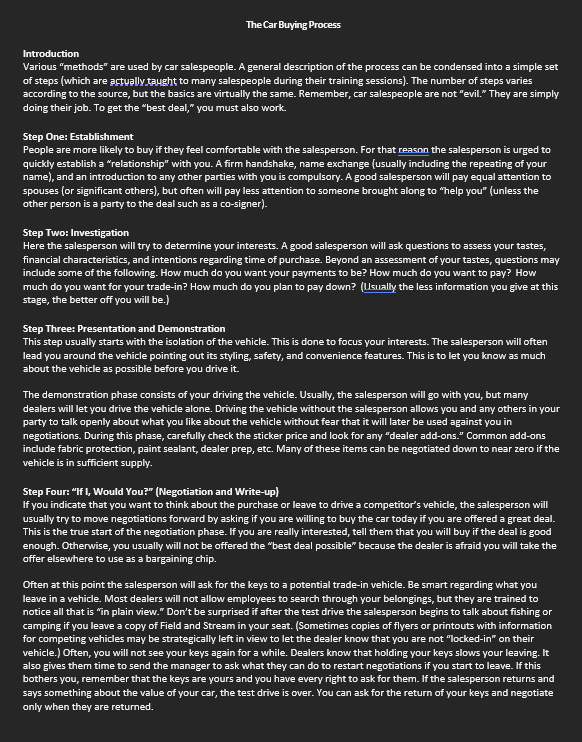
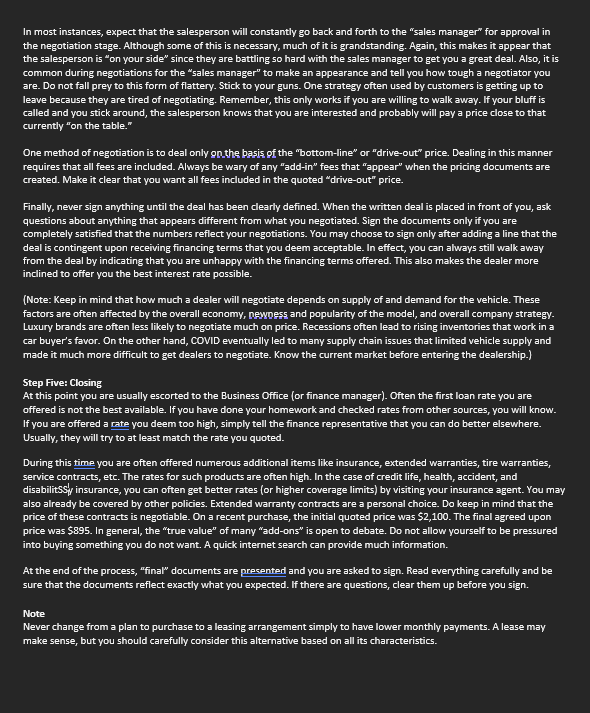
The Car Buying Process Introduction Various "methods" are used by car salespeople. A general description of the process can be condensed into a simple set of steps (which are actually_taught to many salespeople during their training sessions). The number of steps varies according to the source, but the basics are virtually the same. Remember, car salespeople are not "evil." They are simply doing their job. To get the "best deal," you must also work. Step One: Establishment People are more likely to buy if they feel comfortable with the salesperson. For that reasnn the salesperson is urged to quickly establish a "relationship" with you. A firm handshake, name exchange (usually including the repeating of your name), and an introduction to any other parties with you is compulsory. A good salesperson will pay equal attention to spouses (or significant others), but often will pay less attention to someone brought along to "help you" (unless the other person is a party to the deal such as a co-signer). Step Two: Investigation Here the salesperson will try to determine your interests. A good salesperson will ask questions to assess your tastes, financial characteristics, and intentions regarding time of purchase. Beyond an asses5ment of your tastes, questions may include some of the following. How much do you want your payments to be? How much do you want to pay? How much do you want for your trade-in? How much do you plan to pay down? (Usually the less information you give at this stage, the better off you will be.] Step Three: Presentation and Demonstration This step usually starts with the isolation of the vehicle. This is done to focus your interests. The salesperson will often lead you around the vehicle pointing out its styling, safety, and convenience features. This is to let you know as much about the vehicle as possible before you drive it. The demonstration phase consists of your driving the vehicle. Usually, the salesperson will go with you, but many dealers will let you drive the vehicle alone. Driving the vehicle without the salesperson allows you and any others in your party to talk openly about what you like about the vehicle without fear that it will later be used against you in negotiations. During this phase, carefully check the sticker price and look for any "dealer add-ons." Common add-ons include fabric protection, paint sealant, dealer prep, etc. Many of these items can be negotiated down to near zero if the vehicle is in sufficient supply. Step Four: "If I, Would You?" (Negotiation and Write-up) If you indicate that you want to think about the purchase or leave to drive a competitor's vehicle, the salesperson will usually try to move negotiations forward by asking if you are willing to buy the car today if you are offered a great deal. This is the true start of the negotiation phase. If you are really interested, tell them that you will buy if the deal is good enough. Otherwise, you usually will not be offered the "best deal possible" because the dealer is afraid you will take the offer elsewhere to use as a bargaining chip. Often at this point the salesperson will ask for the keys to a potential trade-in vehicle. Be smart regarding what you leave in a vehicle. Most dealers will not allow employees to search through your belongings, but they are trained to notice all that is "in plain view." Don't be surprised if after the test drive the salesperson begins to talk about fishing or camping if you leave a copy of Field and Stream in your seat. (Sometimes copies of flyers or printouts with information for competing vehicles may be strategically left in view to let the dealer know that you are not "locked-in" on their vehicle.) Often, you will not see your keys again for a while. Dealers know that holding your keys slows your leaving. It also gives them time to send the manager to ask what they can do to restart negotiations if you start to leave. If this bothers you, remember that the keys are yours and you have every right to ask for them. If the salesperson returns and says something about the value of your car, the test drive is over. You can ask for the return of your keys and negotiate only when they are returned. In most instances, expect that the salesperson will constantly go back and forth to the "sales manager" for approval in the negotiation stage. Although some of this is necessary, much of it is grandstanding. Again, this makes it appear that the salesperson is "on your side" since they are battling so hard with the sales manager to get you a great deal. Also, it is common during negotiations for the "sales manager" to make an appearance and tell you how tough a negotiator you are. Do not fall prey to this form of flattery. Stick to your guns. One strategy often used by customers is getting up to leave because they are tired of negotiating. Remember, this only works if you are willing to walk away. If your bluff is called and you stick around, the salesperson knows that you are interested and probably will pay a price close to that currently "on the table." One method of negotiation is to deal only on the basis of the "bottom-line" or "drive-out" price. Dealing in this manner requires that all fees are included. Always be wary of any "add-in" fees that "appear" when the pricing documents are created. Make it clear that you want all fees included in the quoted "drive-out" price. Finally, never sign anything until the deal has been clearly defined. When the written deal is placed in front of you, ask questions about anything that appears different from what you negotiated. Sign the documents only if you are completely satisfied that the numbers reflect your negotiations. You may choose to sign only after adding a line that the deal is contingent upon receiving financing terms that you deem acceptable. In effect, you can always still walk away from the deal by indicating that you are unhappy with the financing terms offered. This also makes the dealer more inclined to offer you the best interest rate possible. (Note: Keep in mind that how much a dealer will negotiate depends on supply of and demand for the vehicle. These factors are often affected by the overall economy, nespess and popularity of the model, and overall company strategy. Luxury brands are often less likely to negotiate much on price. Recessions often lead to rising inventories that work in a car buyer's favor. On the other hand, COVID eventually led to many supply chain issues that limited vehicle supply and made it much more difficult to get dealers to negotiate. Know the current market before entering the dealership.) Step Five: Closing At this point you are usually escorted to the Business Office (or finance manager). Often the first loan rate you are offered is not the best available. If you have done your homework and checked rates from other sources, you will know. If you are offered a rate you deem too high, simply tell the finance representative that you can do better elsewhere. Usually, they will try to at least match the rate you quoted. During this time you are often offered numerous additional items like insurance, extended warranties, tire warranties, service contracts, etc. The rates for such products are often high. In the case of credit life, health, accident, and disabilitSSy insurance, you can often get better rates (or higher coverage limits) by visiting your insurance agent. You may also already be covered by other policies. Extended warranty contracts are a personal choice. Do keep in mind that the price of these contracts is negotiable. On a recent purchase, the initial quoted price was $2,100. The final agreed upon price was $895. In general, the "true value" of many "add-ons" is open to debate. Do not allow yourself to be pressured into buying something you do not want. A quick internet search can provide much information. At the end of the process, "final" documents are presenter and you are asked to sign. Read everything carefully and be sure that the documents reflect exactly what you expected. If there are questions, clear them up before you sign. Note Never change from a plan to purchase to a leasing arrangement simply to have lower monthly payments. A lease may make sense, but you should carefully consider this alternative based on all its characteristics
Step by Step Solution
There are 3 Steps involved in it

Get step-by-step solutions from verified subject matter experts
 Study Help