







Question: Read the case above and }What is learned from this case? }Why do you think these products were inadequately product use tested? Case: Product Use
 Read the case above and
}What is learned from this case?
}Why do you think these products were inadequately product use tested?
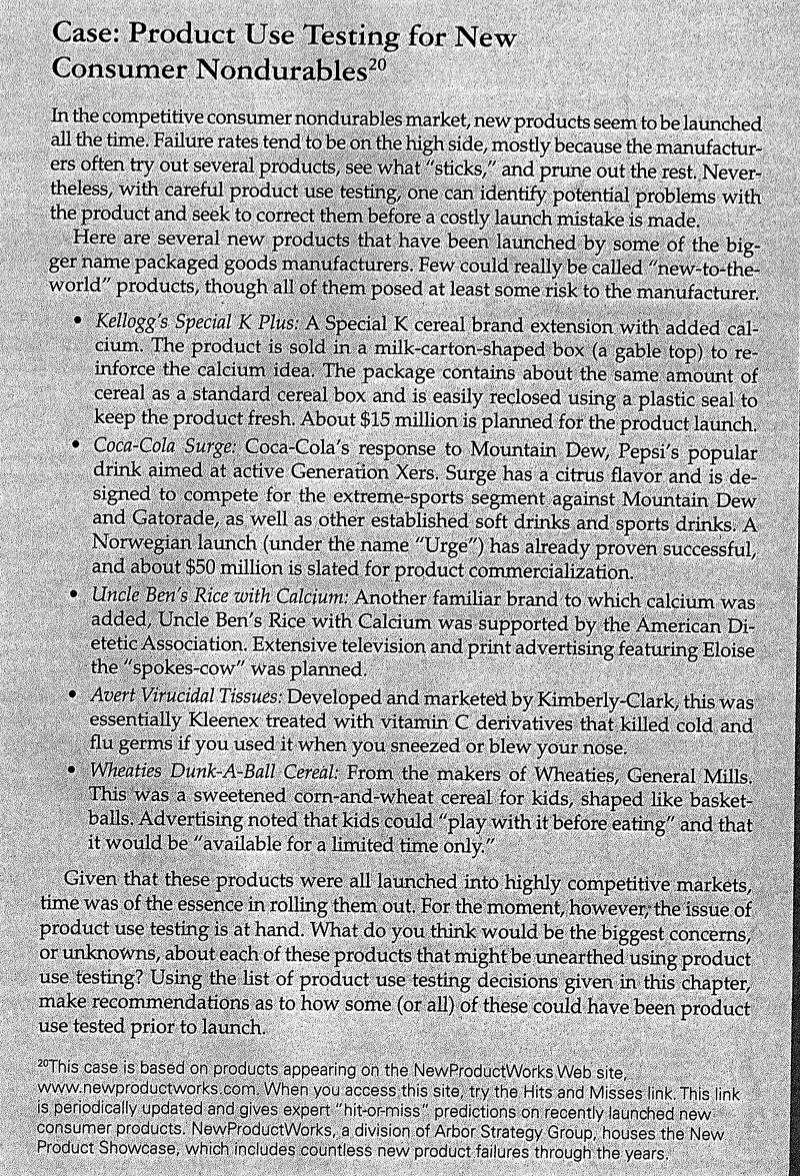
Case: Product Use Testing for New Consumer Nondurables 20 In the competitive consumer nondurables market, new products seem to be launched all the time. Failure rates tend to be on the high side, mostly because the manufactur- ers often try out several products, see what "sticks," and prune out the rest. Never- theless, with careful product use testing, one can identify potential problems with the product and seek to correct them before a costly launch mistake is made. Here are several new products that have been launched by some of the big- ger name packaged goods manufacturers. Few could really be called new-to-the- world" products, though all of them posed at least some risk to the manufacturer. Kellogg's Special K Plus: A Special K cereal brand extension with added cal- cium. The product is sold in a milk-carton-shaped box (a gable top) to re- inforce the calcium idea. The package contains about the same amount of cereal as a standard cereal box and is easily reclosed using a plastic seal to keep the product fresh. About $15 million is planned for the product launch. Coca-Cola Surge: Coca-Cola's response to Mountain Dew, Pepsi's popular drink aimed at active Generation Xers. Surge has a citrus flavor and is de- signed to compete for the extreme-sports segment against Mountain Dew and Gatorade, as well as other established soft drinks and sports drinks. A Norwegian launch (under the name Urge") has already proven successful, and about $50 million is slated for product commercialization. Uncle Ben's Rice with Calcium: Another familiar brand to which calcium was added, Uncle Ben's Rice with Calcium was supported by the American Di- etetic Association. Extensive television and print advertising featuring Eloise the "spokes-cow" was planned. Avert Virucidal Tissues: Developed and marketed by Kimberly-Clark, this was essentially Kleenex treated with vitamin C derivatives that killed cold and flu germs if you used it when you sneezed or blew your nose. Wheaties Dunk-A-Ball Cereal: From the makers of Wheaties, General Mills. This was a sweetened corn-and-wheat cereal for kids, shaped like basket- balls. Advertising noted that kids could "play with it before eating" and that it would be "available for a limited time only." Given that these products were all launched into highly competitive markets, time was of the essence in rolling them out. For the moment, however, the issue of product use testing is at hand. What do you think would be the biggest concerns, or unknowns, about each of these products that might be unearthed using product use testing? Using the list of product use testing decisions given in this chapter, make recommendations as to how some (or all) of these could have been product use tested prior to launch. 20This case is based on products appearing on the New ProductWorks Web site, www.newproductworks.com. When you access this site, try the Hits and Misses link. This link is periodically updated and gives expert "hit-or-miss" predictions on recently launched new consumer products. NewProductWorks, a division of Arbor Strategy Group, houses the New Product Showcase, which includes countless new product failures through the yearsStep by Step Solution
There are 3 Steps involved in it
1 Expert Approved Answer
Step: 1 Unlock

Question Has Been Solved by an Expert!
Get step-by-step solutions from verified subject matter experts
Step: 2 Unlock
Step: 3 Unlock
 Study Help