







Question: read the case and answer question Do you think meetings conducted through telepresence technology will be similar to face to face ones as the technology
read the case and answer question
Do you think meetings conducted through telepresence technology will be similar to face to face ones as the technology becomes more pervasive? how would the rules of etiquette change for telepresence meetings? which would you like best?
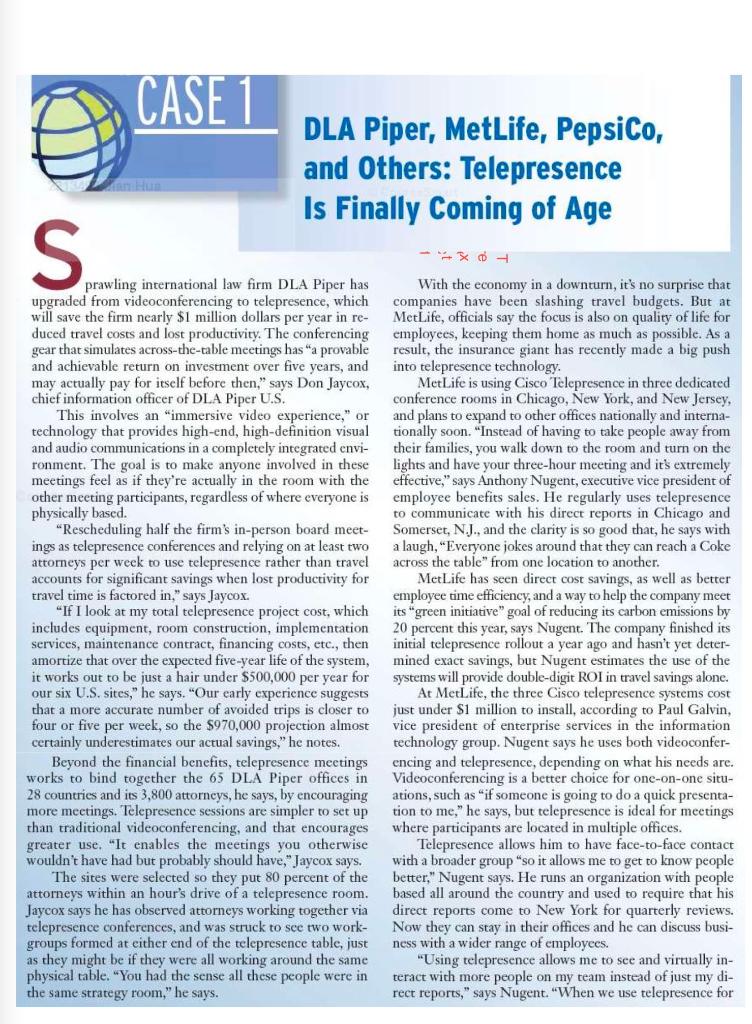
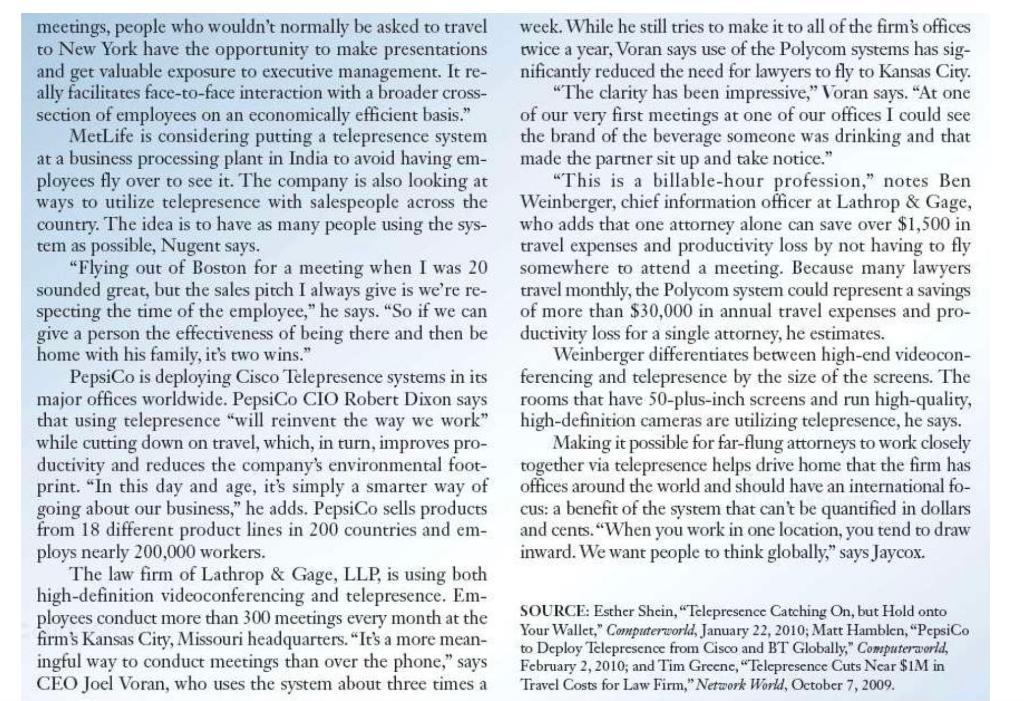
CASE 1 DLA Piper, MetLife, PepsiCo, and Others: Telepresence Is Finally Coming of Age Leinum S 30 effective," says: employee bene regularly prawling international law firm DLA Piper has upgraded from videoconferencing to telepresence, which will save the firm nearly $1 million dollars per year in re- duced travel costs and lost productivity. The conferencing gear that simulates across-the-table meetings has a provable and achievable return on investment over five years, and may actually pay for itself before then," says Don Jaycox, chief information officer of DLA Piper U.S. This involves an immersive video experience," or technology that provides high-end, high-definition visual and audio communications in a completely integrated envi- ronment. The goal is to make anyone involved in these meetings feel as if they're actually in the room with the other meeting participants, regardless of where everyone is physically based "Rescheduling half the firm's in-person board meet- ings as telepresence conferences and relying on at least two attorneys per week to use telepresence rather than travel accounts for significant savings when lost productivity for travel ne is acto in," says Jaycox "If total telepresence project cost, which includes equipment, room construction, implementation services, maintenance contract, financing costs, etc., then amortize that over the expected five-year life of the system, it works out to be just a hair under $500,000 per year for our six U.S. sites," he says. "Our early experience suggests that a more accurate number of avoided trips is closer to four or five per week, so the $970,000 projection almost certainly underestimates our actual savings," he notes. Beyond the financial benefits, telepresence meetings works to bind together the 65 DLA Piper offices in 28 countries and its 3,800 attorneys, he says, by encouraging more meetings. Telepresence sessions are simpler to set up than traditional videoconferencing, and that encourages greater use. "It enables the meetings you otherwise wouldn't have had but probably should have," Jaycox says. The sites were selected so they put 80 percent of the attorneys within an hour's drive of a telepresence room. Jaycox says he has observed attorneys working together via telepresence conferences, and was struck to see two work- groups formed at either end of the telepresence table, just as they might be if they were all working around the same physical table. "You had the sense all these people were in the same strategy room," he says. With the economy in a downturn, it's no surprise that companies have been slashing travel budgets. But at MetLife, officials say the focus is also on quality of life for employees, keeping them home as much as possible. As a result, the insurance giant has recently made a big push into telepresence technology. MetLife is is using Cisco Telepresence in three dedicated conference rooms in Chicago, New York, and New Jersey, and plans to expand to other offices nationally and interna- tionally soon. "Instead of having to take people away from their families, you walk down to the room and turn on the and have your three-hour executive vice president of benefits sales. He uses telepresence to communicate with his direct reports in Chicago and Somerset, N.J., and the clarity is so good that, he says with a laugh, "Everyone jokes around that they can reach a Coke across the table" from one location to another. MetLife has seen direct cost savings, as well as better employee time efficiency, and a way to help the company meet its "green initiative" goal of reducing its carbon emissions by 20 percent this year, says Nugent. The o e company finished its initial telepresence rollout a year ago and hasn't yet deter- mined exact savings, but Nugent estimates the use of the systems s will provide double-digit ROI in travel savings alone. At MetLife, the three Cisco telepresence systems cost just under $1 million to install, according to Paul Galvin, vice president of enterprise services in the information technology group. Nugent says he uses both videoconfer- encing and telepresence, depending on what his needs are. Videoconferencing is a better choice for one-on-one situ- ations, such as if someone is going to do a quick presenta- tion to me," he says, but telepresence is ideal for meetings where participants are located in multiple offices. Telepresence allows him to have face-to-face contact with a broader group "so it allows me to get to know people better," Nugent says. He runs an organization with people based all around the country and used to require that his direct reports come to New York for quarterly reviews. Now they can stay in their offices and he can discuss busi- ness with a wider range of employees. "Using telepresence allows me to see and virtually in- teract with more people on my team instead of just my di- rect reports," says Nugent. "When we use telepresence for meetings, people who wouldn't normally be asked to travel to New York have the opportunity to make presentations and get valuable exposure to executive management. It re- ally facilitates face-to-face interaction with a broader cross- section of employees on an economically efficient basis." MetLife is considering putting a telepresence system at a business processing plant in India to avoid having em- ployees fly over to see it. The company is also looking at ways to utilize telepresence with salespeople across the country. The idea is to have as many people using the sys- tem as possible, Nugent says. "Flying out of Boston for a meeting when I was 20 sounded great, but the sales pitch I always give is we're re- specting the time of the employee," he says. So if we can give a person the effectiveness of being there and then be home with his family, it's two wins." PepsiCo is deploying Cisco Telepresence systems in its major offices worldwide. PepsiCo CIO Robert Dixon says that using telepresence "will reinvent the way we work while cutting down on travel, which in turn, improves pro- ductivity and reduces the company's environmental foot- print. "In this day and age, it's simply a smarter way of going about our business," he adds. PepsiCo sells products from 18 different product lines in 200 countries and em- ploys nearly 200,000 workers. The law firm of Lathrop & Gage, LLP, is using both high-definition videoconferencing and telepresence. Em- ployees conduct more than 300 meetings every month at the firm's Kansas City, Missouri headquarters. It's a more mean- ingful way to conduct meetings than over the phone," says CEO Joel Voran, who uses the system about three times a week. While he still tries to make it to all of the firm's offices twice a year, Voran says use of the Polycom systems has sig- nificantly reduced the need for lawyers to fly to Kansas City. "The clarity has been impressive," Voran says. At one of our very first meetings at one of our offices I could see the brand of the beverage someone was drinking and that made the partner sit up and take notice." "This is a billable-hour profession," notes Ben Weinberger, chief information officer at Lathrop & Gage, who adds that one attorney alone can save over $1,500 in travel expenses and productivity loss by not having to fly somewhere to attend a meeting. Because many lawyers travel monthly, the Polycom system could represent a savings of more than $30,000 in annual travel expenses and pro- ductivity loss for a single attorney, he estimates. Weinberger differentiates between high-end videocon- ferencing and telepresence by the size of the screens. The rooms that have 50-plus-inch screens and run high-quality, high-definition cameras are utilizing telepresence, he says. Making it possible for far-flung attorneys to work closely together via telepresence helps drive home that the firm has offices around the world and should have an international fo- cus: a benefit of the system that can't be quantified in dollars and cents. When you work in one location, you tend to draw inward. We want people to think globally," says Jaycox. SOURCE: Esther Shein, "Telepresence Catching On, but Hold onto Your Wallet," Computerworld, January 22, 2010; Matt Hamblen, "PepsiCo to Deploy Telepresence from Cisco and BT Globally," Computerworld, February 2, 2010; and Tim Grenc, "Telepresence Cuts Near $1M in Travel Costs for Law Firm," Network World, October 7, 2009Step by Step Solution
There are 3 Steps involved in it
1 Expert Approved Answer
Step: 1 Unlock

Question Has Been Solved by an Expert!
Get step-by-step solutions from verified subject matter experts
Step: 2 Unlock
Step: 3 Unlock
 Study Help