







Question: Read the case and answer the 4 questions using the Canadian charter of rights G Class NotFouna i .3 murmur-n .. I {my :rtL' Case
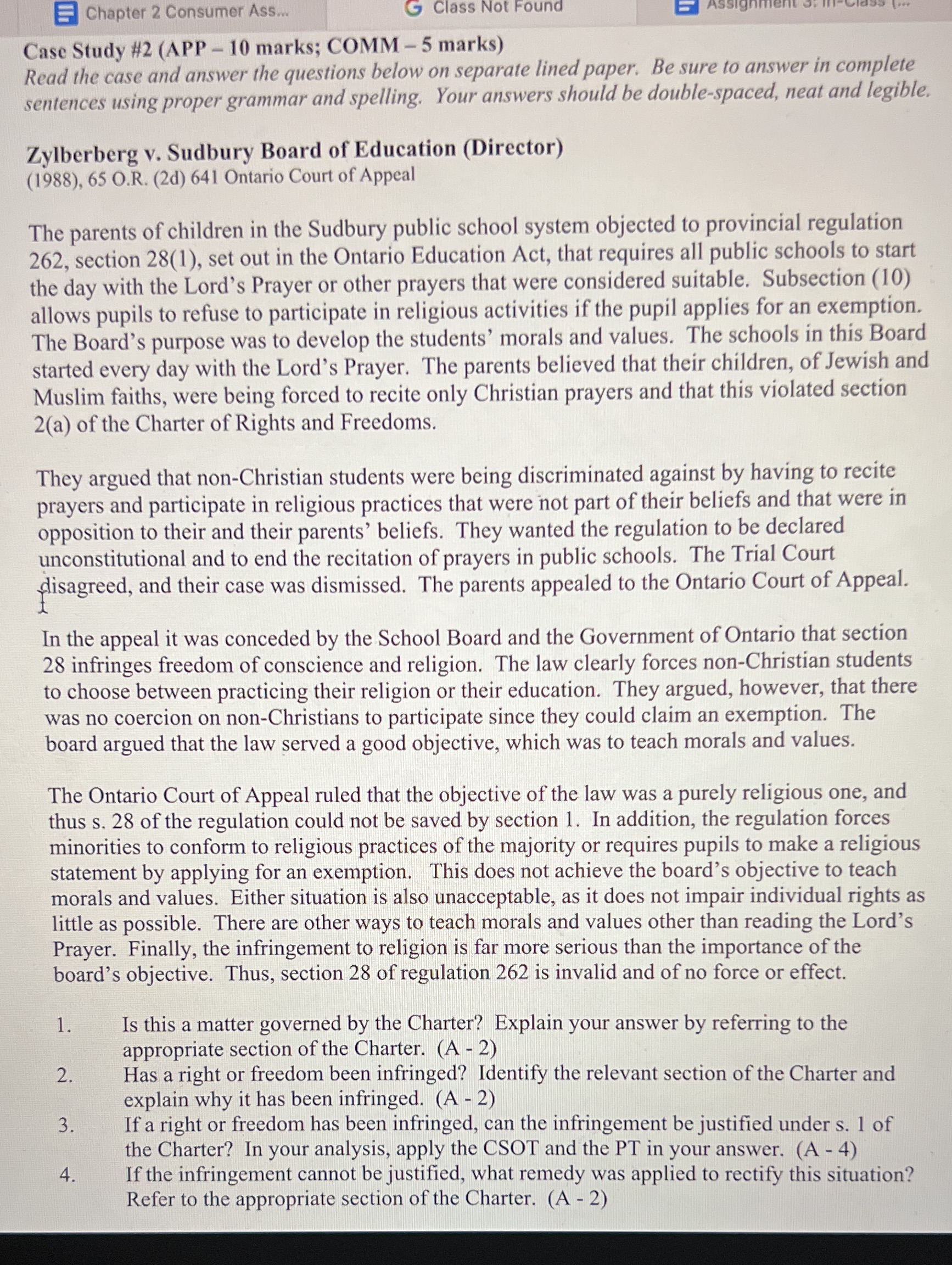
Read the case and answer the 4 questions using the Canadian charter of rights
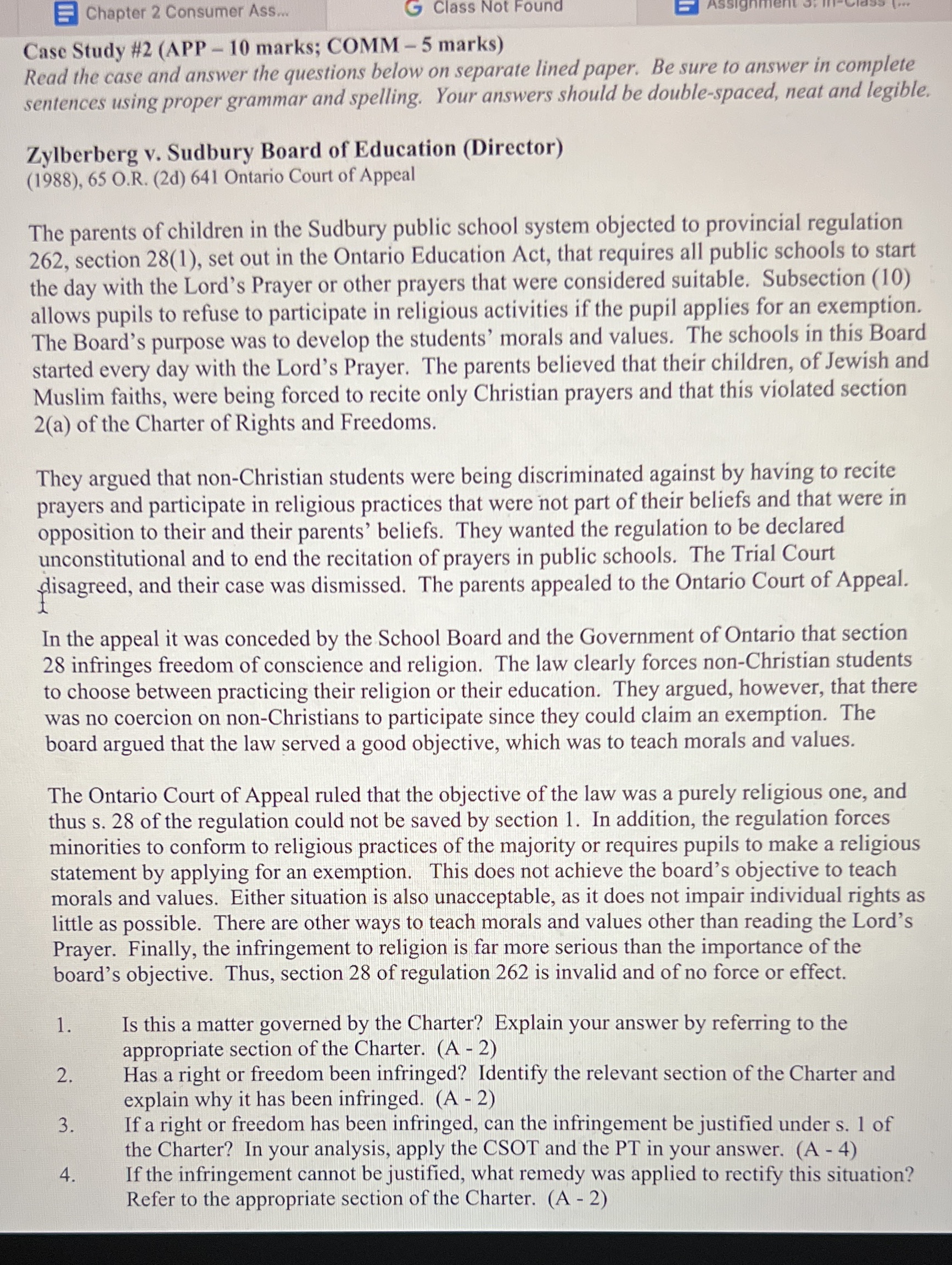
G Class NotFouna i .3 murmur-n .. I {my :rtL' Case Study #2 (APP - 10 marks; COMM 5 marks) Read the case and answer the questions below on separate lined paper. Be sure to answer in complete sentences using proper grammar and spelling. Your answers should be double-spaced, neat and legible; Zylberberg v. Sudbury Board of Education (Director) 0983), 65 QR. (2d) 641 Ontario Court of Appeal The parents of children in the Sudbury public school system objected to provincial regulation 262, section 28(1), set out in the Ontario Education Act, that requires all public schools to start the day with the Lord's Prayer or other prayers that were considered suitable. Subsection ( 10) allows pupils to refuse to participate in religious activities if the pupil applies for an exemption. The Board's purpose was to develop the students' morals and values. The schools in this Board started every day with the Lord's Prayer. The parents believed that their children, of Jewish and Muslim faiths, were being forced to recite only Christian prayers and that this violated section 2(a) of the Charter of Rights and Freedoms. They argued that non-Christian students were being discriminated against by having to recite prayers and participate in religious practices that were "not part of their beliefs and that were in opposition to their and their parents' beliefs. They wanted the regulation to be declared unconstitutional and to end the recitation of prayers in public schools. The Trial Court fisagreed, and their case was dismissed. The parents appealed to the Ontario Court of Appeal. In the appeal it was conceded by the School Board and the Government of Ontario that section 28 infringes freedom of conscience and religion. The law clearly forces non-Christian students to choose between practicing their religion or their education. They argued, however, that there was no coercion on non-Christians to participate since they could claim an exemption. The board argued that the law served a good objective, which was to teach morals and values. The Ontario Court of Appeal ruled that the objective of the law was a purely religious one, and thus 5. 28 of the regulation could not be saved by section 1. In addition, the regulation forces minorities to conform to religious practices of the majority or requires pupils to make a religious statement by applying for an exemption. This does not achieve the board's objective to teach morals and values. Either situation is also unacceptable, as it does not impair individual rights as little as possible. There are other ways to teach morals and values other than reading the Lord's Prayer. Finally, the infringement to religion is far more serious than the importance of the board's objective. Thus, section 28 of regulation 262 is invalid and of no force or effect. 1. Is this a matter governed by the Charter? Explain your answer by referring to the appropriate section of the Charter. (A - 2) Has a right or freedom been infringed? Identify the relevant section of the Charter and explain why it has been infringed. (A 2) .- If a right or freedom has been infringed, can the infringement be justied under s. I of ' . the Charter? In your analysis, apply the CSOT and the PT in your answer. (A - 4) " I .3 . _ If the infringement cannot be justified, what remedy was applied to rectify this situation? -' _ Refer to the appmpriate section of the Charter. (A - 2) . 1? ' p2
Step by Step Solution
There are 3 Steps involved in it

Get step-by-step solutions from verified subject matter experts
 Study Help