Question: Read the Case and answer the question below. Need help with Question number 1 2 CASE The Human Resource Function of Harrison Brothers Corporation COMPANY
Read the Case and answer the question below.
 Need help with Question number 1
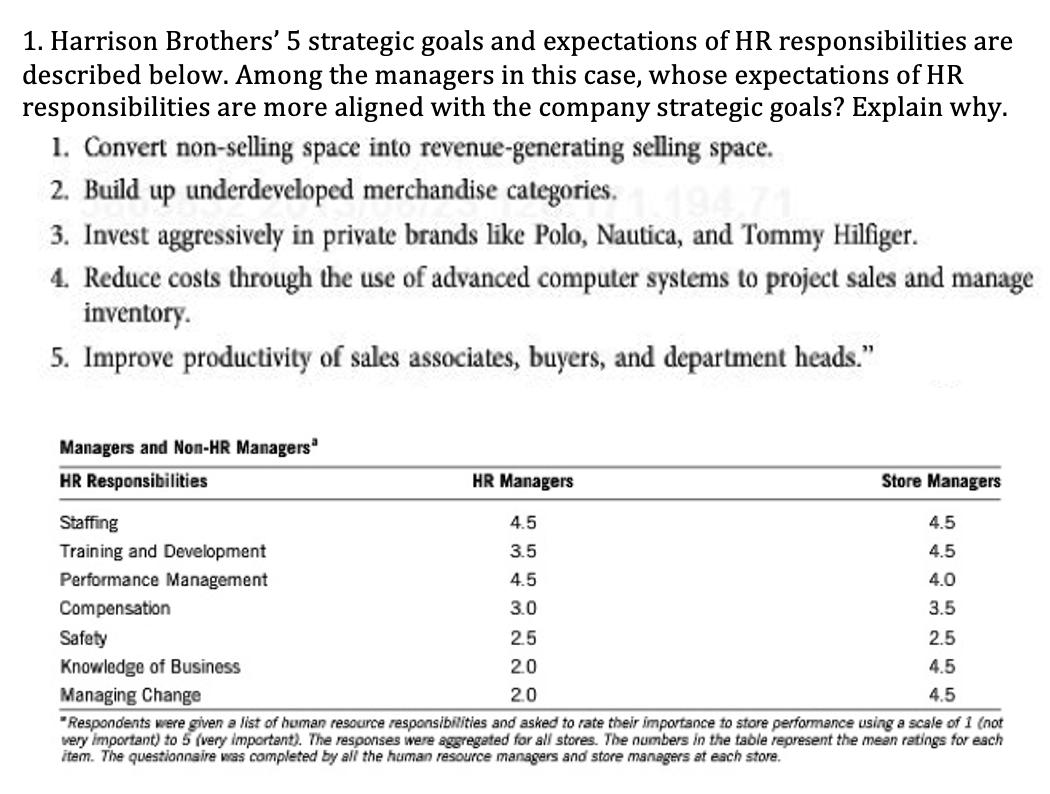
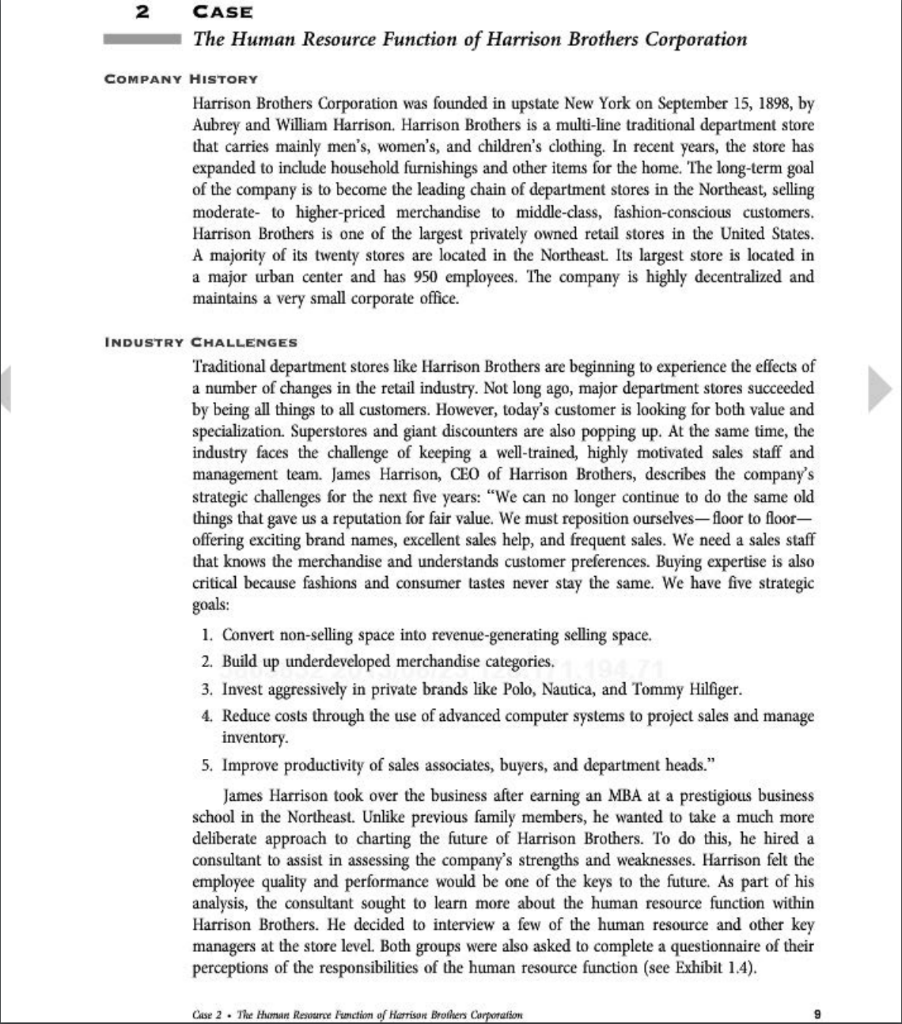
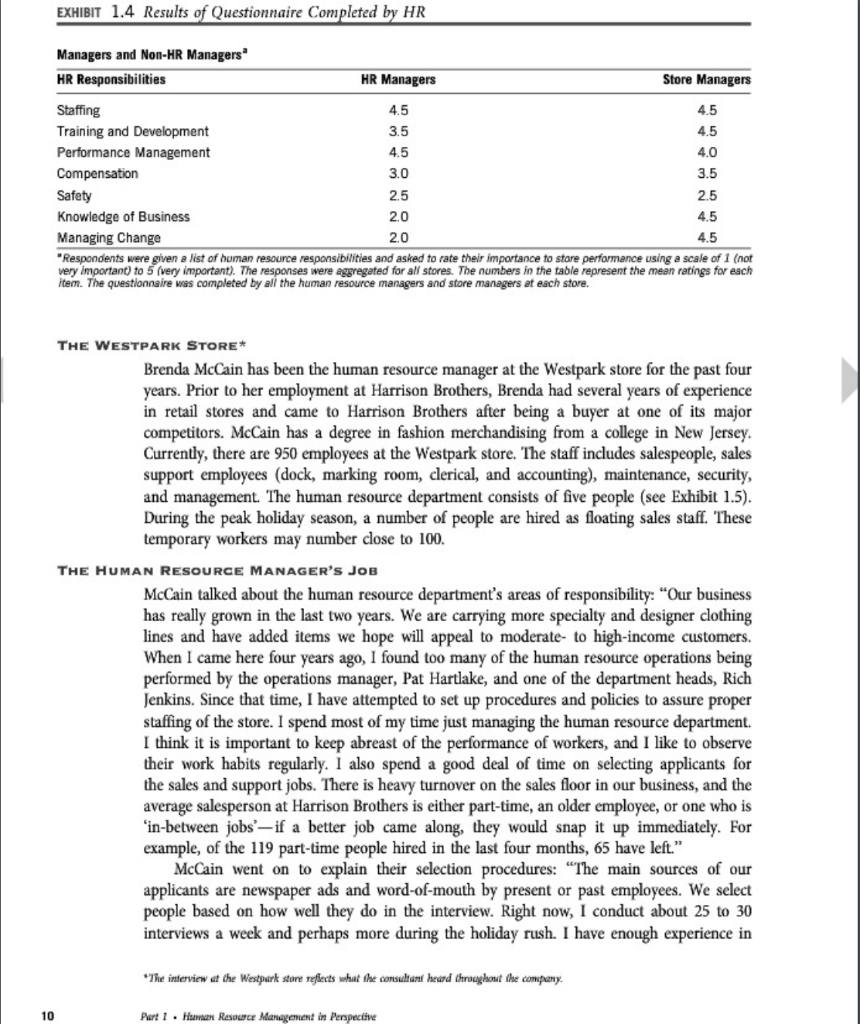
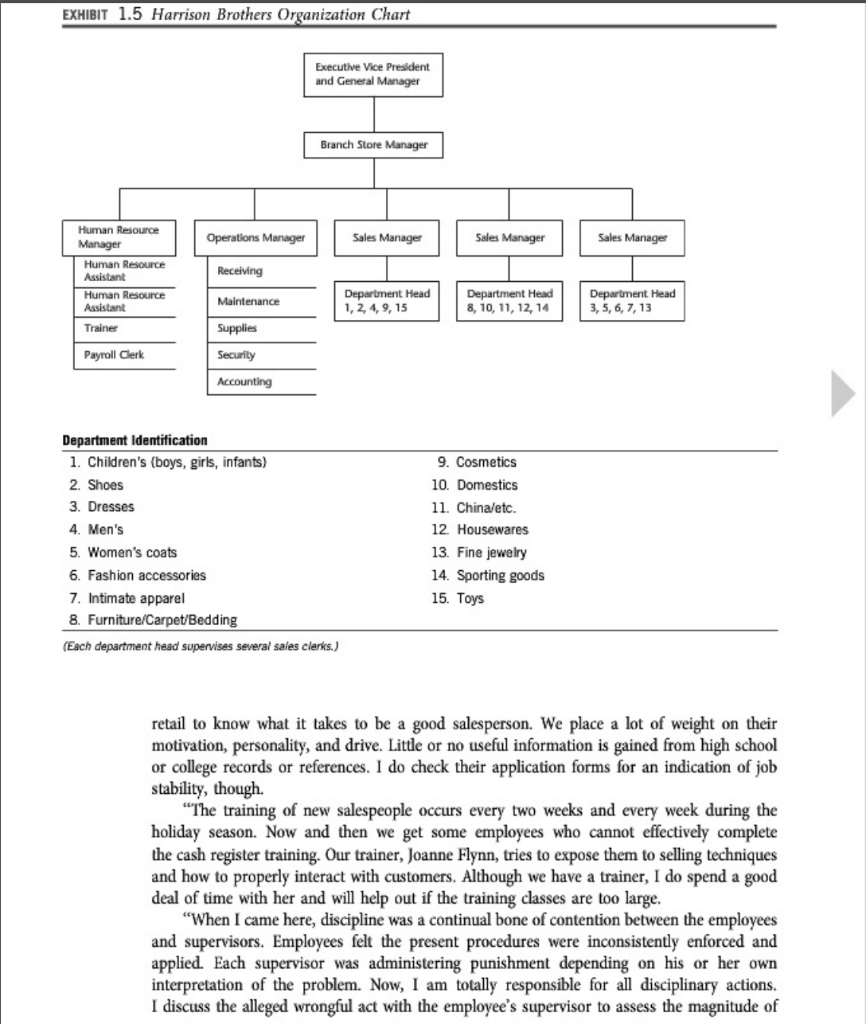
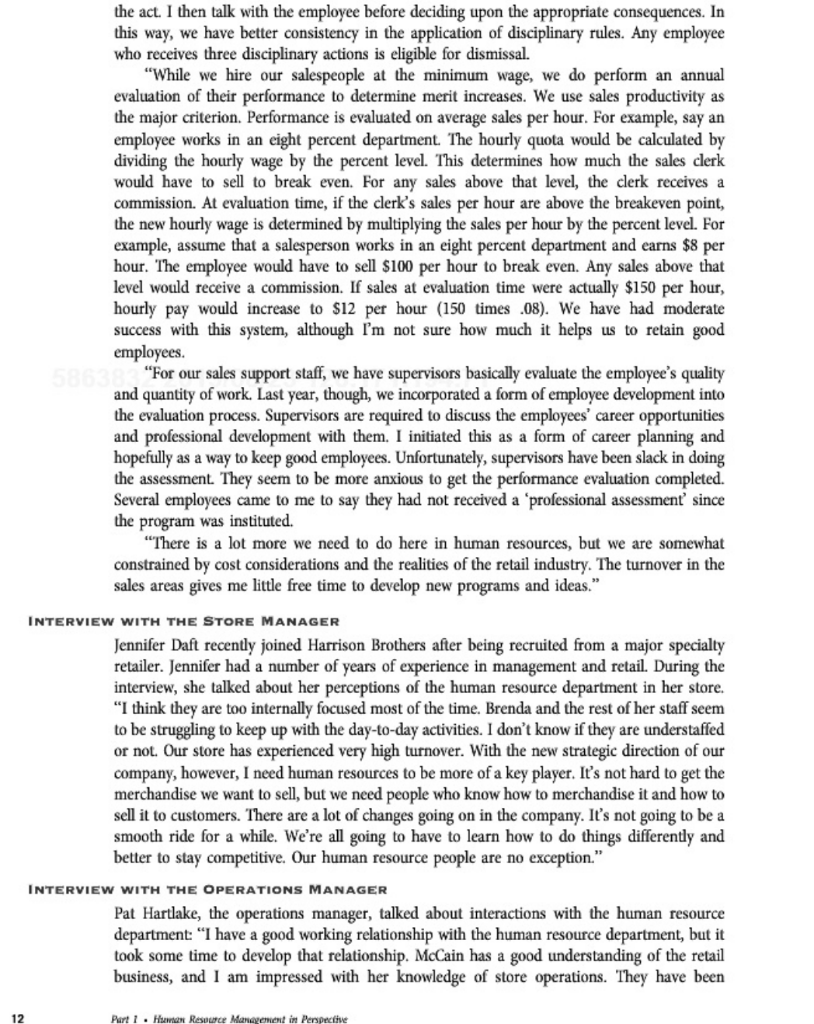
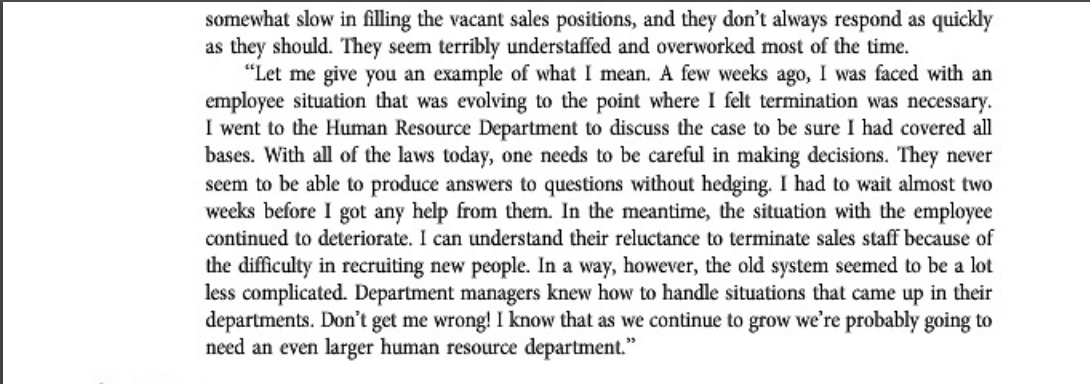
2 CASE The Human Resource Function of Harrison Brothers Corporation COMPANY HISTORY Harrison Brothers Corporation was founded in upstate New York on September 15, 1898, by Aubrey and William Harrison. Harrison Brothers is a multi-line traditional department store that carries mainly men's, women's, and children's clothing. In recent years, the store has expanded to include household furnishings and other items for the home. The long-term goal of the company is to become the leading chain of department stores in the Northeast, selling moderate- to higher-priced merchandise to middle-class, fashion-conscious customers. Harrison Brothers is one of the largest privately owned retail stores in the United States. A majority of its twenty stores are located in the Northeast. Its largest store is located in a major urban center and has 950 employees. The company is highly decentralized and maintains a very small corporate office. INDUSTRY CHALLENGES Traditional department stores like Harrison Brothers are beginning to experience the effects of a number of changes in the retail industry. Not long ago, major department stores succeeded by being all things to all customers. However, today's customer is looking for both value and specialization. Superstores and giant discounters are also popping up. At the same time, the industry faces the challenge of keeping a well-trained, highly motivated sales staff and management team. James Harrison, CEO of Harrison Brothers, describes the company's strategic challenges for the next five years: "We can no longer continue to do the same old things that gave us a reputation for fair value. We must reposition ourselves floor to floor- offering exciting brand names, excellent sales help, and frequent sales. We need a sales staff that knows the merchandise and understands customer preferences. Buying expertise is also critical because fashions and consumer tastes never stay the same. We have five strategic goals: 1. Convert non-selling space into revenue-generating selling space. 2. Build up underdeveloped merchandise categories. 3. Invest aggressively in private brands like Polo, Nautica, and Tommy Hilfiger. 4. Reduce costs through the use of advanced computer systems to project sales and manage inventory. 5. Improve productivity of sales associates, buyers, and department heads." James Harrison took over the business after earning an MBA at a prestigious business school in the Northeast. Unlike previous family members, he wanted to take a much more deliberate approach to charting the future of Harrison Brothers. To do this, he hired a consultant to assist in assessing the company's strengths and weaknesses. Harrison felt the employee quality and performance would be one of the keys to the future. As part of his analysis, the consultant sought to learn more about the human resource function within Harrison Brothers. He decided to interview a few of the human resource and other key managers at the store level. Both groups were also asked to complete a questionnaire of their perceptions of the responsibilities of the human resource function (see Exhibit 1.4). Case 2 The Home Resource Function of Harrison Brothers Corporation 9 EXHIBIT 1.4 Results of Questionnaire Completed by HR Managers and Non-HR Managers HR Responsibilities HR Managers Store Managers Staffing 4.5 4.5 Training and Development 3.5 4.5 Performance Management 4.5 4.0 Compensation 3.0 3.5 Safety 2.5 2.5 Knowledge of Business 2.0 4.5 Managing Change 2.0 4.5 "Respondents were given a list of human resource responsibilities and asked to rate their importance to stare performance using a scale of 1 (not very important) to 5 (very important). The responses were aggregated for all stores. The numbers in the table represent the mean ratings for each item. The questionnaire was completed by all the human resource managers and store managers at each store. THE WESTPARK STORE* Brenda McCain has been the human resource manager at the Westpark store for the past four years. Prior to her employment at Harrison Brothers, Brenda had several years of experience in retail stores and came to Harrison Brothers after being a buyer at one of its major competitors. McCain has a degree in fashion merchandising from a college in New Jersey. Currently, there are 950 employees at the Westpark store. The staff includes salespeople, sales support employees (dock, marking room, clerical, and accounting), maintenance, security, and management. The human resource department consists of five people (see Exhibit 1.5). During the peak holiday season, a number of people are hired as floating sales staff. These temporary workers may number close to 100. THE HUMAN RESOURCE MANAGER'S JOB McCain talked about the human resource department's areas of responsibility: "Our business has really grown in the last two years. We are carrying more specialty and designer clothing lines and have added items we hope will appeal to moderate to high-income customers. When I came here four years ago, I found too many of the human resource operations being performed by the operations manager, Pat Hartlake, and one of the department heads, Rich Jenkins. Since that time, I have attempted to set up procedures and policies to assure proper staffing of the store. I spend most of my time just managing the human resource department. I think it is important to keep abreast of the performance of workers, and I like to observe their work habits regularly. I also spend a good deal of time on selecting applicants for the sales and support jobs. There is heavy turnover on the sales floor in our business, and the average salesperson at Harrison Brothers is either part-time, an older employee, or one who is 'in-between jobs' if a better job came along, they would snap it up immediately. For example, of the 119 part-time people hired in the last four months, 65 have left." McCain went on to explain their selection procedures: "The main sources of our applicants are newspaper ads and word-of-mouth by present or past employees. We select people based on how well they do in the interview. Right now, I conduct about 25 to 30 interviews a week and perhaps more during the holiday rush. I have enough experience in *The interview at the Westpark store reflects what the consultant heard throughout the company. 10 Part 1. Haven Resource Management in Perspective EXHIBIT 1.5 Harrison Brothers Organization Chart Executive Vice President and General Manager Branch Store Manager Operations Manager Sales Manager Sales Manager Sales Manager Receiving Human Resource Manager Human Resource Assistant Human Resource Assistant Trainer Maintenance Department Head 1, 2,4,9,15 Department Head 8, 10, 11, 12, 14 Department Head 3, 5, 6, 7, 13 Supplies Payroll Clerk Security Accounting Department Identification 1. Children's (boys, girls, infants) 2. Shoes 3. Dresses 4. Men's 5. Women's coats 6. Fashion accessories 7. Intimate apparel 8. Furniture/Carpet/Bedding (Each department head supervises several sales clerks.) 9. Cosmetics 10. Domestics 11. China/etc. 12. Housewares 13. Fine jewelry 14. Sporting goods 15. Toys retail to know what it takes to be a good salesperson. We place a lot of weight on their motivation, personality, and drive. Little or no useful information is gained from high school or college records or references. I do check their application forms for an indication of job stability, though. "The training of new salespeople occurs every two weeks and every week during the holiday season. Now and then we get some employees who cannot effectively complete the cash register training. Our trainer, Joanne Flynn, tries to expose them to selling techniques and how to properly interact with customers. Although we have a trainer, I do spend a good deal of time with her and will help out if the training classes are too large. "When I came here, discipline was a continual bone of contention between the employees and supervisors. Employees felt the present procedures were inconsistently enforced and applied. Each supervisor was administering punishment depending on his or her own interpretation of the problem. Now, I am totally responsible for all disciplinary actions. I discuss the alleged wrongful act with the employee's supervisor to assess the magnitude of the act. I then talk with the employee before deciding upon the appropriate consequences. In this way, we have better consistency in the application of disciplinary rules. Any employee who receives three disciplinary actions is eligible for dismissal. "While we hire our salespeople at the minimum wage, we do perform an annual evaluation of their performance to determine merit increases. We use sales productivity as the major criterion. Performance is evaluated on average sales per hour. For example, say an employee works in an eight percent department. The hourly quota would be calculated by dividing the hourly wage by the percent level. This determines how much the sales clerk would have to sell to break even. For any sales above that level, the clerk receives a commission. At evaluation time, if the clerk's sales per hour are above the breakeven point, the new hourly wage is determined by multiplying the sales per hour by the percent level. For example, assume that a salesperson works in an eight percent department and earns $8 per hour. The employee would have to sell $100 per hour to break even. Any sales above that level would receive a commission. If sales at evaluation time were actually $150 per hour, hourly pay would increase to $12 per hour (150 times .08). We have had moderate success with this system, although I'm not sure how much it helps us to retain good employees. 53638For our sales support staff, we have supervisors basically evaluate the employee's quality and quantity of work. Last year, though, we incorporated a form of employee development into the evaluation process. Supervisors are required to discuss the employees' career opportunities and professional development with them. I initiated this as a form of career planning and hopefully as a way to keep good employees. Unfortunately, supervisors have been slack in doing the assessment. They seem to be more anxious to get the performance evaluation completed. Several employees came to me to say they had not received a 'professional assessment since the program was instituted. "There is a lot more we need to do here in human resources, but we are somewhat constrained by cost considerations and the realities of the retail industry. The turnover in the sales areas gives me little free time to develop new programs and ideas. INTERVIEW WITH THE STORE MANAGER Jennifer Daft recently joined Harrison Brothers after being recruited from a major specialty retailer. Jennifer had a number of years of experience in management and retail. During the interview, she talked about her perceptions of the human resource department in her store. "I think they are too internally focused most of the time. Brenda and the rest of her staff seem to be struggling to keep up with the day-to-day activities. I don't know if they are understaffed or not. Our store has experienced very high turnover. With the new strategic direction of our company, however, I need human resources to be more of a key player. It's not hard to get the merchandise we want to sell, but we need people who know how to merchandise it and how to sell it to customers. There are a lot of changes going on in the company. It's not going to be a smooth ride for a while. We're all going to have to learn how to do things differently and better to stay competitive. Our human resource people are no exception." INTERVIEW WITH THE OPERATIONS MANAGER Pat Hartlake, the operations manager, talked about interactions with the human resource department: I have a good working relationship with the human resource department, but it took some time to develop that relationship. McCain has a good understanding of the retail business, and I am impressed with her knowledge of store operations. They have been 12 Part 1. Human Resource Management in Perspective somewhat slow in filling the vacant sales positions, and they don't always respond as quickly as they should. They seem terribly understaffed and overworked most of the time. Let me give you an example of what I mean. A few weeks ago, I was faced with an employee situation that was evolving to the point where I felt termination was necessary. I went to the Human Resource Department to discuss the case to be sure I had covered all bases. With all of the laws today, one needs to be careful in making decisions. They never seem to be able to produce answers to questions without hedging. I had to wait almost two weeks before I got any help from them. In the meantime, the situation with the employee continued to deteriorate. I can understand their reluctance to terminate sales staff because of the difficulty in recruiting new people. In a way, however, the old system seemed to be a lot less complicated. Department managers knew how to handle situations that came up in their departments. Don't get me wrong! I know that as we continue to grow we're probably going to need an even larger human resource department." 1. Harrison Brothers' 5 strategic goals and expectations of HR responsibilities are described below. Among the managers in this case, whose expectations of HR responsibilities are more aligned with the company strategic goals? Explain why. 1. Convert non-selling space into revenue-generating selling space. 2. Build up underdeveloped merchandise categories. 3. Invest aggressively in private brands like Polo, Nautica, and Tommy Hilfiger. 4. Reduce costs through the use of advanced computer systems to project sales and manage inventory. 5. Improve productivity of sales associates, buyers, and department heads." Managers and Non-HR Managers HR Responsibilities HR Managers Store Managers Staffing 4.5 4.5 Training and Development 3.5 4.5 Performance Management 4.5 4.0 Compensation 3.0 3.5 Safety 2.5 2.5 Knowledge of Business 20 4.5 Managing Change 2.0 4.5 Respondents were given a list of human resource responsibilities and asked to rate their importance to store performance using a scale of 1 (not very important) to 5 (very important). The responses were aggregated for all stores. The numbers in the table represent the mean ratings for each item. The questionnaire was completed by all the human resource managers and store managers at each store









 Study Help