







Question: Read the case and answer the steps from 1 to 15 Organ xongo x Orgian xm Organ: x | bcx Puterix HLME 4. MC *
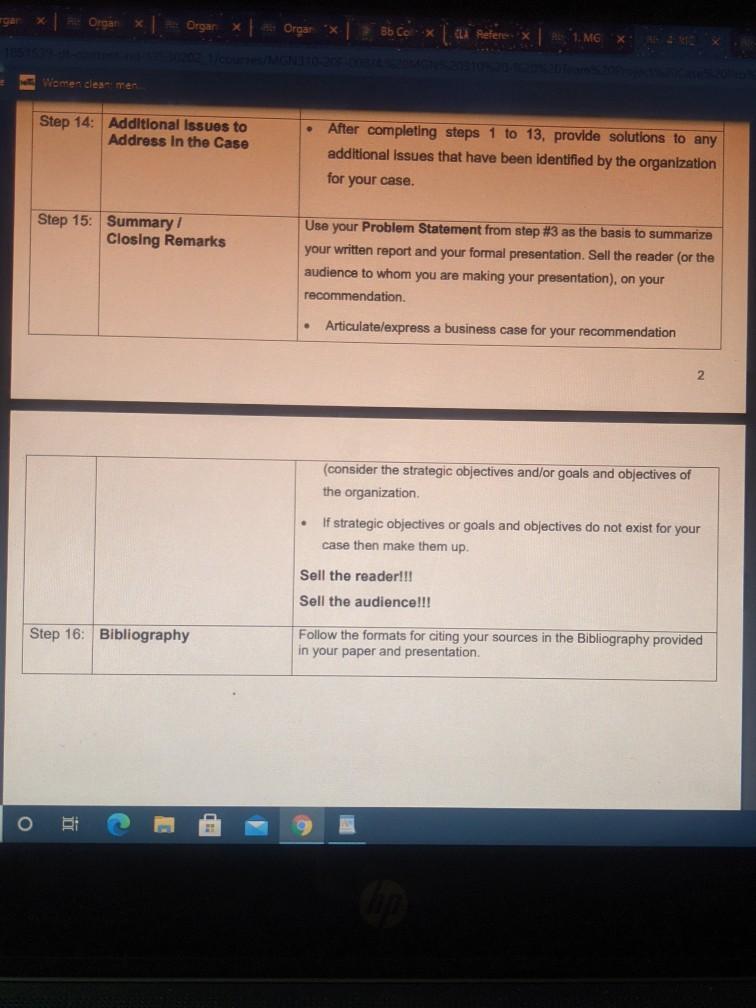
Read the case and answer the steps from 1 to 15
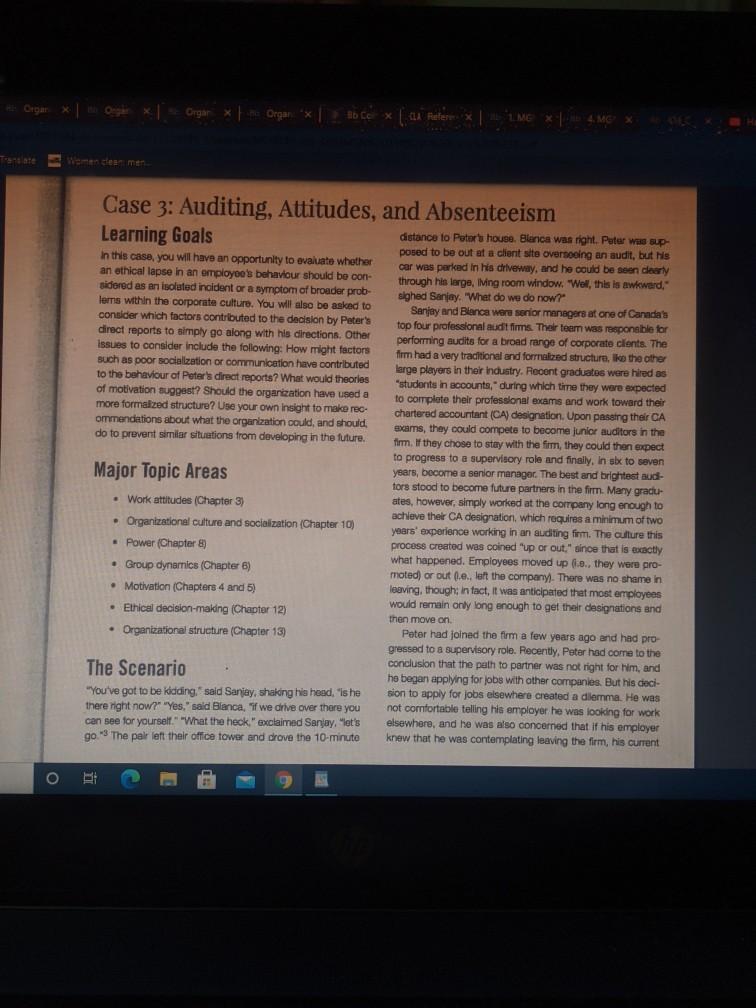
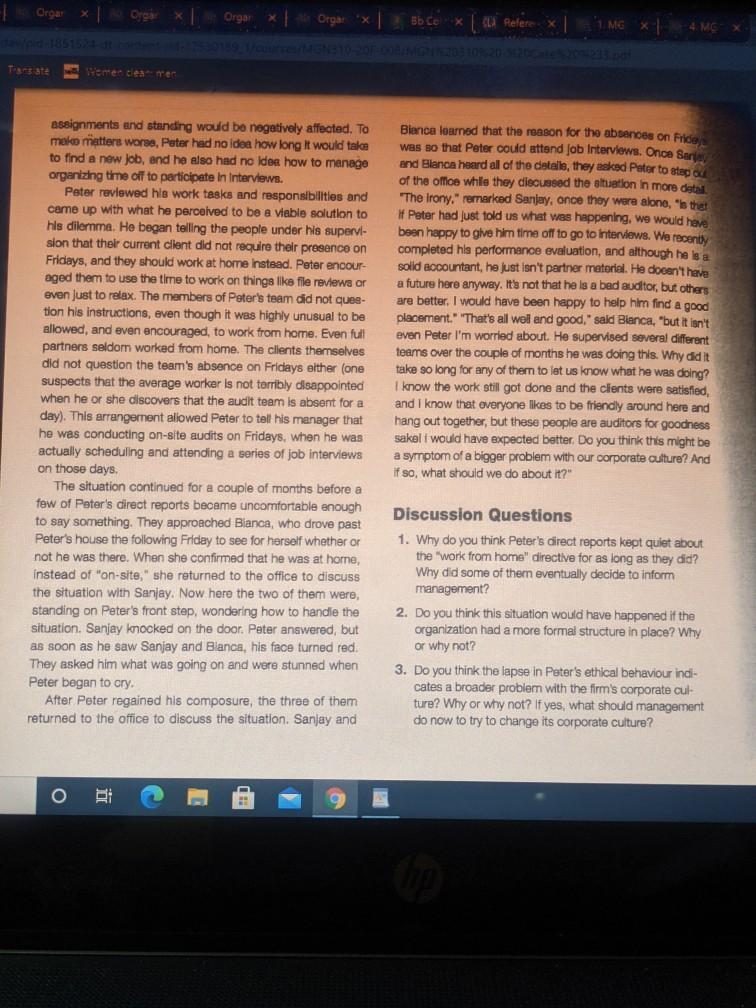
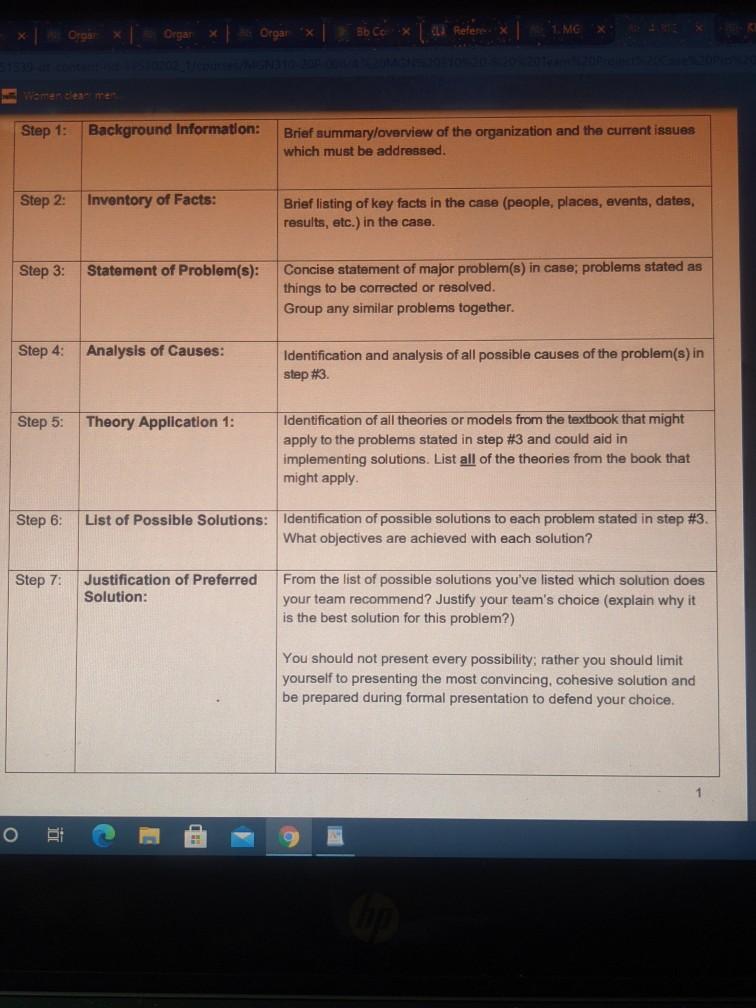
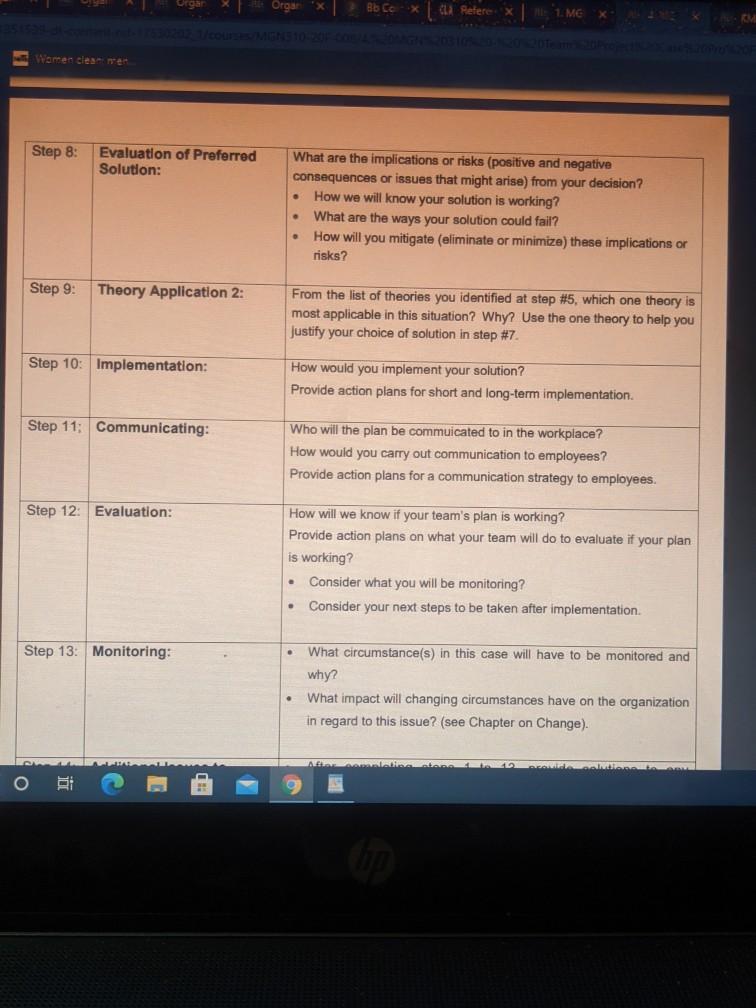
Organ xongo x Orgian xm Organ: x | bcx Puterix HLME 4. MC * Wendler men Case 3: Auditing, Attitudes, and Absenteeism Learning Goals In this case, you will have an opportunity to evaluate whether an ethical lapse in an employee's behaviour should be con- sidered as an isolated incident or a symptom of broader prob- lerns within the corporate culture. You will also be asked to consider which factors contributed to the decision by Peter's direct reports to simply go along with his directions. Other Issues to consider include the following: How might factors such poor socialization or communication have contributed to the behaviour of Peter's direct reports? What would theories of motivation suggest? Should the organization have used a more formalized structure? Use your own Insight to make rec- ommendations about what the organization could, and should do to prevent similar situations from developing in the future. Major Topic Areas distance to Peter's house Blanca was right. Peter We sup posed to be out at a client site overseeing an audit, but his car was parked in his driveway, and he could be seen clearly through his large, Iming room window. "Well, this is awkward," sighed Sanjay. "What do we do now? Sanjay and Blanca were senior managers at one of Canada's top four professional audit firms. Their teem was responsible for performing audits for a broad range of corporate clients. The firm had a very traditional and formalized structure, like the other large players in their industry. Recent graduates were hired as students in accounts. during which time they were expected to complete their professional exams and work toward their chartered accountant (CA) designation. Upon passing their CA exams, they could compete to become junior auditors in the firm. If they chose to stay with the firm, they could then expect to progress to a supervisory role and finally, in six to seven years, become a senior manager. The best and brightest aud- tors stood to become future partners in the firm. Many gradu ates, however, simply worked at the company long enough to achieve their CA designation, which requires a minimum of two years' experience working in an auditing firm. The culture this process created was coined "up or out." since that is exactly what happened. Employees moved up ... they were pro- moted) or out (e. left the company. There was no shame in leaving, though; In fact, it was anticipated that most employees would remain only long enough to get their designations and then move on Peter had joined the firm a few years ago and had pro gressed to a supervisory role. Recently, Peter had come to the conclusion that the path to partner was not right for him, and he began applying for jobs with other companies. But his deci sion to apply for jobs elsewhere created a dilemma. He was not comfortable telling his employer he was looking for work elsewhere, and he was also concerned that if his employer knew that he was contemplating leaving the firm, his current Work attitudes (Chapter 3) Organizational culture and socialization (Chapter 10) Power (Chapter 8) Group dynamics (Chapter 6) Motivation (Chapters 4 and 5) Ethical decision-making (Chapter 12) Organizational structure (Chapter 13) The Scenario "You've got to be kidding." said Sanjay, shaking his head, "ishe there right now?" "Yes," said Blanca, if we drive over there you can see for yourself." "What the heck." exclaimed Sanjay, let's go 3 The pair left their office tower and drove the 10-minute PA Croa Creo Bb Cex A Refere ME Tinate Senter cleger assignments and standing would be negatively affected. To malce matters worse, Peter had no idea how long it would take to find a new job, and he also had no idea how to manage organizing time off to participate in Interviews. Peter reviewed his work tasks and responsibilities and came up with what he perceived to be a viable solution to his dilemma. He began telling the people under his supervi- sion that their current client did not require their presence on Fridays, and they should work at home instead. Peter encour- aged them to use the time to work on things like fie reviews or even just to relax. The members of Peter's team did not ques- tion his instructions, even though it was highly unusual to be allowed, and even encouraged, to work from home. Even full partners seldom worked from home. The clients themselves did not question the team's absence on Fridays ether (one suspects that the average worker is not terribly disappointed when he or she discovers that the audit team is absent for a day). This arrangement allowed Peter to tell his manager that he was conducting on-site audits on Fridays, when he was actually scheduling and attending a series of job interviews on those days, The situation continued for a couple of months before a few of Peter's direct reports became uncomfortable enough to say something. They approached Bianca, who drove past Peter's house the following Friday to see for herself whether or not he was there. When she confirmed that he was at home, instead of "on-site," she returned to the office to discuss the situation with Sanjay. Now here the two of them were, standing on Peter's front step, wondering how to handle the situation. Sanjay knocked on the door. Peter answered, but as soon as he saw Sanjay and Blanca, his face turned red They asked him what was going on and were stunned when Peter began to cry. After Peter regained his composure, the three of them returned to the office to discuss the situation. Sanjay and Blanca learned that the reason for the absences on Frides was so that Peter could attend Job Interviews. Once Sara and Blanca heard all of the details, they asked Peter to stay at of the office while they discussed the situation in more detail "The Irony." remarked Sanjay, once they were alone, "sthet # Peter had just told us what was happening, we would have been happy to give him time off to go to interviews. We recently completed his performance evaluation, and although he is a solid accountant, he just isn't partner material. He doesn't have a future here anyway. It's not that he is a bad auditor, but others are better. I would have been happy to help him find a good placement." "That's all well and good." sald Bianca, "but it isn't even Peter I'm worried about. He supervised several different teams over the couple of months he was doing this. Why did it take so long for any of them to let us know what he was doing? I know the work still got done and the clients were satisfied, and I know that everyone likes to be friendly around here and hang out together, but these people are auditors for goodness sakel i would have expected better. Do you think this might be a symptom of a bigger problem with our corporate culture? And if so, what should we do about it?" Discussion Questions 1. Why do you think Peter's direct reports kept quiet about the "work from home" directive for as long as they did? Why did some of them eventually decide to inform management? 2. Do you think this situation would have happened if the organization had a more formal structure in place? Why or why not? 3. Do you think the lapse in Peter's ethical behaviour indi- cates a broader problem with the firm's corporate cul- ture? Why or why not? If yes, what should management do now try to change its corporate culture? O Organ Grgar Refer merasa mer Step 1: Background Information: Brief summary/overview of the organization and the current issues which must be addressed. Step 2: Inventory of Facts: Brief listing of key facts in the case (people, places, events, dates, results, etc.) in the case. Step 3: Statement of Problem(s): Concise statement of major problem(s) in case; problems stated as things to be corrected or resolved. Group any similar problems together. Step 4: Analysis of Causes: Identification and analysis of all possible causes of the problem(s) in step #3 Step 5: Theory Application 1: Identification of all theories or models from the textbook that might apply to the problems stated in step #3 and could aid in implementing solutions. List all of the theories from the book that might apply Step 6: List of Possible Solutions: Identification of possible solutions to each problem stated in step #3 What objectives are achieved with each solution? Step 7 Justification of Preferred Solution: From the list of possible solutions you've listed which solution does your team recommend? Justify your team's choice (explain why it is the best solution for this problem?) You should not present every possibility; rather you should limit yourself to presenting the most convincing, cohesive solution and be prepared during formal presentation to defend your choice. Orgae Bb Coix CA Refere Wame cles mer Step 8 Evaluation of Preferred Solution: What are the implications or risks (positive and negative consequences or issues that might arise) from your decision? How we will know your solution is working? What are the ways your solution could fail? How will you mitigate (eliminate or minimize) these implications or risks? Step 9 Theory Application 2: From the list of theories you identified at step #5, which one theory is most applicable in this situation? Why? Use the one theory to help you justify your choice of solution in step #7 Step 10: Implementation: How would you implement your solution? Provide action plans for short and long-term implementation Step 11: Communicating: Who will the plan be commuicated to in the workplace? How would you carry out communication to employees? Provide action plans for a communication strategy to employees. Step 12 Evaluation: How will we know if your team's plan is working? Provide action plans on what your team will do to evaluate if your plan is working? Consider what you will be monitoring? Consider your next steps to be taken after implementation . Step 13: Monitoring: What circumstance(s) in this case will have to be monitored and why? What impact will changing circumstances have on the organization in regard to this issue? (see Chapter on Change). O Organ Orgar * | * Orgar x. | Bb c * ( au peteren Comen cleaner Step 14: Additional Issues to Address In the Case After completing steps 1 to 13, provide solutions to any additional issues that have been identified by the organization for your case. Step 15: Summary Closing Remarks Use your Problem Statement from step #3 as the basis to summarize your written report and your formal presentation. Sell the reader (or the audience to whom you are making your presentation), on your recommendation Articulate/express a business case for your recommendation 2 (consider the strategic objectives and/or goals and objectives of the organization If strategic objectives or goals and objectives do not exist for your case then make them up. Sell the reader!!! Sell the audience!!! Step 16: Bibliography Follow the formats for citing your sources in the Bibliography provided in your paper and presentation OStep by Step Solution
There are 3 Steps involved in it
1 Expert Approved Answer
Step: 1 Unlock

Question Has Been Solved by an Expert!
Get step-by-step solutions from verified subject matter experts
Step: 2 Unlock
Step: 3 Unlock
 Study Help