







Question: Read the case found in this file: Then, in a paper that is 500 to 600 words in length, respond to the following questions: What
Read the case found in this file: 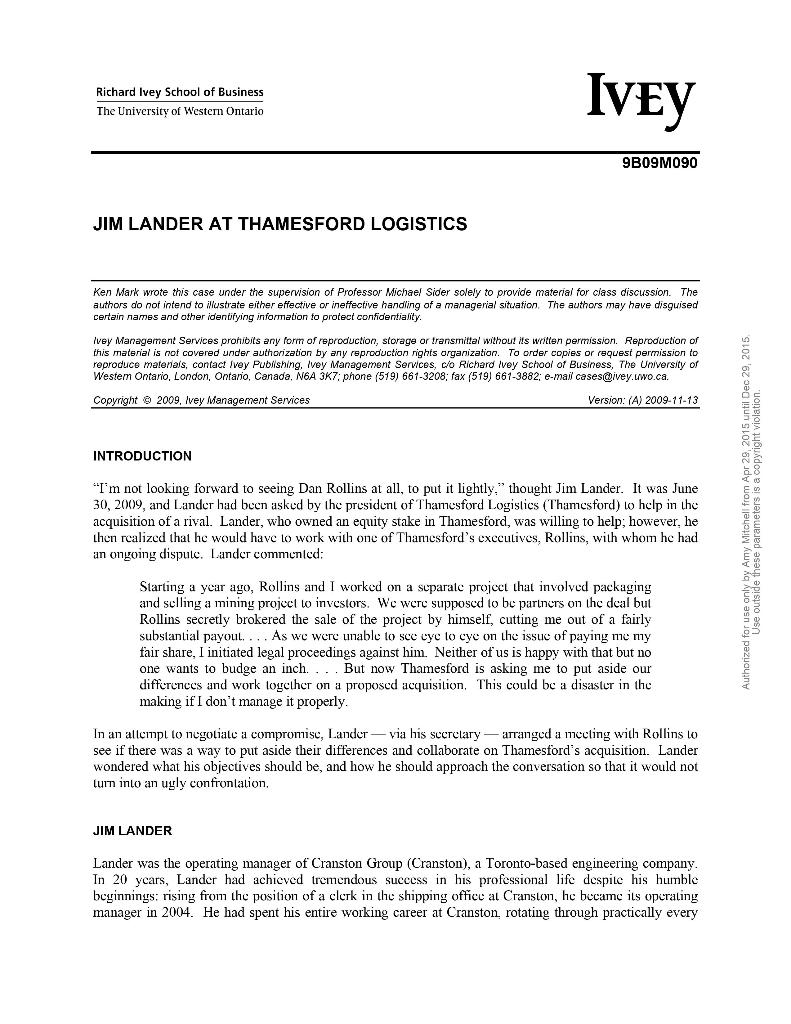
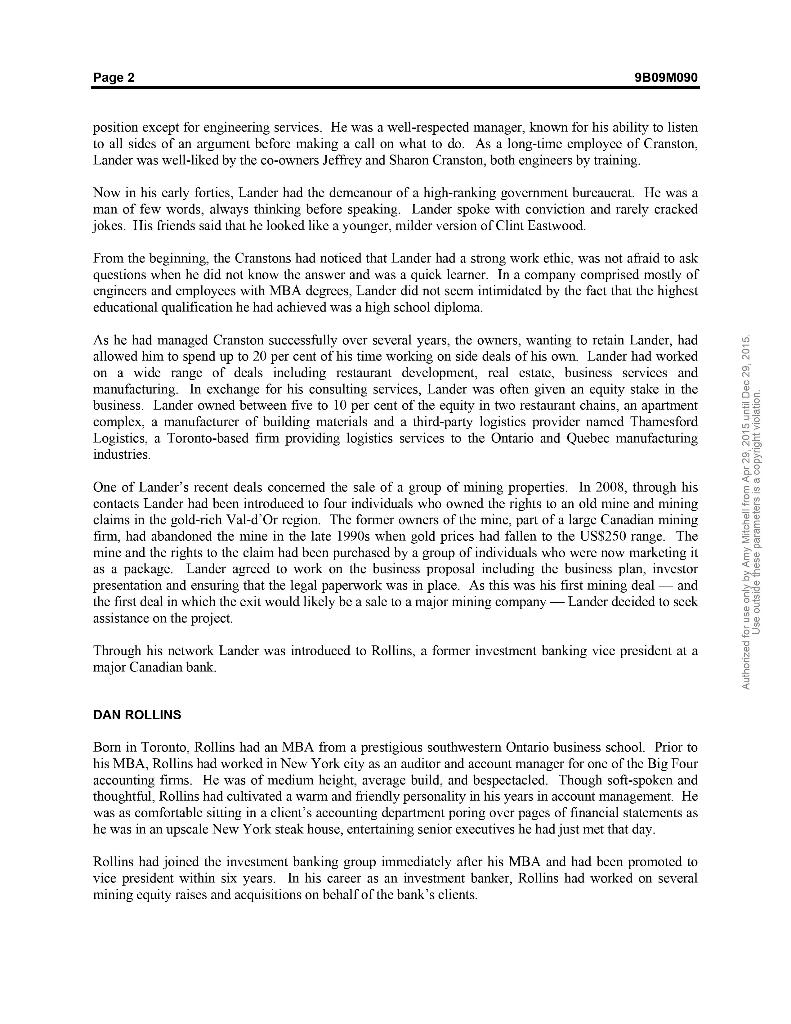
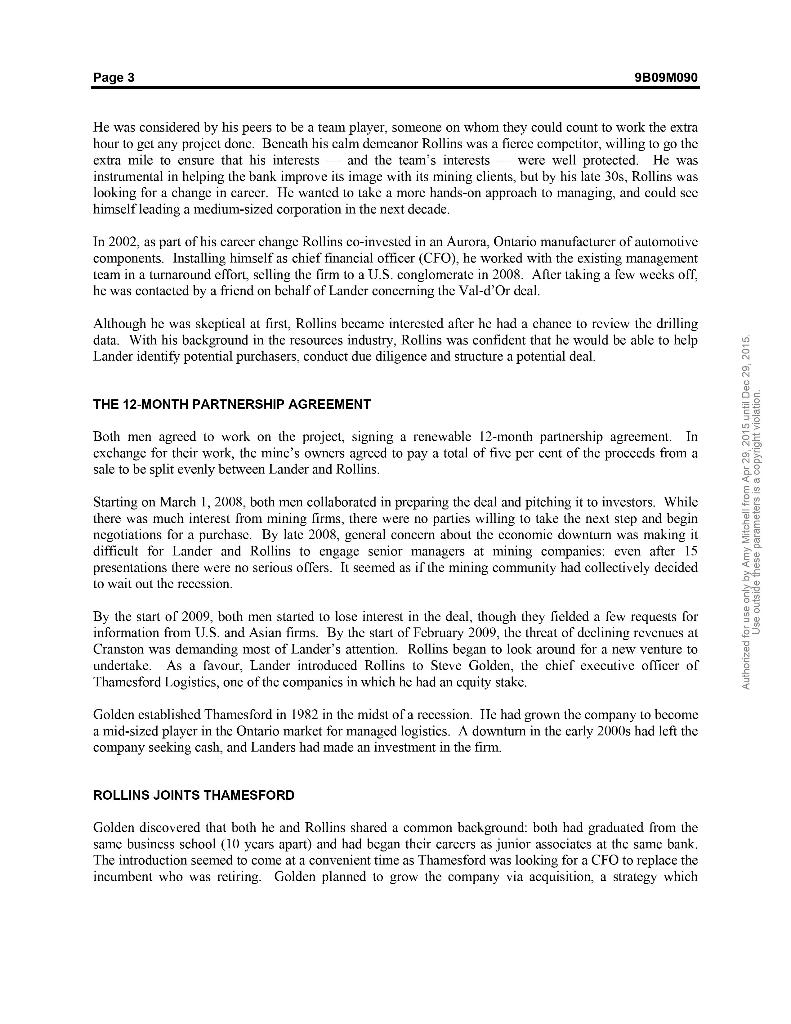
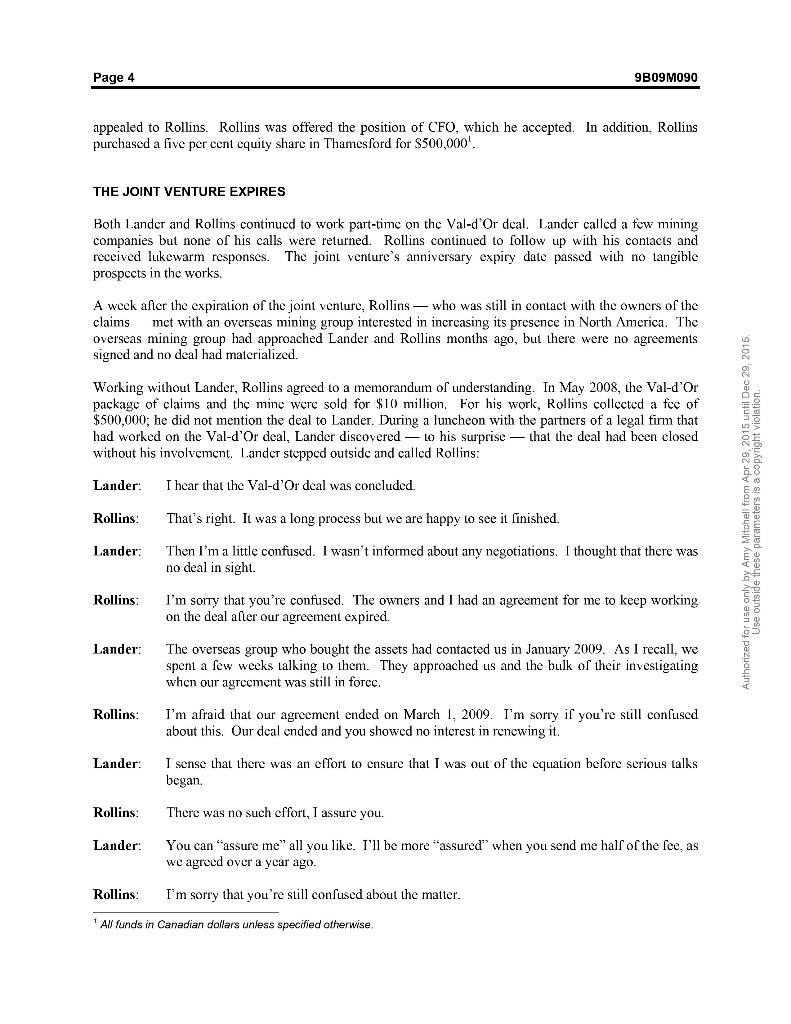
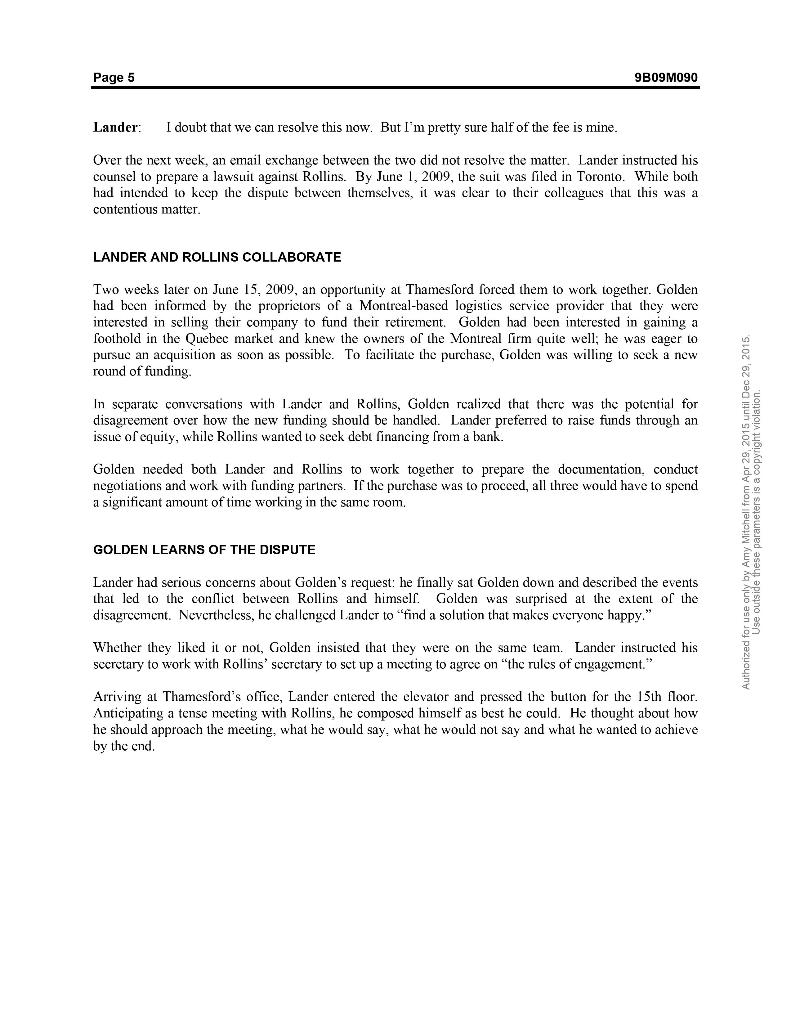
Then, in a paper that is 500 to 600 words in length, respond to the following questions:
- What are the major issues described in this case?
- Who is involved?
- What caused the issues?
- What are your recommendations for resolving the issues?
Richard Ivey School of Business The University of Westem Ontario Ivey 9B09M090 JIM LANDER AT THAMESFORD LOGISTICS Ken Mark wrote this case under the supervision of Professor Michael Sider solely to provide material for class discussion. The authors do not intend to illustrate either effective or ineffective handling of a managerial situation. The authors may have disguised certain names and other identifying information to protect confidentiality. Ivey Management Services prohibits any form of reproduction, storage or transmittal without is written permission. Reproduction of this matsrial is not covered under authorization by any rsproduction rights organization. To order copies or requesi permission to reproduce materials, contact /vey Publishing, Ivey Management Services, c/o Richard Ivey School of Business, The University of Westem Ontario, London, Ontario, Canada, N6A 3K7: phone (519) 661-3208, fax (519) 661-3882; e-mail cases@ivey.uwo.ca. Copyright 2009. Ivey Management Services Version: (A) 2009-11-13 INTRODUCTION "I'm not looking forward to seeing Dan Rollins at all, to put it lightly." thought Jim Lander. It was June 30, 2009, and Lander had been asked by the president of Thamesford Logistics (Thamesford) to help in the acquisition of a rival. Lander, who owned an equity stake in Thamesford, was willing to help; however, he then realized that he would have lo work with one of Thanicsford's executives, Rollins, with whom he had an ongoing dispulc. Lander commenlcd: Authorized for use only by Amy Mitchell from Apr 29, 2015 until Dec 29, 2015 Use outside these parameters is a copyright violation. a Starting a year ago, Rollins and I worked on a separate project that involved packaging and selling a mining project to investors. We were supposed to be parlners on the deal but Rollins secretly brokered the sale of the project by himself, cutting me out of a fairly substantial payout ... As we were unable to see cyc lo cye on the issuc of paying me my fair share, I initiated legal proceedings against him. Neither of us is happy with that but no one wants to budge an inch. .. But now Thamesford is asking me to put aside our differences and work together on a proposed acquisition. This could be a disaster in the making if I don't manage it properly. In an allempt negotiate a compromise, Lander - via his secretary arranged a meeting with Rollins lo see if there was a way to put aside their differences and collaborate on Thamesford's acquisition. Lander wondered what his objectives should be, and how he should approach the conversation so that it would not turn into an ugly confrontation, JIM LANDER Lander was the operating manager of Cranston Group (Cranston), a Toronto-based engineering company. In 20 years, Lander had achieved tremendous success in his professional life despite his humble beginnings: rising from the position of a clerk in the shipping office at Cranston, he became ils opcraling manager in 2004. He had spent his entire working career at Cranston rotating through practically every Page 2 9B09M090 position except for engineering services. He was a well-respected manager, known for his ability to listen Lo all sides of an argument before making a call on what to do. As a long-time employee of Cranston, Lander was well-liked by the co-owners Jeffrey and Sharon Cranston, both engineers by training. Now in his carly fortics, Lander had the demeanour of a high-ranking government burcaucrat. Ile was a man of few words, always thinking before speaking. Lander spoke with conviction and rarely cracked jokes. Ilis friends said that he looked like a younger, milder version or Clint Eastwood. From the beginning the Cranstons had noticed that Lander had a strong work ethic, was not afraid to ask questions when he did not know the answer and was a quick learner. In a company comprised mostly of engineers and employees with MBA degrees, Lander did not seem intimidated by the fact that the highest educational qualification he had achieved was a high school diploma. As he had managed Cranston successfully over several years, the owners, wanting to retain Lander, had allowed him to spend up to 20 per cent of his time working on side deals of his own. Lander had worked on a wide range of deals including restaurant development, real estate, business services and manufacturing. In exchange for his consulting services, Lander was often given an equity stake in the business. Lander owned between five to 10 per cent of the equity in two restaurant chains, an apartment complex, a manufacturer of building materials and a third-party logistics provider named Thamesford Logistics, a Toronto-based firm providing logistics services to the Ontario and Quebec manufacturing industries. One of Lander's recent deals concerned the sale of a group of mining properties. In 2008, through his contacts Lander had been introduced to four individuals who owned the rights to an old mine and mining claims in the gold-rich Val-d'Or region. The former owners of the minc, part of a large Canadian mining firm, had abandoned the mine in the late 1990s when gold prices had fallen to the US$250 range. The mine and the rights to the claim had been purchased by a group of individuals who were now marketing it as a package. Landcr agreed to work on the business proposal including the business plan, investor presentation and ensuring that the legal paperwork was in place. As this was his first mining deal the first deal in which the exit would likely be a sale to a major mining company - Lander decided to seek assistance on the project. Through his network Lander was introduced to Rollins, a former investment banking vice president at a major Canadian bank Use outside these parameters is a copyright violation. Authorized to and DAN ROLLINS Born in Toronto. Rollins had an MBA from a prestigious southwestern Ontario business school. Prior to his MBA, Rollins had worked in New York cily as an auditor and account manager for one of the Big Tour accounting firms. He was of medium height, average build, and bespectacled. Though soft-spoken and thoughtful Rollins had cultivated a warm and friendly personality in his years in account management. He was as comfortable silling in a client's accounting department poring over pages of financial statements as he was in an upscale New York steak house, entertaining senior executives he had just met that day. Rollins had joined the investment banking group immediately after his MBA and had been promoted to vice president within six years. In his career as an investment banker, Rollins had worked on several mining equity raises and acquisitions on behalf of the bank's clients. Page 3 9B09M090 He was considered by his peers to be a team player, someone on whom they could count to work the extra hour to get any project donc. Bencath his calm demcanor Rollins was a fierce competitor, willing to go the extra mile to ensure that his interests and the team's interests were well protected. He was instrumental in helping the bank improve its image with its mining clients, but by his late 30s, Rollins was looking for a change in career. He wanted to take a more hands-on approach to managing, and could sco a himself leading a medium-sized corporation in the next decade. In 2002, as part of his carcer change Rollins co-invested in an Aurora, Ontario manufacturer of automotive components. Installing himself as chief financial officer (CFO), he worked with the existing management Leam in a turnaround effort, selling the firm to a U.S. conglomerate in 2008. After taking a few weeks off, he was contacted by a friend on bchalf of Lander concerning the Val-d'Or deal. Although he was skeptical at first, Rollins became interested after he had a chance to review the drilling data. With his background in the resources industry, Rollins was confident that he would be able to help Lander identify potential purchasers, conduct due diligence and structure a potential deal. THE 12-MONTH PARTNERSHIP AGREEMENT Both men agreed to work on the project, signing a renewable 12- month partnership agreement. In cxchange for their work, the minc's owners agreed to pay a total of five per cent of the proceeds from a sale to be split evenly between Lander and Rollins. Starting on March 1, 2008. both men collaborated in preparing the deal and pitching it to investors. While there was much interest from mining firms, there were no parties willing to take the next step and begin negotiations for a purchase. By late 2008, general concern about the cconomic downturn was making it difficult for Lander and Rollins to engage senior managers at mining companies: even after 15 presentations there were no serious offers. It seemed as if the mining community had collectively decided Lo wail out the recession, y Amy Mitchell from Apr 29, 2015 unt Use outside these parameters is a copyright violation. Authorized to By the start of 2009, both men started to lose interest in the deal, though they lielded a few requests for information from U.S. and Asian firms. By the start of February 2009, the threat of declining revenues at Cranston was demanding most of Lander's attention. Rollins began to look around for a new venture to undertake. As a favour. Lander introduced Rollins to Steve Golden, the chief executive officer of Thamesford Logistics, one of the companies in which he had an cquity stake. Golden established Thamesford in 1982 in the midst of a recession. Ile had grown the company to become a mid-sized player in the Ontario market for managed logistics. A downturn in the early 2000s had left the company seeking cash and Landers had made an investment in firm ROLLINS JOINTS THAMESFORD Golden discovered that both he and Rollins shared a common background: both had graduated from the same business school (10) years apart) and had began their careers as junior associates at the same bank. The introduction seemed to come at a convenient time as Thamesford was looking for a CFO to replace the incumbent who was retiring. Golden planned to grow the company via acquisition, a strategy which Page 4 9B09M090 appealed to Rollins. Rollins was offered the position of CFO, which he accepted. In addition, Rollins purchased a five per cent cquity share in Thames ford for $500,000! THE JOINT VENTURE EXPIRES Both Lander and Rollins continued to work part-time on the Val-d'Or dcal. Lander called a few mining companies but none of his calls were returned. Rollins continued to follow up with his contacts and received lukewarm responses. The joint venture's anniversary expiry date passed with no tangible prospects in the works. A week after the expiration of the joint venture, Rollins who was still in contact with the owners of the claims met with an overseas mining group interested in increasing its presence in North America. The overseas mining group had approached Lander and Rollins months ago, but there were no agreements signed and no deal had materialized. Working without Lander, Rollins agreed to a memorandum of understanding. In May 2008, the Val-d'Or package of claims and the minc were sold for $10 million. For his work, Rollins collected a fee of $500,000; he did not mention the deal to Lander. During a luncheon with the partners of a legal firm that had worked on the Val-d'Or deal, Lander discovered to his surprise that the deal had been closed without his involvement. Landet stepped outside and called Rollins: Lander: I hear that the Val-d'Or deal was concluded. Rollins That's right. It was a long process but we are happy to see it linished. Authorized for use only by Amy Mitchell from Apr 29, 2015 until Dec 29, 2015 Use outside these parameters is a copyright violation. Lander: Then I'm a little confused. I wasn't informed about any negotiations. I thought that there was no deal in sight. Rollins I'm sorry that you're confused. The owners and I had an agreement for me to keep working on the deal after our agreement expired. Lander: The overseas group who bought the assets had contacted us in January 2009. As I recall, we spent a few weeks talking to them. They approached us and the bulk of their investigating when our agreement was still in forcc. Rollins: I'm afraid that our agreement ended on March 1, 2009. I'm sorry if you're still confused about this. Our deal ended and you showed no interest in renewing it. I sense that there was an effort to ensure that I was out of the cqualion before serious talks began Lander: Rollins: There was no such effort, I assure you. Lander: You can assure me" all you like. I'll be more "assured when you send me half of the fee, as we agreed over a year ago Rollins: I'm sorry that you're still confused about the matter. All funds in Canadian dollars unless specified otherwise, Page 5 9B09M090 Lander: I doubt that we can resolve this now. But I'm pretty sure half of the fee is mine. Over the next week, an email exchange between the two did not resolve the matter. Lander instructed his counsel to prepare a lawsuit against Rollins. By June 1, 2009, the suit was filed in Toronto. While both had intended to keep the dispute between themselves, it was clear to their colleagues that this was a contentious matter. LANDER AND ROLLINS COLLABORATE Two weeks later on June 15, 2009, an opportunity at Thamesord forced them to work together. Golden had been informed by the proprietors of a Montreal-based logistics service provider that they were interested in selling their company to fund their retirement. Golden had been interested in gaining a foothold in the Quebec market and knew the owners of the Montreal firm quite well; he was eager to pursue an acquisition as soon as possible. To facilitate the purchase, Golden was willing to seek a new round of funding In separate conversations with Lander and Rollins, Golden rcalized that there was the potential for disagreement over how the new funding should be handled. Lander preferred to raise funds through an issue of equily, while Rollins wanted to seek debt financing from a bank. Golden needed both Lander and Rollins to work together to prepare the documentation, conduct negotiations and work with funding partners. If the purchase was to proceed, all three would have to spend a significant amount of time working in the same room. Authorized for use only by Amy Mitchell from Apr 29, 2015 until Dec 29, 2015 Use outside these parameters is a copyright violation. GOLDEN LEARNS OF THE DISPUTE Lander had serious concerns about Golden's request: he finally sat Golden down and described the events that led to the conflict between Rollins and himself. Golden was surprised at the extent of the disagreement. Nevertheless, he challenged Lander to find a solution that makes everyone happy." Whether they liked it or not, Golden insisted that they were the same team. Lander instructed his secretary to work with Rollins' secretary to set up a mecting to agree on the rules of engagement." Arriving at Thamesford's office, Lander cntered the elevator and pressed the button for the 15th floor. Anticipating a tense meeting with Rollins, he composed himself as best he could. He thought about how he should approach the meeting, what he would say, what he would not say and what he wanted to achieve by the end
Step by Step Solution
There are 3 Steps involved in it
1 Expert Approved Answer
Step: 1 Unlock

Question Has Been Solved by an Expert!
Get step-by-step solutions from verified subject matter experts
Step: 2 Unlock
Step: 3 Unlock
 Study Help