Question: Read the Case Study 14-1 and answer the question 2. The case suggests that on certain important issues, guidance coming from the influence leaders would
Read the Case Study 14-1 and answer the question

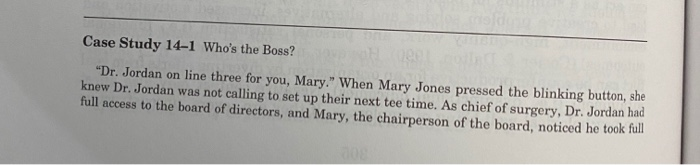
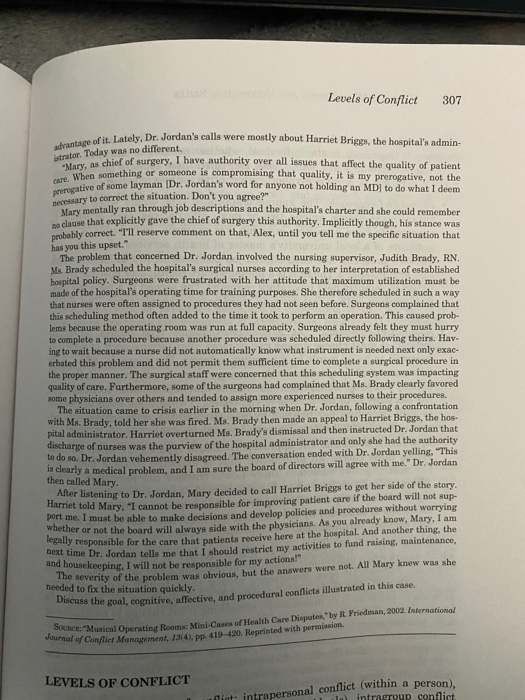
2. The case suggests that on certain important issues, guidance coming from the influence leaders would be viewed as more credible than guidance coming from the CEO. Explain. arte tho..ce of influence loadlare What are nnecihle drawshanke the real Case Study 14-1 Who's the Boss? "Dr. Jordan on line three for you, Mary." When Mary Jones pressed the blinking button, she knew Dr. Jordan was not calling to set up their next tee time. As chief of surgery, Dr. Jordan had full access to the board of directors, and Mary, the chairperson of the board, noticed he took full advantage of it. Lately, Dr. Jordan's calls were mostly about Harriet Briggs, the hospital's admin- prerogative of some layman [Dr. Jordan's word for anyone not holding an MD to do what I deem Journal of Conflict Management, 1314), pp. 419 420 Reprinted with permission. Levels of Conflict 307 istrator. Today was no different. stratory, as chief of surgery, I have authority over all issues that affect the quality of patient necessary to correct the situation. Don't you agree?" Mary mentally ran through job descriptions and the hospital's charter and she could remember no clause that explicitly gave the chief of surgery this authority. Implicitly though, his stance was probably correct. "Til reserve comment on that, Alex, until you tell me the specific situation that has you this upset." The problem that concerned Dr. Jordan involved the nursing supervisor, Judith Brady, RN. Ms. Brady scheduled the hospital's surgical nurses according to her interpretation of established hospital policy. Surgeons were frustrated with her attitude that maximum utilization must be made of the hospital's operating time for training purposes. She therefore scheduled in such a way that nurses were often assigned to procedures they had not seen before. Surgeons complained that this scheduling method often added to the time it took to perform an operation. This caused prob- lems because the operating room was run at full capacity. Surgeons already felt they must hurry to complete a procedure because another procedure was scheduled directly following theirs. Hav. ing to wait because a nurse did not automatically know what instrument is needed next only exac- erbated this problem and did not permit them sufficient time to complete a surgical procedure in the proper manner. The surgical staff were concerned that this scheduling system was impacting quality of care. Furthermore, some of the surgeons had complained that Ms. Brady clearly favored some physicians over others and tended to assign more experienced nurses to their procedures. The situation came to crisis earlier in the morning when Dr. Jordan, following a confrontation with Ms. Brady, told her she was fired. Ms. Brady then made an appeal to Harriet Briggs, the hos- pital administrator. Harriet overturned Ms. Brady's dismissal and then instructed Dr. Jordan that discharge of nurses was the purview of the hospital administrator and only she had the authority to do so. Dr. Jordan vehemently disagreed. The conversation ended with Dr. Jordan yelling. "This is clearly a medical problem, and I am sure the board of directors will agree with me." Dr. Jordan After listening to Dr. Jordan, Mary decided to call Harriet Briggs to get her side of the story. Harriet told Mary. "I cannot be responsible for improving patient care if the board will not sup- port me. I must be able to make decisions and develop policies and procedures without worrying legally responsible for the care that patients receive here at the hospital . And another thing, the next time Dr. Jordan tells me that I should restrict my activities to fund raising, maintenance, and housekeeping. I will not be responsible for my actions!" The severity of the problem was obvious, but the answers were not. All Mary knew was she needed to fix the situation quickly. Discuss the goal, cognitive, affective, and procedural conflicts illustrated in this case, Socnet "Musical Operating Roome Mini-Cases of Health Care Disputes," by R. Friedman, 2002. International then called Mary. LEVELS OF CONFLICT flint intrapersonal conflict (within a person), intragroup conflict









 Study Help