







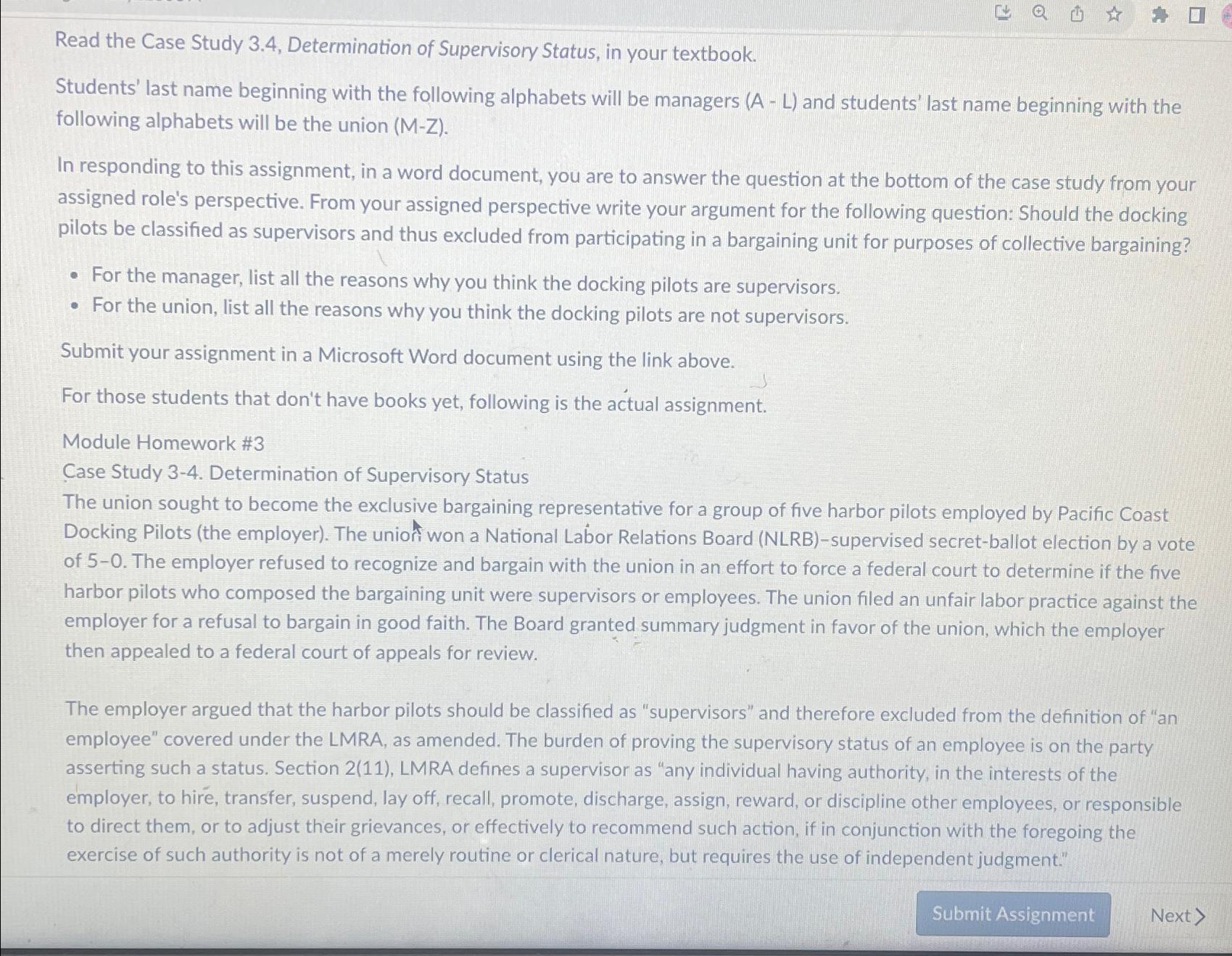
Question: Read the Case Study 3 . 4 , Determination of Supervisory Status, in your textbook. Students' last name beginning with the following alphabets will be
Read the Case Study Determination of Supervisory Status, in your textbook.
Students' last name beginning with the following alphabets will be managers and students' last name beginning with the following alphabets will be the union MZ
In responding to this assignment, in a word document, you are to answer the question at the bottom of the case study from your assigned role's perspective. From your assigned perspective write your argument for the following question: Should the docking pilots be classified as supervisors and thus excluded from participating in a bargaining unit for purposes of collective bargaining?
For the manager, list all the reasons why you think the docking pilots are supervisors.
For the union, list all the reasons why you think the docking pilots are not supervisors.
Submit your assignment in a Microsoft Word document using the link above.
For those students that don't have books yet, following is the actual assignment.
Module Homework #
Case Study Determination of Supervisory Status
The union sought to become the exclusive bargaining representative for a group of five harbor pilots employed by Pacific Coast Docking Pilots the employer The uniof won a National Labor Relations Board NLRBsupervised secretballot election by a vote of The employer refused to recognize and bargain with the union in an effort to force a federal court to determine if the five harbor pilots who composed the bargaining unit were supervisors or employees. The union filed an unfair labor practice against the employer for a refusal to bargain in good faith. The Board granted summary judgment in favor of the union, which the employer then appealed to a federal court of appeals for review.
The employer argued that the harbor pilots should be classified as "supervisors" and therefore excluded from the definition of an employee" covered under the LMRA, as amended. The burden of proving the supervisory status of an employee is on the party asserting such a status. Section LMRA defines a supervisor as "any individual having authority, in the interests of the employer, to hire, transfer, suspend, lay off, recall, promote, discharge, assign, reward, or discipline other employees, or responsible to direct them, or to adjust their grievances, or effectively to recommend such action, if in conjunction with the foregoing the exercise of such authority is not of a merely routine or clerical nature, but requires the use of independent judgment."
Step by Step Solution
There are 3 Steps involved in it
1 Expert Approved Answer
Step: 1 Unlock

Question Has Been Solved by an Expert!
Get step-by-step solutions from verified subject matter experts
Step: 2 Unlock
Step: 3 Unlock
 Study Help