







Question: Read the Case study An Analysis of 3M... in Chapter 17. Answer the following case questions: 1. Describe 3Ms organizational structure. How does it contribute
Read the Case study "An Analysis of 3M..." in Chapter 17. Answer the following case questions:
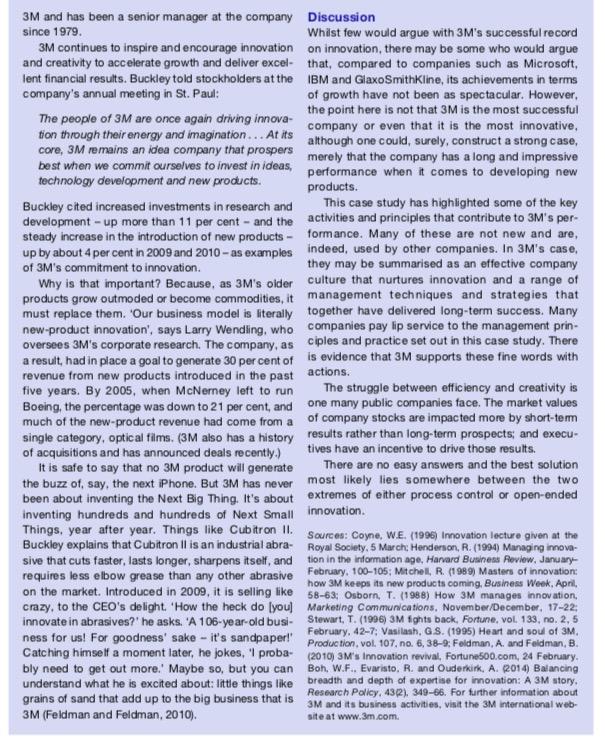
1. Describe 3Ms organizational structure. How does it contribute to their innovativeness.
2. How does 3M manage through failure?
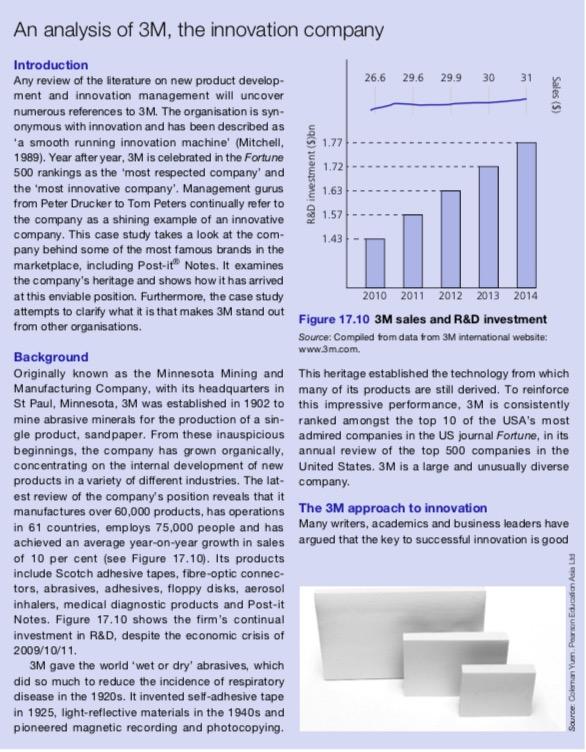
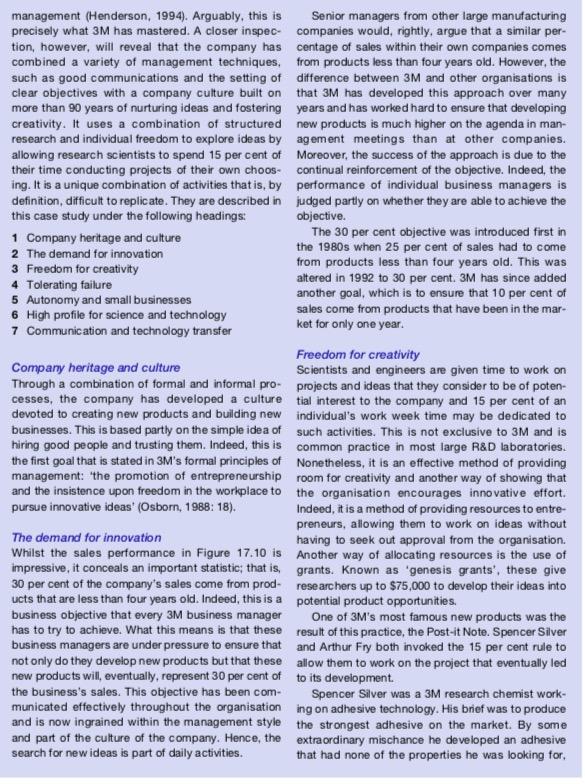
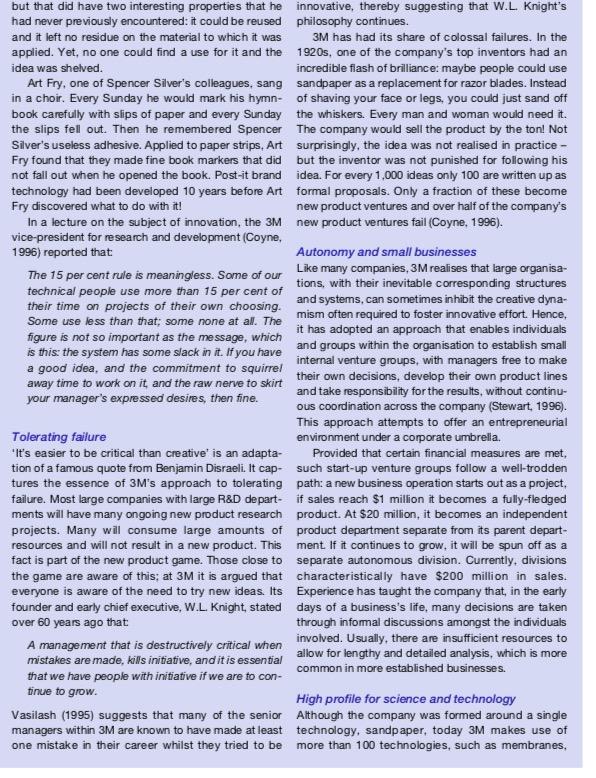
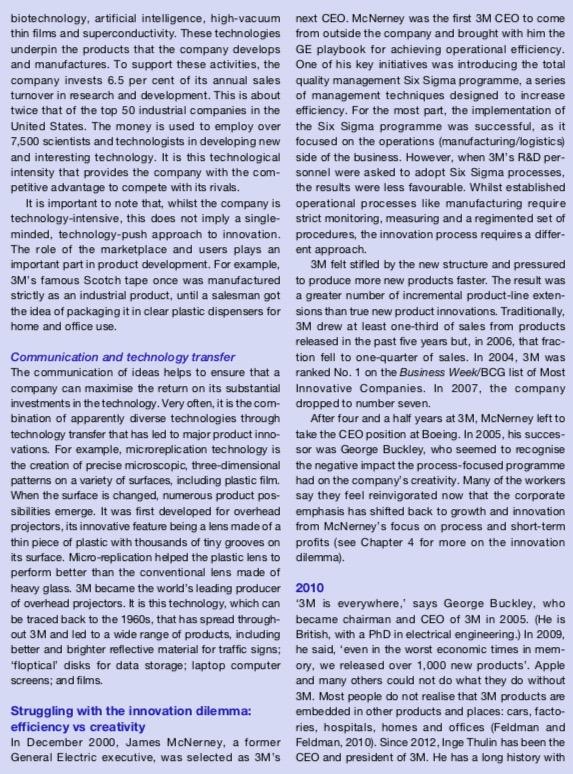
An analysis of 3M, the innovation company 29.9 30 Sales (5) R&D investment (Son 2014 Introduction Any review of the literature on new product develop 26.6 29.6 31 ment and innovation management will uncover numerous references to 3M. The organisation is syn- onymous with innovation and has been described as *a smooth running innovation machine' (Mitchell 1.77 1989). Year after year, 3M is celebrated in the Fortune 500 rankings as the most respected company' and 1.72 the most innovative company'. Management gurus 1.63 from Peter Drucker to Tom Peters continually refer to 1.57 the company as a shining example of an innovative company. This case study takes a look at the com- 1.43 pany behind some of the most famous brands in the marketplace, including Post-it Notes. It examines the company's heritage and shows how it has arrived at this enviable position. Furthermore, the case study 2010 2011 2012 2013 attempts to clarify what it is that makes 3M stand out Figure 17.10 3M sales and R&D investment from other organisations Source: Compiled from data from 3M international websites Background www.3m.com Originally known as the Minnesota Mining and This heritage established the technology from which Manufacturing Company, with its headquarters in many of its products are still derived. To reinforce St Paul, Minnesota, 3M was established in 1902 to this impressive performance, 3M is consistently mine abrasive minerals for the production of a sin- ranked amongst the top 10 of the USA's most gle product, sandpaper. From these inauspicious admired companies in the US journal Fortune, in its beginnings, the company has grown organically, annual review of the top 500 companies in the concentrating on the internal development of new United States, 3M is a large and unusually diverse products in a variety of different industries. The lat- company. est review of the company's position reveals that it manufactures over 60,000 products, has operations The 3M approach to innovation in 61 countries, employs 75,000 people and has many writers, academics and business leaders have achieved an average year-on-year growth in sales argued that the key to successful innovation is good of 10 per cent (see Figure 17.10). Its products include Scotch adhesive tapes, fibre-optic connec- tors, abrasives, adhesives, floppy disks, aerosol inhalers, medical diagnostic products and Post-it Notes. Figure 17.10 shows the firm's continual investment in R&D, despite the economic crisis of 2009/10/11 3M gave the world wet or dry' abrasives, which did so much to reduce the incidence of respiratory disease in the 1920s. It invented self-adhesive tape in 1925, light-reflective materials in the 1940s and pioneered magnetic recording and photocopying. Source: Coleman Yuen Porn Education Ass management (Henderson, 1994). Arguably, this is Senior managers from other large manufacturing precisely what 3M has mastered. A closer inspec- companies would, rightly, argue that a similar per- tion, however, will reveal that the company has centage of sales within their own companies comes combined a variety of management techniques, from products less than four years old. However, the such as good communications and the setting of difference between 3M and other organisations is clear objectives with a company culture built on that 3M has developed this approach over many more than 90 years of nurturing ideas and fostering years and has worked hard to ensure that developing creativity. It uses a combination of structured new products is much higher on the agenda in man- research and individual freedom to explore ideas by agement meetings than at other companies. allowing research scientists to spend 15 per cent of Moreover, the success of the approach is due to the their time conducting projects of their own choos- continual reinforcement of the objective. Indeed, the ing. It is a unique combination of activities that is, by performance of individual business managers is definition, difficult to replicate. They are described in judged partly on whether they are able to achieve the this case study under the following headings: objective. 1 Company heritage and culture The 30 per cent objective was introduced first in the 1980s when 25 per cent of sales had to come 2 The demand for innovation 3 Freedom for creativity from products less than four years old. This was altered in 1992 to 30 per cent. 3M has since added 4 Tolerating failure 5 Autonomy and small businesses another goal, which is to ensure that 10 per cent of 6 High profile for science and technology sales come from products that have been in the mar- 7 Communication and technology transfer ket for only one year Freedom for creativity Company heritage and culture Scientists and engineers are given time to work on Through a combination of formal and informal pro- projects and ideas that they consider to be of poten- cesses, the company has developed a culture tial interest to the company and 15 per cent of an devoted to creating new products and building new individual's work week time may be dedicated to businesses. This is based partly on the simple idea of such activities. This is not exclusive to 3M and is hiring good people and trusting them. Indeed, this is common practice in most large R&D laboratories. the first goal that is stated in 3M's formal principles of Nonetheless, it is an effective method of providing management: the promotion of entrepreneurship room for creativity and another way of showing that and the insistence upon freedom in the workplace to the organisation encourages innovative effort. pursue innovative ideas' (Osborn, 1988: 18). Indeed, it is a method of providing resources to entre- preneurs, allowing them to work on ideas without The demand for innovation having to seek out approval from the organisation. Whilst the sales performance in Figure 17.10 is Another way of allocating resources is the use of impressive, it conceals an important statistic; that is, grants. Known as 'genesis grants', these give 30 per cent of the company's sales come from prod researchers up to $75,000 to develop their ideas into ucts that are less than four years old. Indeed, this is a potential product opportunities. business objective that every 3M business manager One of 3M's most famous new products was the has to try to achieve. What this means is that these result of this practice, the Post-it Note. Spencer Silver business managers are under pressure to ensure that and Arthur Fry both invoked the 15 per cent rule to not only do they develop new products but that these allow them to work on the project that eventually led new products will, eventually, represent 30 per cent of to its development. the business's sales. This objective has been com- Spencer Silver was a 3M research chemist work- a municated effectively throughout the organisation ing on adhesive technology. His brief was to produce and is now ingrained within the management style the strongest adhesive on the market. By some and part of the culture of the company. Hence, the extraordinary mischance he developed an adhesive search for new ideas is part of daily activities. that had none of the properties he was looking for, but that did have two interesting properties that he innovative, thereby suggesting that W.L. Knight's had never previously encountered: it could be reused philosophy continues. and it left no residue on the material to which it was 3M has had its share of colossal failures. In the applied. Yet, no one could find a use for it and the 1920s, one of the company's top inventors had an idea was shelved. incredible flash of brilliance: maybe people could use Art Fry, one of Spencer Silver's colleagues, sang sandpaper as a replacement for razor blades. Instead in a choir. Every Sunday he would mark his hymn- of shaving your face or legs, you could just sand off book carefully with slips of paper and every Sunday the whiskers. Every man and woman would need it. the slips fel out. Then he remembered Spencer The company would sell the product by the ton! Not Silver's useless adhesive. Applied to paper strips, Art surprisingly, the idea was not realised in practice - Fry found that they made fine book markers that did but the inventor was not punished for following his not fall out when he opened the book. Post-it brand idea. For every 1,000 ideas only 100 are written up as technology had been developed 10 years before Art formal proposals. Only a fraction of these become Fry discovered what to do with it! new product ventures and over half of the company's In a lecture on the subject of innovation, the 3M new product ventures fail (Coyne, 1996). vice-president for research and development (Coyne, 1996) reported that Autonomy and small businesses The 15 per cent rule is meaningless. Some of our Like many companies, 3M realises that large organisa- technical people use more than 15 per cent of tions with their inevitable corresponding structures their time on projects of their own choosing and systems, can sometimes inhibit the creative dyna- Some use less than that: some none at all. The mism often required to foster innovative effort. Hence, figure is not so important as the message, which it has adopted an approach that enables individuals is this the system has some slack in it. If you have and groups within the organisation to establish small a good idea, and the commitment to squirrel internal venture groups, with managers free to make away time to work on it and the raw nerve to skirt their own decisions, develop their own product lines your manager's expressed desires, then fine. and take responsibility for the results, without continu- ous coordination across the company (Stewart, 1996). This approach attempts to offer an entrepreneurial Tolerating failure environment under a corporate umbrella. It's easier to be critical than creative' is an adapta- Provided that certain financial measures are met, tion of a famous quote from Benjamin Disraeli. It cap- such start-up venture groups follow a well-trodden tures the essence of 3M's approach to tolerating path: a new business operation starts out as a project, failure. Most large companies with large R&D depart. if sales reach $1 million it becomes a fully-fledged ments will have many ongoing new product research product. At $20 million, it becomes an independent projects. Many will consume large amounts of product department separate from its parent depart- resources and will not result in a new product. This ment If it continues to grow, it will be spun off as a fact is part of the new product game. Those close to separate autonomous division. Currently. divisions the game are aware of this: at 3M it is argued that characteristically have $200 million in sales. everyone is aware of the need to try new ideas. Its Experience has taught the company that, in the early founder and early chief executive, W.L Knight, stated days of a business's life, many decisions are taken over 60 years ago that through infomal discussions amongst the individuals A management that is destructively crtical when involved. Usually, there are insufficient resources to mistakes are made, kilis initiative, and it is essential allow for lengthy and detailed analysis, which is more that we have people with initiative if we are to con- common in more established businesses. tinue to grow. High profile for science and technology Vasilash (1995) suggests that many of the senior Although the company was formed around a single managers within 3M are known to have made at least technology, sandpaper, today 3M makes use of one mistake in their career whilst they tried to be more than 100 technologies, such as membranes, biotechnology, artificial intelligence, high-vacuum next CEO. Mc Nerney was the first 3M CEO to come thin films and superconductivity. These technologies from outside the company and brought with him the underpin the products that the company develops GE playbook for achieving operational efficiency. and manufactures. To support these activities, the One of his key initiatives was introducing the total company invests 6.5 per cent of its annual sales quality management Six Sigma programme, a series turnover in research and development. This is about of management techniques designed to increase twice that of the top 50 industrial companies in the efficiency. For the most part, the implementation of United States. The money is used to employ over the Six Sigma programme was successful, as it 7.500 scientists and technologists in developing new focused on the operations (manufacturing/logistics and interesting technology. It is this technological side of the business. However, when 3M's R&D per- intensity that provides the company with the com- Sonnel were asked to adopt Six Sigma processes, petitive advantage to compete with its rivals. the results were less favourable. Whilst established It is important to note that, whilst the company is operational processes like manufacturing require technology-intensive, this does not imply a single strict monitoring, measuring and a regimented set of minded, technology-push approach to innovation procedures, the innovation process requires a differ- The role of the marketplace and users plays an ent approach. important part in product development. For example, 3M felt stifled by the new structure and pressured 3M's famous Scotch tape once was manufactured to produce more new products faster. The result was strictly as an industrial product, until a salesman got a greater number of incremental product-line exten- the idea of packaging it in clear plastic dispensers for sions than true new product innovations. Traditionally, home and office use. 3M drew at least one-third of sales from products released in the past five years but, in 2006, that frac- Communication and technology transfer tion fell to one-quarter of sales. In 2004, 3M was The communication of ideas helps to ensure that a ranked No. 1 on the Business Week/BCG list of Most company can maximise the return on its substantial Innovative Companies. In 2007, the company investments in the technology. Very often, it is the com- dropped to number seven. bination of apparently diverse technologies through After four and a half years at 3M, McNerney left to technology transfer that has led to major product inno- take the CEO position at Boeing. In 2005, his succes- vations. For example, microreplication technology is sor was George Buckley, who seemed to recognise the creation of precise microscopic, three-dimensional the negative impact the process focused programme patterns on a variety of surfaces, including plastic film had on the company's creativity. Many of the workers When the surface is changed, numerous product pos- say they feel reinvigorated now that the corporate sibilities emerge. It was first developed for overhead emphasis has shifted back to growth and innovation projectors, its innovative feature being a lens made of a from McNerney's focus on process and short-term thin piece of plastic with thousands of tiny grooves on profits (see Chapter 4 for more on the innovation its surface. Micro-replication helped the plastic lens to dilemma). perform better than the conventional lens made of heavy glass. 3M became the world's leading producer 2010 of overhead projectors. It is this technology, which can *3M is everywhere,' says George Buckley, who be traced back to the 1960s, that has spread through became chairman and CEO of 3M in 2005. (He is out 3M and led to a wide range of products, including British, with a PhD in electrical engineering.) In 2009, better and brighter reflective material for traffic signs; he said, 'even in the worst economic times in mem- "floptical disks for data storage; laptop computer ory, we released over 1,000 new products". Apple screens; and films. and many others could not do what they do without 3M. Most people do not realise that 3M products are Struggling with the innovation dilemma: embedded in other products and places: cars, facto- efficiency vs creativity ries, hospitals, homes and offices (Feldman and In December 2000, James McNerney, a former Feldman, 2010). Since 2012, Inge Thulin has been the General Electric executive, was selected as 3M's CEO and president of 3M. He has a long history with 3M and has been a senior manager at the company Discussion since 1979. Whist few would argue with 3M's successful record 3M continues to inspire and encourage Innovation on innovation, there may be some who would argue and creativity to accelerate growth and deliver excel- that, compared to companies such as Microsoft, lent financial results. Buckley told stockholders at the IBM and GlaxoSmithKline, its achievements in terms company's annual meeting in St. Paul: of growth have not been as spectacular. However, The people of 3M are once again driving innova company or even that it is the most innovative, the point here is not that 3M is the most successful tion through their energy and imagination... At its although one could surely, construct a strong case, core, 3M remains an idea company that prospers merely that the company has a long and impressive best when we commit ourselves to invest in ideas, technology development and new products. performance when it comes to developing new products. Buckley cited increased investments in research and This case study has highlighted some of the key development - up more than 11 per cent - and the activities and principles that contribute to 3M's per- steady increase in the introduction of new products - formance. Many of these are not new and are, up by about 4 per cent in 2009 and 2010 - as examples indeed, used by other companies. In 3M's case, of 3M's commitment to innovation. they may be summarised as an effective company Why is that important? Because, as 3M's older culture that nurtures innovation and a range of products grow outmoded or become commodities, it management techniques and strategies that must replace them. 'Our business model is literally together have delivered long-term success. Many new-product innovation', says Larry Wending, who companies pay lip service to the management prin oversees 3M's corporate research. The company, as ciples and practice set out in this case study. There a result, had in place a goal to generate 30 per cent of is evidence that 3M supports these fine words with revenue from new products introduced in the past actions. five years. By 2005, when McNerney left to run The struggle between efficiency and creativity is Boeing, the percentage was down to 21 per cent, and one many public companies face. The market values much of the new-product revenue had come from a of company stocks are impacted more by short-term single category, optical films (3M also has a history results rather than long-term prospects and execu- of acquisitions and has announced deals recently.) tives have an incentive to drive those results. it is safe to say that no 3M product will generate There are no easy answers and the best solution the buzz of, say, the next iPhone. But 3M has never most likely lies somewhere between the two been about inventing the Next Big Thing. It's about extremes of either process control or open-ended inventing hundreds and hundreds of Next Small innovation. Things, year after year. Things like Cubitron II. Sources: Coyne, W.E. (1996) Innovation lecture given at the Buckley explains that Cubitron II is an industrial abra- Royal Society, 5 March: Henderson, R. (1994) Managing innova sive that cuts faster, lasts longer, sharpens itself, and tion in the information age, Harvard Business Review, January requires less elbow grease than any other abrasive how 3M keapa ta new products coming, Business Week, April , February, 100-105: Mitchell, R. (1989) Masters of innovation: on the market. Introduced in 2009, it is selling like 58-63: Osborn, T. (1988) How 3M manages innovation crazy, to the CEO's delight. "How the heck do (you) Marketing Communications. November/December, 17-22 innovate in abrasives?' he asks. 'A 106-year-old busi- Stewart, T. (1996) 3M fight back. Fortune, vol. 133, no. 2,5 ness for us! For goodness' sake - it's sandpaper!' February 42-7. Vasilush, G.S. (1995) Heart and soul of 3M Production, vol. 107, no. 6, 38-9; Foldman, A. and Feldman, B. Catching himself a moment later, he jokes, ' proba- (2010) 3M's Innovation revival, Fortune 500.com, 24 February bly need to get out more.' Maybe so, but you can Boh, W.F.. Evaristo, R. and Ouderkirk, A. (2014) Balancing understand what he is excited about: little things like breadth and depth of expertise for innovation: A 3M story. grains of sand that add up to the big business that is Research Policy, 43(2), 349-66. For further information about 3M and its business activities, visit the 3M International web- 3M (Feldman and Feldman, 2010). site at www.3m.comStep by Step Solution
There are 3 Steps involved in it
1 Expert Approved Answer
Step: 1 Unlock

Question Has Been Solved by an Expert!
Get step-by-step solutions from verified subject matter experts
Step: 2 Unlock
Step: 3 Unlock
 Study Help