







Question: Read the case study and analysis the following; 1. Problem Identification Identify the major problems found in the case. Ensure that you distinguish between causes
Read the case study and analysis the following;
1. Problem Identification
Identify the major problems found in the case. Ensure that you distinguish between causes and symptoms. Causes may include changing customer preferences, increased competition, etc. Symptoms include declining revenues, loss of brand equity, increased customer churn, etc.
Please support your problem identification by relevant case facts along with the associated theory and concepts.
2. Quantitative Reasoning and Analysis
Conduct research to identify data (e.g., obtain data in the form of trends, statistics, ratings, etc. from the library and other sources) that can be utilized to provide additional insight into the case.
Draw appropriate conclusions based on the quantitative analysis of data, while recognizing the limits of this analysis.
3. Discussion and Recommendation
Identify and recommend a solution to the major problem in the case (there is likely to be more than one solution).
Briefly outline your solution and evaluate it in terms of its pros and cons.
Always ensure that your recommendations are supported by statistical evidence and provide spreadsheets as necessary.
4. Appendix and References
Please include any tables or figures that are not included but are referenced in your report.
Make sure all references are cited correctly.
Please ensure that your assignments are typed, proofread, and concise. Points will be deducted if
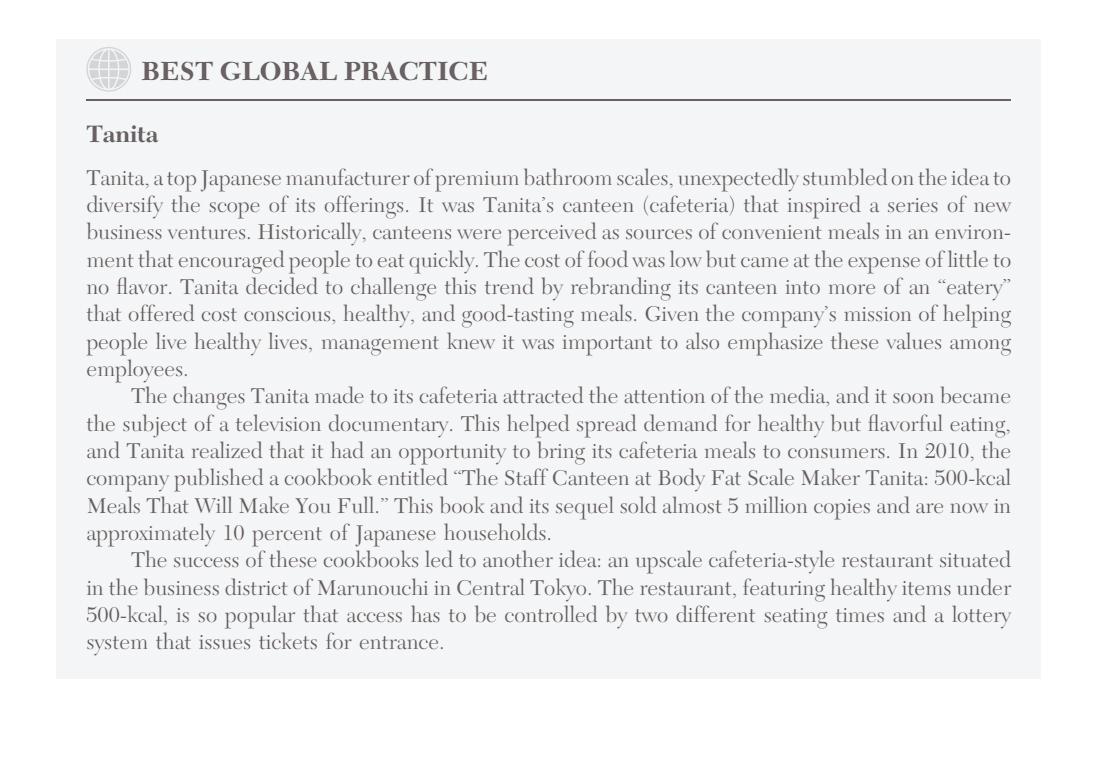
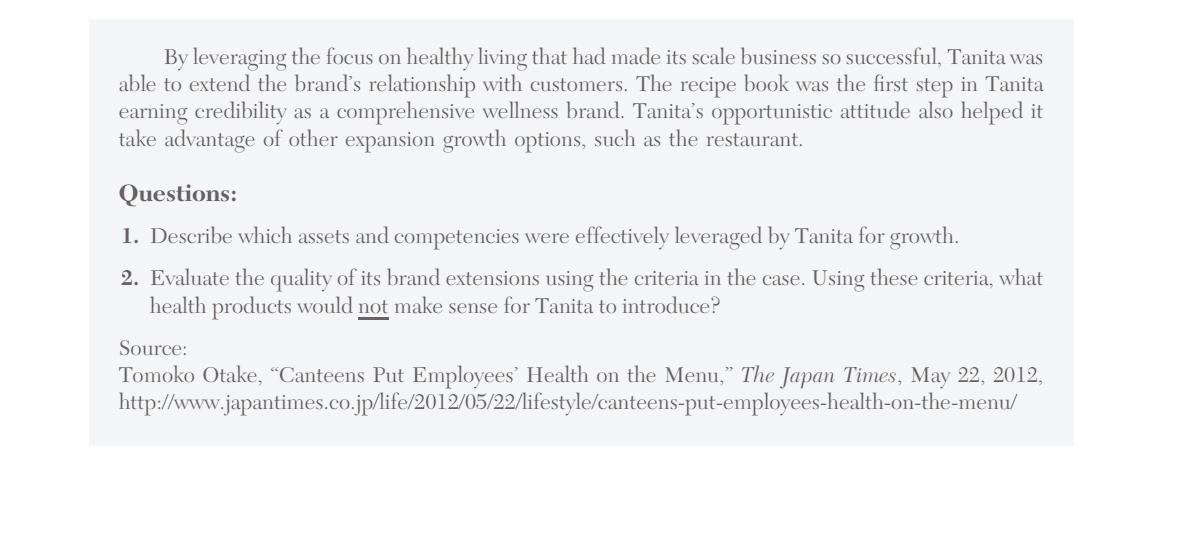
Tanita, a top Japanese manufacturer of premium bathroom scales, unexpectedly stumbled on the idea to diversify the scope of its offerings. It was Tanita's canteen (cafeteria) that inspired a series of new business ventures. Historically, canteens were perceived as sources of convenient meals in an environment that encouraged people to eat quickly. The cost of food was low but came at the expense of little to no flavor. Tanita decided to challenge this trend by rebranding its canteen into more of an "eatery" that offered cost conscious, healthy, and good-tasting meals. Given the company's mission of helping people live healthy lives, management knew it was important to also emphasize these values among employees. The changes Tanita made to its cafeteria attracted the attention of the media, and it soon became the subject of a television documentary. This helped spread demand for healthy but flavorful eating, and Tanita realized that it had an opportunity to bring its cafeteria meals to consumers. In 2010, the company published a cookbook entitled "The Staff Canteen at Body Fat Scale Maker Tanita: 500-kcal Meals That Will Make You Full." This book and its sequel sold almost 5 million copies and are now in approximately 10 percent of Japanese households. The success of these cookbooks led to another idea: an upscale cafeteria-style restaurant situated in the business district of Marunouchi in Central Tokyo. The restaurant, featuring healthy items under 500 -kcal, is so popular that access has to be controlled by two different seating times and a lottery system that issues tickets for entrance. By leveraging the focus on healthy living that had made its scale business so successful, Tanita was able to extend the brand's relationship with customers. The recipe book was the first step in Tanita earning credibility as a comprehensive wellness brand. Tanita's opportunistic attitude also helped it take advantage of other expansion growth options, such as the restaurant. Questions: 1. Describe which assets and competencies were effectively leveraged by Tanita for growth. 2. Evaluate the quality of its brand extensions using the criteria in the case. Using these criteria, what health products would not make sense for Tanita to introduce? Source: Tomoko Otake, "Canteens Put Employees' Health on the Menu," The Japan Times, May 22, 2012, http://www.japantimes.co.jp/life/2012/05/22/lifestyle/canteens-put-employees-health-on-the-menu/
Step by Step Solution
There are 3 Steps involved in it

Get step-by-step solutions from verified subject matter experts
 Study Help