







Question: Read the case study and answer the questions below How to achieve your Digital Transformation in MENA through Culture A few core habits are needed
Read the case study and answer the questions below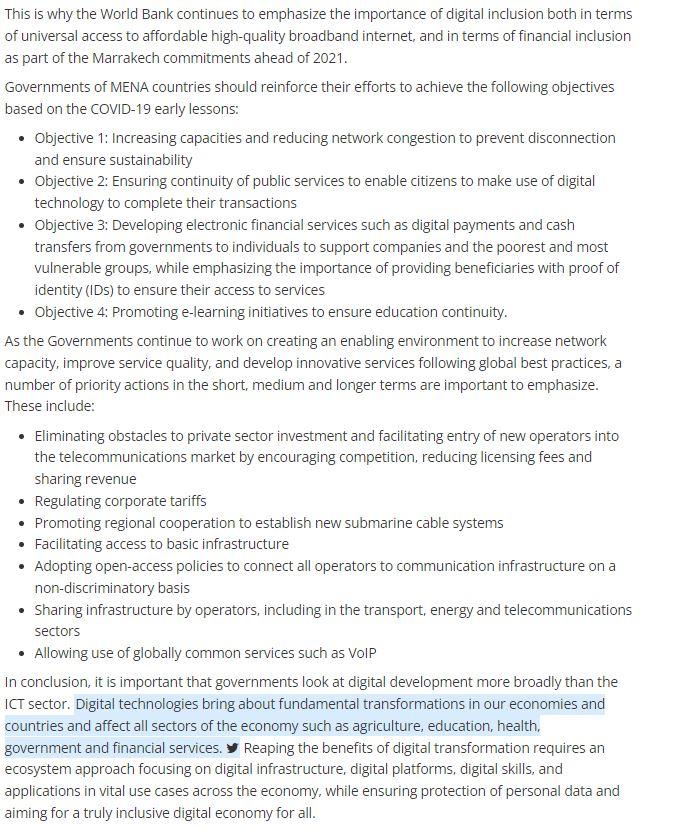
 How to achieve your Digital Transformation in MENA through Culture
A few core habits are needed to build leaders and team members who think strategically:
- Observe to learn. Monitor the broader market, not just your sector but beyond, to see and learn from the changes taking place
- Encourage watchfulness across the organisation. Help staff particularly those on the front lines to be attuned to and flag changes they are seeing. In the market to help the entire company stay one step ahead of trends
- Train for disruption. Expose your leaders to disruption through visiting startups, learning from others and by digital immersion
- Reframe your mission and redefine your purpose : if you havent already so now is the time to do so. What is your true vakue to your consumer ? How will this help you lead in the current age ?
1. From the case study explain the disruption technologies that are Driving Change in the Digital Economy and Digital Platforms across MENA region. 2. What is the role of data, broadband and digital platforms in the digital economy in the Arab Region? 3. Analyze the main challenges for a digital economy in the Arab region? 4. Analyze the benefits of adopting new business models to digital economy.
5. From your point of view and depending on the given articles, what is the impact of COVID-19 Pandemic on the digital transformation process? support your answer with evidences ( statistics, examples, ...etc.)
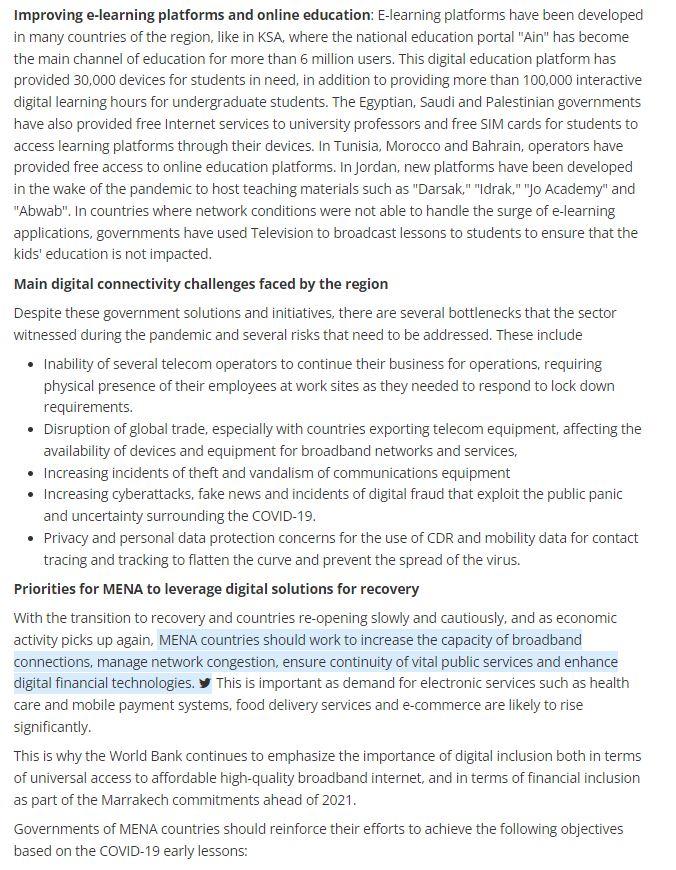
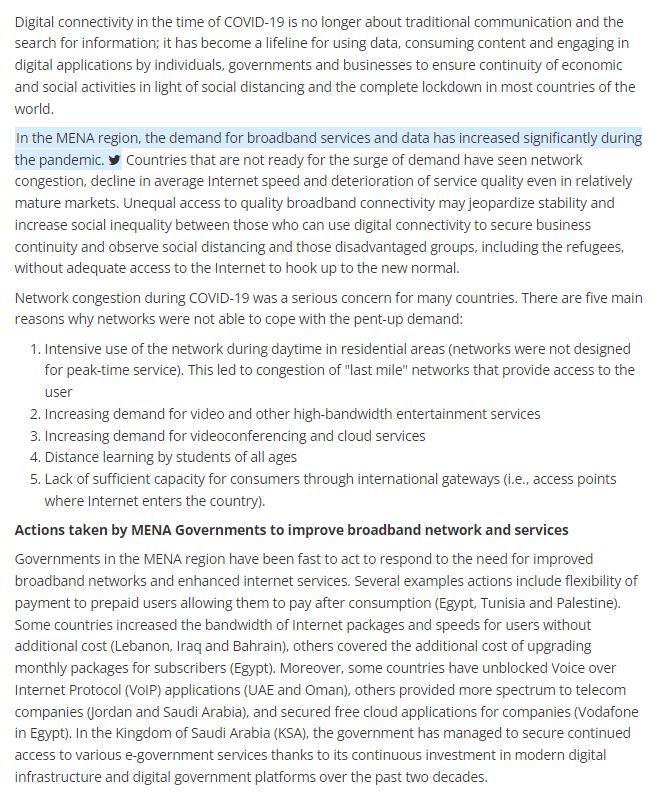
This is why the World Bank continues to emphasize the importance of digital inclusion both in terms of universal access to affordable high-quality broadband internet, and in terms of financial inclusion as part of the Marrakech commitments ahead of 2021. Governments of MENA countries should reinforce their efforts to achieve the following objectives based on the COVID-19 early lessons: Objective 1: Increasing capacities and reducing network congestion to prevent disconnection and ensure sustainability Objective 2: Ensuring continuity of public services to enable citizens to make use of digital technology to complete their transactions Objective 3: Developing electronic financial services such as digital payments and cash transfers from governments to individuals to support companies and the poorest and most vulnerable groups, while emphasizing the importance of providing beneficiaries with proof of identity (IDs) to ensure their access to services Objective 4: Promoting e-learning initiatives to ensure education continuity. As the Governments continue to work on creating an enabling environment to increase network capacity, improve service quality, and develop innovative services following global best practices, a number of priority actions in the short, medium and longer terms are important to emphasize. These include: Eliminating obstacles to private sector investment and facilitating entry of new operators into the telecommunications market by encouraging competition, reducing licensing fees and sharing revenue Regulating corporate tariffs Promoting regional cooperation to establish new submarine cable systems Facilitating access to basic infrastructure Adopting open-access policies to connect all operators to communication infrastructure on a non-discriminatory basis Sharing infrastructure by operators, including in the transport, energy and telecommunications sectors Allowing use of globally common services such as VOIP In conclusion, it is important that governments look at digital development more broadly than the ICT sector. Digital technologies bring about fundamental transformations in our economies and countries and affect all sectors of the economy such as agriculture, education, health, government and financial services. Reaping the benefits of digital transformation requires an ecosystem approach focusing on digital infrastructure, digital platforms, digital skills, and applications in vital use cases across the economy, while ensuring protection of personal data and aiming for a truly inclusive digital economy for all. Improving e-learning platforms and online education: E-learning platforms have been developed in many countries of the region, like in KSA, where the national education portal "Ain" has become the main channel of education for more than 6 million users. This digital education platform has provided 30,000 devices for students in need, in addition to providing more than 100,000 interactive digital learning hours for undergraduate students. The Egyptian, Saudi and Palestinian governments have also provided free Internet services to university professors and free SIM cards for students to access learning platforms through their devices. In Tunisia, Morocco and Bahrain, operators have provided free access to online education platforms. In Jordan, new platforms have been developed in the wake of the pandemic to host teaching materials such as "Darsak," "drak." "Jo Academy" and "Abwab". In countries where network conditions were not able to handle the surge of e-learning applications, governments have used Television to broadcast lessons to students to ensure that the kids' education is not impacted. Main digital connectivity challenges faced by the region Despite these government solutions and initiatives, there are several bottlenecks that the sector witnessed during the pandemic and several risks that need to be addressed. These include Inability of several telecom operators to continue their business for operations, requiring physical presence of their employees at work sites as they needed to respond to lock down requirements. Disruption of global trade, especially with countries exporting telecom equipment, affecting the availability of devices and equipment for broadband networks and services, Increasing incidents of theft and vandalism of communications equipment Increasing cyberattacks, fake news and incidents of digital fraud that exploit the public panic and uncertainty surrounding the COVID-19. Privacy and personal data protection concerns for the use of CDR and mobility data for contact tracing and tracking to flatten the curve and prevent the spread of the virus. Priorities for MENA to leverage digital solutions for recovery With the transition to recovery and countries re-opening slowly and cautiously, and as economic activity picks up again, MENA countries should work to increase the capacity of broadband connections, manage network congestion, ensure continuity of vital public services and enhance digital financial technologies. This is important as demand for electronic services such as health care and mobile payment systems, food delivery services and e-commerce are likely to rise significantly. This is why the World Bank continues to emphasize the importance of digital inclusion both in terms of universal access to affordable high-quality broadband internet, and in terms of financial inclusion as part of the Marrakech commitments ahead of 2021. Governments of MENA countries should reinforce their efforts to achieve the following objectives based on the COVID-19 early lessons: Digital connectivity in the time of COVID-19 is no longer about traditional communication and the search for information; it has become a lifeline for using data, consuming content and engaging in digital applications by individuals, governments and businesses to ensure continuity of economic and social activities in light of social distancing and the complete lockdown in most countries of the world. In the MENA region, the demand for broadband services and data has increased significantly during the pandemic. y Countries that are not ready for the surge of demand have seen network congestion, decline in average Internet speed and deterioration of service quality even in relatively mature markets. Unequal access to quality broadband connectivity may jeopardize stability and increase social inequality between those who can use digital connectivity to secure business continuity and observe social distancing and those disadvantaged groups, including the refugees, without adequate access to the Internet to hook up to the new normal. Network congestion during COVID-19 was a serious concern for many countries. There are five main reasons why networks were not able to cope with the pent-up demand: 1. Intensive use of the network during daytime in residential areas (networks were not designed for peak-time service). This led to congestion of "last mile" networks that provide access to the user 2. Increasing demand for video and other high-bandwidth entertainment services 3. Increasing demand for videoconferencing and cloud services 4. Distance learning by students of all ages 5. Lack of sufficient capacity for consumers through international gateways (i.e., access points where Internet enters the country). Actions taken by MENA Governments to improve broadband network and services Governments in the MENA region have been fast to act to respond to the need for improved broadband networks and enhanced internet services. Several examples actions include flexibility of payment to prepaid users allowing them to pay after consumption (Egypt, Tunisia and Palestine). Some countries increased the bandwidth of Internet packages and speeds for users without additional cost (Lebanon, Iraq and Bahrain), others covered the additional cost of upgrading monthly packages for subscribers (Egypt). Moreover, some countries have unblocked Voice over Internet Protocol (VOIP) applications (UAE and Oman), others provided more spectrum to telecom companies (Jordan and Saudi Arabia), and secured free cloud applications for companies (Vodafone in Egypt). In the Kingdom of Saudi Arabia (KSA), the government has managed to secure continued access to various e-government services thanks to its continuous investment in modern digital infrastructure and digital government platforms over the past two decadesStep by Step Solution
There are 3 Steps involved in it

Get step-by-step solutions from verified subject matter experts
 Study Help