







Question: Read the case study and answer the questions that follow. As humans, we weigh and analyze conflicting inputs and make thousands of decisions that affect
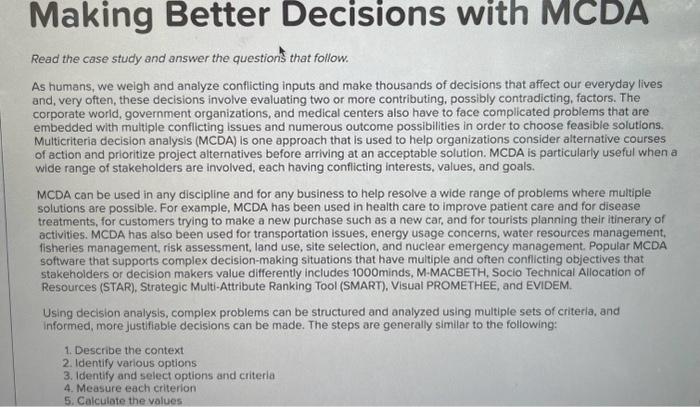
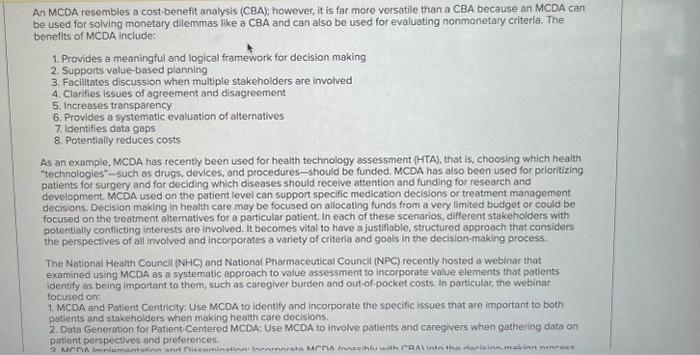
Read the case study and answer the questions that follow. As humans, we weigh and analyze conflicting inputs and make thousands of decisions that affect our everyday lives and, very often, these decisions involve evaluating two or more contributing, possibly contradicting, factors. The corporate world, government organizations, and medical centers also have to face complicated problems that are embedded with multiple conflicting issues and numerous outcome possibilities in order to choose feasible solutions. Multicriteria decision analysis (MCDA) is one approach that is used to help organizations consider alternative courses of action and prioritize project alternatives before arriving at an acceptable solution. MCDA is particularly useful when a wide range of stakeholders are involved, each having conflicting interests, values, and goals. MCDA can be used in any discipline and for any business to help resolve a wide range of problems where multiple solutions are possible. For example, MCDA has been used in health care to improve patient care and for disease treatments, for customers trying to make a new purchase such as a new car, and for tourists planning their itinerary of activities. MCDA has also been used for transportation issues, energy usage concerns, water resources management, fisheries management, risk assessment, land use, site selection, and nuclear emergency management. Popular MCDA software that supports complex decision-making situations that have multiple and often conflicting objectives that stakehoiders or decision makers value differently includes 1000minds, M-MACBETH, Socio Technical Allocation of Resources (STAR), Strategic Multi-Attribute Ranking Tool (SMART), Visual PROMETHEE, and EVIDEM. Using decision analysis, complex problems can be structured and analyzed using multiple sets of criteria, and informed, more Justifiable decisions can be made. The steps are generally similar to the following: 1. Describe the context 2. Identify various options 3. Identify and select options and criteria 4. Measure each criterion 5. Calculate the values An MCDA resembles a cost-benefit analysis (CBA); however, it is far more versatile than a CBA because an MCDA can be used for solving monetary dilemmas like a CBA and can also be used for evaluating nonmonetary criteria. The benefits of MCDA include: 1. Provides a meaningful and logical framework for decision making 2. Supports value-based planning 3. Facilitates discussion when multiple stakeholders are involved 4. Clarifies issues of agreement and disagreement 5. Increases transparency 6. Provides a systematic evaluation of alternatives 7. Identifies data gaps 8. Potentially reduces costs As an example, MCDA has recently been used for health technology assessment (HTA), that is, choosing which health "technologies" -such as drugs, devices, and procedures-should be funded. MCDA has also been used for prioritizing patients for surgery and for deciding which diseases should recelve attention and funding for research and development. MCDA used on the patient level can support specific medication decisions or treatment management decisions. Decision making in health care may be focused on allocoting funds from a very limited budget or could be focused on the treatment altematives for a particular patient in each of these scenarios, different stakeholders with potentially conflicting interests are involved. It becomes vital to have a justifable, structured approach that considers the perspectives of all involved and incorporates a variety of criteria and goals in the decision-making process. What are some examples where MCDA can be used to evaluate nonmonetary criteria
Step by Step Solution
There are 3 Steps involved in it

Get step-by-step solutions from verified subject matter experts
 Study Help