







Question: Read the case study and fill out the SWOT Analysis. ***NO OUTSIDE RESEARCH*** Best Buy Co., Inc. June 11, 2019. Best Buy (BBY) appoints Core
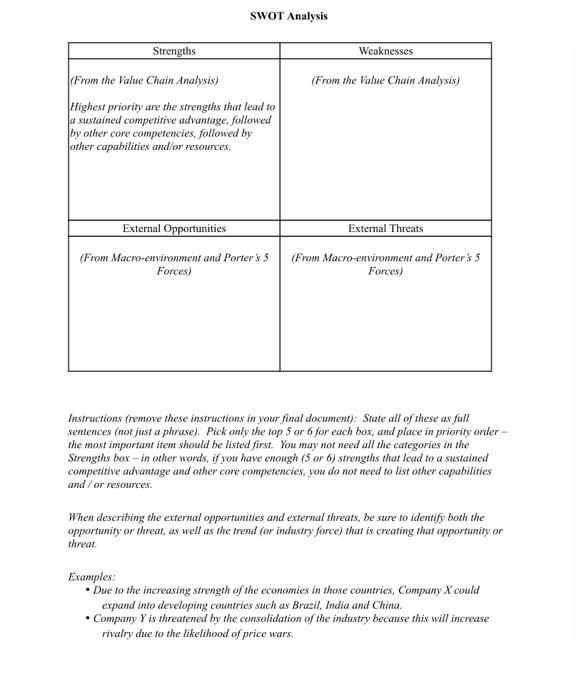
Read the case study and fill out the SWOT Analysis.
***NO OUTSIDE RESEARCH***
Best Buy Co., Inc.
June 11, 2019. Best Buy (BBY) appoints Core Barry as CEO from her prior CFO position to replace Hubert Joly, who served as CEO since 2012 and remains as chairman of the board. Since 2014, Best Buy's stock performance has exceeded the S&P 500, but it has lagged behind Amazon- firm that has redefined retail. Exhibit 1 depicts a stock price comparison of retailers from 2014 to July 2019.
Best Buy's performance reflects a stark contrast from many retailers that have declared or are facing bankruptcy, such as RadioShack, Sears, and Toys-R-Us. The strategy developed by Hubert Joly was to engage customers in "high touch" products that allow customers to interact with competitively priced products, including private label brands. Further, Best Buy offers complements, such as recycling and in home installation, to further engage with customers. The result was a clear value proposition reflected in the slogan "Expert Service. Unbeatable Prices." The strategic initiative's past success is reflected in Best Buy's performance, and Hubert Joly's selection as the "retailer of the year" by Forbes for 2016. Still, Core Barry faces multiple challenges, including being the young. est CEO of a S&P 500 company and one of the few women to run a Fortune 100 company. In addition, Best Buy continues to face considerable head winds.
Competition in the consumer-electronics industry remains cutthroat. While Best Buy is no longer considered doomed to follow other national consumer electronics retail superstores into extinction, several concerns suggest it will be harder for Best Buy to meet expectations for continued performance. First. Best Buy may simply have received a temporary boost due to struggles by other traditional retailers. Second, Best Buy depends on consumer
electronics, a product category increasingly caught up in U.S.-China trade tensions that do not appear to have an easier or quick resolution.. Third, five suppliers (Apple, Samsung, Hewlett-Packard, Sony and LG) supply Best Buy with over half its inventory. Best Buy actively partners with its suppliers. For example, Best Buy pioneered the "store within a store" concept with Samsung in 2013 to highlight Samsung products within Best Buy locations. The expansion of this program to other firms (e.g., Microsoft and Apple) adds another source of revenue for its stores, but it also increases Best Buy's dependence on suppliers. Fourth, retail continues to change as people adapt to technology and relationships between retailers, customers, and manufacturers adapt. Best Buy's "high touch" approach to retail rests on attracting and retaining qualified employees, and this may hurt profitability if automation by competitors is successful. " In support of seeing continued challenges for Best Buy, roughly 70 percent of inside stock trades by executives at Best Buy were sales of shares (rather than buying of shares).
At the same time, Amazon remains a formidable competitor in the electronics retail industry. For example, Amazon has begun offering in-home consultation with its digital assistant Alexa hosted on its Echo speakers. By comparison, Best Buy does not offer a digital assistant that may substitute for its trained sales staff. Amazon is also creating increased physical presence through the expansion of warehouses, its purchase of Whole Foods, and partnering with Kohls and Rite Aid for returns. While the purchase of Whole Foods by Amazon drove grocery chain companies stock lower, it also gives Amazon a physical presence where customers will be able to pick up purchases. As a result, Best Buy and CEO Barry cannot simply rest on its past success as the competition continues to evolve. Opening a can of Diet Coke and booting up her laptop. Barry is thinking about the next earnings call with investors ...
A Brief History of Best Buy
Together with his business partner, James Wheeler, Richard Schulze founded Sound of Music, an audio specialty store, in Minnesota in 1966. The fledgling company ended its first fiscal year with gross sales of $173,000 and continued to grow rapidly over the next few years. By the time of its initial public offering in 1969, the hometown enterprise had acquired two of its local competitors" and it opened two new outlets near the University of
Minnesota in downtown Minneapolis
Schulze bought out Wheeler in 1971. shortly after Sound of Music hit the $1 million mark in annual revenues. In 1979, Sound of Music became the first supplier of video and laserdisc equipment from companies such as Panasonic, Magnavox, Sony, and Sharp. After a tornado hit the Roseville, Minnesota, store in June 1981, the
company responded with a "Tornado Sale" that became an annual event, storm or no storm. This strategy boosted Sound of Music's average sales per square foot to $350, compared with an industry average of $150 to $200.
ARRIVAL OF THE SUPERSTORE
With ambitions to capture an even larger market share, Sound of Music changed its name, in 1983, to Best Buy Co., Inc. Soon, it adopted its now-familiar superstore format, with an increasingly diversified product range. Best Buy proceeded to grow from 8 to 24 stores and saw its revenues increase from $29 million in 1984 to $290 million in 1987. On July 20, 1987, Best Buy made its debut on the New York Stock Exchange (NYSE: BBY) with an initial offering of 8.3 million shares of common stock.
Best Buy changed its logo to the yellow tag in 1987, and in 1989 its stores adopted a new "grab-and-go" store format, called Concept I. Schulze's revolutionary new approach to big-box retailing combined Walmart's prices with Circuit City's assortment, in a shopping warehouse with a 35,000-square-foot footprint." The new stores consisted of well-stocked showrooms with self-help information so that people could make their product selections
independently and check out in a single stop. Answer centers were still available for people who desired assistance but salespeople no longer needed to attend to each individual customer or fetch merchandise from storage. This change reduced Best Buy's employment costs by one-third, which compensated for the corresponding deemphasis on service contracts. However, Best Buy's store format has continued to evolve, and it currently operates Concept IV stores that provide an open floor format and cash registers throughout the store, as well as dedicated spaces to vendors.
GROWTH THROUGH ACQUISITIONS
The year 2000 marked the launch of a new phase of inorganic growth through acquisitions. Best Buy grew its revenues from $12.5 billion in 2000 to nearly $51 billion in 2012. The company first purchased Magnolia, a high-end consumer-electronics chain with 13 locations throughout Washington, California, and Oregon, for $88 million in 2000. The next year, Best Buy purchased Musicland for $425.1 million. The acquisition of the mall-based music and entertainment retailer gave Best Buy access to an additional 1,300 stores across the United States and Puerto Rico, including 650 Sam Goody and 400 Suncoast Motion Picture outlets. In 2002, the company acquired Geek Squad, a 24-hour computer-support task force. By 2004, Geek Squad precincts were in all of its stores.
In contrast to the rapid expansion of Geek Squad, Best Buy divested Musicland, in 2003, due to declining sales, and increased competition from Walmart and Target in the CD segment, as well as iTunes in digital music. Sun Capital Partners Inc., a private equity firm, purchased the failing firm for only the assumption of Musicland's debt and lease obligations. Brad Anderson, who succeeded Schulze as CEO in 2002. described the Musicland venture as "a very expensive but powerful learning experience for Best Buy."
After a two-year hiatus from acquisitions, Best Buy purchased AudioVisions and Pacific Sales in 2005. In 2007, Seattle-based Speakeasy Inc. was bought, and following that purchase, Best Buy acquired Napster and Dealtree in 2008. The acquisition of Mindshaft followed in 2011 (which was then divested in 2014). But since becoming CEO, Joly has not made a purchase, but Best Buy has divested operations outside North America.
INTERNATIONAL EXPANSION THEN RETRENCHMENT
Best Buy expanded internationally before refocusing on the North American market, and in 2016 only 8.4 per. cent of its sales were international. Its first cross-border expansion was the 2001 acquisition of Futureshop Ltd. a Canadian electronics chain, which added annual sales of $1.32 billion. Maintaining Futureshop as a wholly owned subsidiary, Best Buy later strengthened its Canadian presence by opening 77 branded stores of its own." Best Buy established an active presence in the growing Asian markets with its 2006 acquisition of a majority interest in the retail chain Jiangsu Five Star Appliance Co., Ltd., China's fourth-largest appliance and consumer electronics retailer, for $180 million." A year later on January 26, 2007, the first Best Buy store in China-touted as the largest Best Buy in existence-opened in Shanghai." Other regions quickly followed. By 2008, Best Buy had
announced the opening of its first pilot stores in Mexico and Turkey, as well as multiple branded superstores in the United Kingdom and other European countries." However, Best Buy exited Turkey in 2011, the United Kingdom in 2011 and all of Europe in 2013, and China in 2014. In 2019, Best Buy only had a presence in North America (United States, Canada, and Mexico), which is only the second largest consumer electronics market after China.
LEADERSHIP CHANGES
After having just two CEOs in its first 43 years of operations (Richard Schulze and his successor Brad Anderson), Best Buy went through three top leaders in a six-month period in 2012. Brian Dunn assumed the helm, in June 2009, and he had been trying to "right" Best Buy's "ship" for three years. Dunn believed that the company's physical stores were an asset: "There are still things in the physical world that are going to be important: expert advice and the ability to see and touch the latest tablets." But to cut costs, he announced in 2011 that Best Buy would reduce its "big box" real estate by 10 percent over five years by closing some stores, renegotiating leases, and letting some leases expire."Thousands of workers, including some 600 highly trained Geek Squad staffers, were laid off."? Moving forward, Dunn planned to open 600 to 800 new Best Buy Mobile stores, focusing on smartphones and other mobile devices." The goal was to increase the number of retail points of contact while decreasing square foot age, thereby increasing the company's flexibility as a multichannel retailer." He also increased Best Buy's online
offerings by more than 20,000 items to broaden its "virtual" footprint.
Unfortunately, the company's stock price continued to decline. Analysts felt Dunn had been slow to recognize the company's problems, and he was not being aggressive enough in shutting down underperforming units. Dunn announced his resignation in April 2012 after 28 years as a Best Buy employee after allegations of personal relation ship with an employee.
The fallout did not stop there. Richard Schulze, who was then serving as chairman of the board, stepped down from his position at the June 2012 board meeting. The board "expanded his role" by granting him the honorary title of "Founder and Chairman Emeritus" and permitted him to finish out his term as director through 2013. The investigative report indicated that Schulz had learned about Dun's actions, confronted him, warned him that such behavior was contrary to company policy, but then dropped the issue when Dunn denied the allegations. To rectify this breach of ethics, the board named Hatim Tyabji, chair of the audit committee, as the new chairman and hired an external consultant to run the search process for a new CEO. In the interim, George Mikan Ill, another director, agreed to take on the day-to-day responsibilities for running the company. The board also recommended that shareholders approve the declassification of the board, making each director subject to annual re-election.
Hailing from Nancy, France. Hubert Joly was appointed Best Buy CEO on August 20, 2012. In prior jobs, Joly had engineered successful turnaround strategies for Vivendi and Carlson Wagonlit Travel, and he saw no reason why Best Buy would be any different. Still, several investors were not happy with his appointment. Some saw Joly's lack of retail experience as a significant limitation, while others wondered if the company had rushed the search just so it could proceed with its restructuring plan. It was not until 2015 that Joly began to win some respect for his turnaround efforts (see Exhibit 2 for Best Buy financial data). Hubert Joly's success is reflected in his selection of Core Barry as his successor and his continuing as the chairman of the board.
The Consumer-Electronics Retail Industry
A BRIEF HISTORY
The consumer-electronics retail industry grew rapidly in the second half of the 20th century due to several converging trends. At the end of World War II, a significant portion of the U.S. population migrated from cities to suburbs, creating a need for suburban retail centers. At the same time, the cost of technology decreased, corresponding to an increase in demand for televisions and other consumer electronics. Many of these new customers were price-sensitive, first-time homeowners, who were willing to accept decreased customer service in return for lower prices, leading to a rapid growth in discount stores.
As the children of the WWII generation-the baby boomers-reached adulthood in the 1970s, demand for consumer electronics soared. Retailers shifted from carrying just one or two lines of equipment toward stocking a diverse set of product lines. Strong industry growth continued through the late 1980s, until the new VCR market became saturated and a recession slowed consumer sales. By 1991, 98 percent of all homes had at least one-color
TV and 77 percent of those that owned TVs also owned a VCR. The United States alone had at least 10,000 radio, television, and consumer electronics stores that had sprung up to meet the surge in demand. With market saturation, however, growth in the 1990s was limited to the replacement and upgrading of existing devices. As a result, competition intensified and many companies, such as Highland Superstores Inc., left the electronics market.
Technology advancements and improved economic conditions in the mid-to late-1990s again led to a period of growth that supported the rise of large superstores such as Best Buy and Circuit City, In 1998, sales at Best Buy and Circuit City increased by 21 percent and 48 percent, respectively. It was around this time that the industry faced yet another great shakeup-the birth of online retailing. In 1998, Amazon.com, a new competitor, entered the consumer-electronics market by offering music CD sales online. Not willing to cede this potentially lucrative market, Circuit City, Tweeter Home Entertainment Group, and Outpost.com all opened online consumer-electronics sites of their own within the next year. Best Buy followed suit with Bestbuy.com in 2000, making it a relatively late mover in e-retailing. However, sales of CDs were decimated following the success of Apple's iTunes that allowed consumers to buy only the songs they wanted and play them all on an iPod.
The ability to reach new consumers online, coupled with increased interest in digital cameras and DVDs, led to yet another period of rapid expansion throughout the early 2000s. This time, however, growth occurred primarily through acquisitions and industry consolidation. From 1994 to 2007, the three largest consumer-electronics retailers (Circuit City, Best Buy, and Radio Shack) consolidated their combined market share from approximately 22 percent to 45 percent. Meanwhile, the total number of firms in electronics retailing with over 100 employees declined by four percent per annum from 1998 to 2004.
From 2005 to 2007, the industry compound annual growth rate (CAGR) was approximately six percent. With the onset of the global recession, growth fell to 3.4 percent in 2008 and - 0.4 percent in 2009. The industry started to recover in 2010 but growth remained relatively flat for the next several years. Since 2015, sales of consumer electronics in North America has grown and it is projected to continue growing but at a slower rate (see Exhibit 3). In 2017, the average revenue per customer purchasing consumer electronics was $189.02, and that has largely held steady in 2019 at $191.60 in 2019. The most popular products include laptops, memory cards, Bluetooth speakers/headphones, smart televisions, wireless earphones, USB drives, and voice-activated speakers. Further, the largest customer demographic is 25 to 34 years old. Exhibit 4 shows Best Buy's revenue share in the United States (in percent) in different product and service segments.
GENERAL TRENDS
The consumer-electronics retail industry is both cyclical and seasonal. Industry sales during the holiday season in the fourth quarter typically exceed sales from the other three quarters combined. As most consumer-electronics items are considered discretionary purchases, sales are directly correlated with macroeconomic factors, including consumer confidence, unemployment, the housing market, and the ability to obtain credit. To increase sales in other quarters. Amazon pioneered Prime Day in July, and, while other retailers have imitated it. Amazon still gains more as it drives additional consumers to become Prime subscribers. By 2019. 100 million Americans were signed up for Prime membership (which now costs $119 a year).
Declining prices place constant pressure on consumer-electronics manufacturers to improve functionality, portability, and style as a way of differentiating their products from competitors. As a result, the product life cycle has grown increasingly shorter as manufacturers cannibalize their own products in an effort to maintain customer interest and loyalty. One way that Best Buy has adapted to lower prices is to develop private label products. For example, under its Insignia brand of televisions, Best Buy builds televisions based on the leftover parts from manufacturers for a prior year."' Best Buy has a portfolio of other private-label brands (i.e., Dynex, Init, Rocketfish, Geek Squad) as part of Best Buy's defense against online competitors. Dynex involves a variety of economically priced computer and entertainment accessories such as storage media, data and power cables, webcams, and office supplies, with recent forays into electronics such as high-definition LCD televisions. Init offered storage solutions for many of the products made by both Insignia and Dynex, including media storage, equipment bags, totes, and furniture for home theaters. Rocketfish's high-end cables were predominantly used in home-theater installation and setup as well as on computer accessories, providing another complementary product line. The Geek Squad was the most well-known of all of Best Buy's private brands, and provided both computer repair and installation services as well
as high-end computer accessories and cables.
Best Buy has also leveraged a commitment to environmental sustainability and corporate social responsibility to recycle electronics. The company's electronics recycling program has kept more than 2 billion pounds of equipment out of landfills. Initially, its recycling program turned a profit, but lower commodity prices lowered revenues and higher costs led it to charge $25 to recycle televisions and computer monitors in 2016 so the recycling program could break even. An advantage of the recycling program is that dropping off out-of-date electronics still brings customers to Best Buy's stores. Another adaptation by Best Buy is to offer customers the ability to "trade in" older products for new ones that helps drive additional sales.
A distinctive trend in the consumer-electronics industry is that of ever-falling prices. Product and part cannibalization has led to the evolution of consumer electronics as a measure of socioeconomic status in countries, such as the United States. Financial wealth buys access to the latest and greatest technology. As prices fall, the technology becomes affordable to a wider demographic, but the technological elite have already moved on to the next generation of devices. Cellular phones were once fantasy gadgets seen only in James Bond movies. In the 1980s, yuppies proudly displayed their cell phones on their belts as a status symbol. These days, nearly everyone has a cell phone whose design and functionality make early "dinosaur" phones laughable, making mobile the product category with the fastest refresh of products. Laptops, large-screen TVs, and smartphones have enjoyed a similar proliferation among the masses, and laptops remain relevant due to businesses and gaming. Still, today's must-have is tomorrow's bargain commodity at Walmart, so retailers must strike while the product is hot. A product will, in its boom days, attract a very different clientele than in the later, less-exclusive phases of its shelf life. Additionally, Apple forward integrated into consumer electronics by developing Apple stores in 2001. Apple stores continue to dominant the field with one of the most profitable per square in the entire retail industry.
Past and Current Competitors
The consumer-electronics retail industry has consolidated. Prior to the 2008 recession, the top three consumer- electronics retailers (Circuit City, Best Buy, and Radio Shack) accounted for 42 percent of the U.S. market. In comparison, the top three firms in home improvement and office supply retail controlled 58 percent and 79 percent, respectively. However, by 2016, Best Buy had the largest with over 20 percent of the U.S. market, followed by Amazon, which is nearing 20 percent market share and will likely overtake Best Buy as market leader. Amazon has already passed Walmart in consumer electronic sales, as well as the sales of consumer electronic companies, including Hewlett Packard, Dell, and Apple (Exhibit 5 shows consumer electronics market share in the United States of the top-three companies). Online sales, moreover, are representing an increasing share of total consumer electronic sales. In 2019, the top five online consumer electronics retailers were Amazon, Apple, Best Buy, Walmart, and Dell.
CIRCUIT CITY
The story of Best Buy is not complete without an account of the rise and fall of Circuit City, once the company's most formidable competitor. When its founder, Samuel Wurtzel, learned that the first commercial television station in the South was soon to hit the airwaves, he decided that a store selling TVs sounded lucrative. He opened the first Wards Company store in Richmond, Virginia, in 1949. Soon, Wurtzel and his partner diversified their product
offerings to include a range of home appliances as well as television sets. As profits grew over the next decade, they opened three additional stores in the Richmond area. The company went public in 1961, selling 1 10,000 shares at a price of $5.375 through a Baltimore stockbroker.
Wards expanded across the Southeast and Midwest through a series of acquisitions from 1965 to 1970, after which Samuel Wurtzel passed the torch on to his son, Alan Wurtzel. In 1974, Wards arguably suffered adverse effects due to its rapid expansion and diversification, losing $3 million on overall sales of $69 million. In response, Alan Wurtzel withdrew Wards from areas outside its core competencies, such as tire sales, and refocused the product line on consumer electronics. To showcase its new strategy, the company opened a 40,000-square-foot store called "The Wards Loading Dock. This "big box" format had ample room to display Wards' extensive selection of 2,000 products. Because of its novel store design, Wards increased its sales ten-fold to $246 million by 1983.
In 1984, Wards changed its name to Circuit City Stores and listed on the New York Stock Exchange. That same year, Richard Sharp succeeded Alan Wurtzel as CEO. Under Sharp, the company consolidated its operations in very large stores located in clusters throughout the Southeast. These "Circuit City Superstores" encompassed up to an acre of floor space. Circuit City's approach of opening several large stores at once in the same region, accom-
panied by heavy advertising, represented a methodical determination to win the lion's share of sales. By 1987, the company was reaping $1 billion in annual revenues and dominated the U.S. market.
In 1992, Circuit City expanded its offerings to include personal computers and recorded music. In 1993, Circuit City stretched its boundaries even further and opened the first CarMax used-car lot. About that time, Circuit City also found itself in an intense price war with Best Buy that pitted the companies sales forces against one another. Circuit City was known for its hard-sell tactics, with salespeople working for commission. In contrast, Best Buy employees enjoyed a more relaxed, self-service-oriented sales environment, in which they were paid a flat hourly rate. Best Buy's "we're here if you need us" approach was so popular that Circuit City was forced to adapt. Yet, despite dismissing 3,900 workers and implementing an hourly pay structure. Circuit City's 600 stores posted an annual loss of $89.3 million by the end of 2003. The company continued to restructure in 2004, closing dozens of stores at less-desirable sites and opening some 70 new stores in more ideal locations.
Circuit City's reaction to the flat-screen price war in the early 2000s likely helped to seal its fate. A bubble in the U.S. housing market had led to a dramatic increase in demand for consumer electronics, which in turn created a flood of investment in new factories, resulting in excess supply and inventory for retailers. Then, in the fourth quarter of 2006, the housing market weakened, leading to a decline in consumer spending. To move inventory,
discount retailers such as Walmart began slashing prices of flat-panel TVs, and Circuit City followed suit. By the end of 2006, flat-panel TV prices had declined between 40 and 50 percent. Prices fell so quickly during the holiday season that Circuit City's weekly advertising circulars were often outdated by the time they reached customers.
Circuit City was especially vulnerable to eroding margins caused by the price war since nearly 44 percent of its revenues came from TV sales. By November 2006, Circuit City realized a net loss of $16 million, down from a quarterly profit of $10.1 million in 2005. Its share price plummeted 80 percent by the end of that year." In an attempt to mollify investors, Circuit City CEO Schoonover fired some 3,400 of the firm's most experienced employees and replaced them with less-costly personnel." Circuit City had hoped to save $110 million in fiscal 2007 and $140 million in 2008, but in reality, the mass layoff led to poor salesmanship and lower sales." Some analysts alleged that the laid-off Circuit City employees took their experience and their customers to Best Buy, bolstering the company's main competitor.
On January 5, 2008, Herb Greenberg of The Wall Street Journal named Philip Schoonover as the worst CEO of the year. A few months later, Schoonover resigned and was replaced by James Marcum, who served as Circuit City's CEO and acting president until the firm's demise. Circuit City filed for Section 11 bankruptcy in November 2008, closing 155 stores in an attempt to preserve a future for the rest. After failing to find a buyer, Circuit City
began liquidation of the remainder of its assets in January 2009. The firm cited reduced consumer spending and an overall economic downturn as the reasons for its downfall. In May 2009, Systemax purchased the Circuit City brand and trademark for $6.5 million for use in online electronics retail. In 2010, following Circuit City's closure, Best Buy reported a 5.5 percent increase in market share, to approximately 22.9 percent of the $170 billion domestic market. However, other retailers rapidly entered the fray and established significant footholds in the increasingly competitive consumer-electronics industry.
WALMART
As the world's largest retailer, Walmart serves nearly 260 million customers worldwide in over 11,500 stores supported by 158 distribution centers, and it employs two million associates worldwide with 1.5 million in the United States alone. Walmart was founded by Sam Walton, who opened his first store in 1962 in Rogers, Arkansas. The young company expanded rapidly, reaching 24 stores and $12.7 million in sales within its first five years of operations. In 1970, Walmart went public with a market cap of $4.95 million (in the fall of 2019, Walmart's market cap stood at $335 billion).
Since then, Walmart has leveraged its superior capabilities in logistics and supply chain management to provide consumers with a wide breadth of merchandise at low prices. Walmart stores carry products in areas such as family apparel, health and beauty aids, toys, home furnishings, housewares, hardware, lawn and garden supplies, and automotive products, in addition to consumer electronics. In 2000, the company launched Walmart.com to compete with online retailers such as Amazon.com, and by 2017, Walmart online purchases grew 60 percent. In 2016, Walmart's purchase of Jet.com for over $3 billion, and the overall success of combining online sales with a physical presence led to increased sales in both online and physical store channels.
Walmart moved aggressively into the consumer-electronics market in the wake of Circuit City's collapse. In May 2010, the company announced that it was significantly expanding its offerings of Blu-ray players, HDTVs, home theater systems, DVDs and Blu-ray movies, and wireless products for home networks. At the same time, Walmart rolled out a dedicated area for pay-as-you-go mobile broadband products from well-respected vendors such as Verizon, Virgin, and AT&T, as well as a new pay-as-you-go program with Sprint for cellular users. The company also
increased its smartphone offerings by close to 60 percent. Walmart's senior vice president for home entertainment explained the company's strategy as: "We...[provide] a well-defined shopping experience in entertainment that enables customers to find what they need quickly, learn about new technology, compare prices among top brands, and every day find amazing value. Our commitment to the best price and surprising value is always a top priority.
While Walmart proved more recession-proof than many of its competitors, the anticipated increase in consumer-electronics sales never materialized. By 2012, the company announced plans to reduce the amount of floor space dedicated to electronics in its stores, a striking reversal of its previous expansion efforts. Poor electronic sales were considered a primary factor in several successive quarterly declines in U.S. sales at stores open for one year or longer. According to one consultant, "You don't need as much space in that area with products shrinking and purchases going online, and electronics has narrow profit margins. Floor space is a scarce commodity.
Since 2016, Walmart has trailed Amazon in the sales of consumer electronics. As the leading discount retailer, Walmart is one of the few companies that stands to benefit from the commoditization of products such as HDTVs, Blu-ray players, computers, and smartphones. Accordingly, recent tactics have included beefing up its online offerings and slashing prices on poorly performing TVs, laptops, tablets, and cell phones. Such massive discounts (e.g., home theaters for $278) are intended to appeal to Walmart's price-sensitive core customers and entice them into making electronics purchases they would not have previously considered. Following its 2017 purchase of Jet.com, Walmart has grown both its in-store and online sales.
AMAZON.COM
Founded in 1994 by Jeffrey Bezos as an online book retailer, and, since the company went public in 1997, it has rapidly diversified into multiple product areas. "In 1998, Amazon.com launched its online music and video store and began to sell toys as well as consumer electronics: it added clothing in 2002, health and personal care items in 2003, and beauty products in 2004. Amazon opened its marketplace to third-party vendors through the launch of its "Fulfillment by Amazon" service in 2006. This move enabled small to medium-sized businesses to utilize Amazon's order fulfillment and customer service infrastructure while further broadening Amazon's own online presence. More recently, Amazon has extended its vast array of products and services beyond traditional retail boundaries by offering Amazon Web Services. Its foray into cloud computing includes both infrastructure (e.g., data storage) and applications such as database services and workflow software.
At the same time, Amazon has engaged in an aggressive string of acquisitions, purchasing, or investing in more than 70 companies since 1998. Some of these deals are aimed at increasing the breadth of products offered, such as Amazon's acquisition of Zappos, the number-one online shoe retailer, for $890 million in 2009. Others, such as the 2012 purchase of Kiva Systems, a robotics company, are intended to enhance Amazon's business operations. Importantly, the company has ample amounts of cash, as well as ready access to affordable debt, to continue its
buying spree well into the future.
Another prong of Amazon's expansion strategy has been to enter the electronic device market directly, through the manufacture and sale of its Amazon Kindle e-reader series, tablets, and the Amazon Echo and Dot featuring its Alexa digital assistant. As opposed to merely selling electronic books for customers to read on competitors technology (e.g., the iPad), Amazon now can influence the development of both the content and the underlying technology. The idea is to create an interlocking ecosystem that enhances sales in both categories, enabling it to compete more directly with Apple. While the theory seems sound, Amazon's tablet and smartphone devices have struggled to gain a foothold in the market beyond tablets and Amazon's initial lead in home speakers featuring a digital assistant is under attack by both Google and Apple.
Amazon's competitive advantage comes from its breadth of selection, the convenience of online shopping coupled with same-day delivery services, and its ability to undercut competitors on price. Until its 2017 purchase of Whole Foods, Amazon's lack of physical stores avoided the costs of retail real estate, inventory displays, and an onsite sales force. The purchase followed Amazon collecting sales tax on purchases in all 50 states in 2017. Still, traditional retailers, such as Best Buy, are frustrated to find that their stores are increasingly serving as showrooms for Amazon buyers. People come in to Best Buy to try out the merchandise and speak with the trained sales associates, but then utilize their smartphones to compare prices and purchase directly from Amazon if its prices are lower Amazon's strategy appears to be working, as it accounts for 43 percent of all online sales, and it only
lags Best Buy in overall consumer electronic sales.
APPLE
By 2019. Apple has rolled out over 500 of its own retail stores worldwide, creating direct competition for Best Buy and other firms that carry Apple products. Apple stores have greater revenue per square foot than any other retail location. In addition to providing consumers with hands-on access to the latest iPods, iPads, iPhones, and Macs, Apple's retail stores offer one-to-one tech support, as well as a variety of training workshops and youth
programs. Apple places its stores in high-profile, high-traffic locations in quality shopping malls and districts, with the goal of attracting new customers and providing a customized shopping experience. Management believes that direct customer contact is useful in demonstrating the superior quality of Apple's products. All of this requires a significant investment in property (leaseholds), equipment, information systems, inventory, and personnel. Still, Apple has partnered with Best Buy to leverage its retail locations, and in 2019 expanded its partnership to allow
Best Buy to repair iPhones and other products.
Apple continues to provide solid returns, and, in August 2018, it became the first company to have a $1 trillion valuation, but the firm's value has subsequently fallen and it has been surpassed by others. Investor concerns relate to Apple's reliance on iPhone sales. However, in 2019, the majority of Apple's revenue came from products and services other than the iPhone. Still, the company was more diversified under Steve Jobs with revenue
coming from multiple products and international markets. Meanwhile, Apple has become more dependent on the North American market as it faces increased competition from China. The impact is best seen in Apple's sales in China continue to fall due to domestic competitors, such as Huawei. Perhaps Apple's greatest challenge involves investors and consumers having big expectations.
TARGET
Target is the second-largest discount retailer in the United States, behind Walmart. Target was founded in 1962, when Dayton's, a Minneapolis department store, expanded into a shopping mall in Roseville, Minnesota. The store was named Target, to distinguish the discount retailer from Dayton's higher-end stores. From 1970 to 1990, Target grew from 24 to 420 stores through organic and inorganic growth, becoming the leading brand in the Dayton Hudson Corporation portfolio in 1977. In 1998, Dayton Hudson increased the company's Internet presence through the purchase of Rivertown Trading. In 2001, Target ended a partnership with Amazon started in 2006 that leveraged Amazon's e-commerce technology to compete more effectively online. In 2017, Target's online sales were only 4.3 percent of sales, but it was the only source of growth in sales.
Following Circuit City's collapse, Target increased its consumer-electronics offerings, including TVs and video games. Changes included the installation of new TV-merchandising walls to make side-by-side comparisons cashier for customers, as well as expanding store inventory to include larger and more technologically advanced TV sets. At the same time, Target enlarged its video game section by a third and added demo stations for players to try out new releases. Target was also the first physical retailer to carry Amazon's Kindle -book reader. The company added a TV delivery and installation service in January 2010, and in 2011 unveiled three new consumer-electronics services nationwide to further enhance consumers shopping experience. However, Target has prioritized other categories over consumer electronics, and, while Target has more tech savvy customers. Target customers are just as likely to buy from other retailers.
Analysts like Target's focus on phones because of the limited footprint required, and generally believe that there is room for Target's approach in the intensely competitive consumer-electronics market. While Walmart dominates in terms of brand recognition, breadth of selection, and low-cost pricing, Target caters to more of a middle- and upper-class clientele that is likely to appreciate its enhanced service offerings. As a general merchandiser, Target also sees much higher foot traffic than Best Buy, and can capitalize on spur-of-the-moment purchases and customers' desire for a one-stop shopping experience.
DELL
For Best Buy, Dell represents both a vendor and a competitor, showcasing complicated competitive dynamics in consumer electronics. Named for its founder, Michael Dell, Dell pioneered selling computer electronics online through a direct sales model that allows customers to custom order computers. The direct sales model was key to Dell's success, but after returning as CEO following taking Dell private in 2013, Michael Dell has signaled that the firm may need to change its business model. This reflects that, in addition to direct sales, Dell (off and on) has built standard versions of its products to use excess inventory and maintain capacity utilization that it offers to retailers. For example, in 2007, Dell started selling its branded computers through Best Buy. The electron is division of Dell is now a subsidiary of Dell Technologies, a newly formed company and taken public in 2016, focusing on personal computers and laptops but also business software offerings such as computer and network security, among other service offerings. In 2019, Best Buy offers Dell laptops, desktops, monitors and other consumer electronics.
Continuing Best Buy's Comeback?
After taking over Best Buy, CEO Joly labelled his turnaround strategy "Renew Blue" that focused a value proposition through providing "advice, service and convenience at competitive prices." Further, Joly emphasized five pillars directed toward Best Buy's five main stakeholder groups: customers, employees, supply chain partners, investors, and the broader community. He also picked his successor, Corie Barry who spent two decades working at Best Buy, and Joly will remain chairman, suggesting no big shifts in strategy. However, will continuing with past efforts be sufficient as the consumer electronics marketplace continues to change? Understanding what may happen requires considering Best Buy's relationship with its stakeholders, beginning with its customers.
CUSTOMER EXPERIENCE
Best Buy's strategy had long been characterized by a commitment to customer-centricity attained through in-depth data analysis and systematic customer segmentation. The term customer-centricity indicates a business orientation that caters to specific customer needs and behaviors. Compared to traditional product-centered marketing, customer-centricity looks at a business from the "outside in," asking what problems its customers are facing and then providing solutions. The firm then customizes sales strategies to appeal to the more lucrative customer segments ("angels") and to discourage the "devils" who actually cost the store money (i.e., buying returned merchandise, loading up on loss leaders, and so on).
Through market research, Best Buy identified four overarching segments that accounted for 90 percent of its customer base: Urban Trendsetters, Upscale Suburban, Empty Nesters, and Middle America. Each was associated with a male and a female persona that encompassed all of the associated customer characteristics. For example "Jill" was an "Upscale Suburban" mom who appreciates personal shopping assistants who can help her find the right products for her family quickly. She usually purchased items with accessories and required help with installation. Stores were specifically configured to serve the needs of the predominant customer segment(s) in a given region. Despite renovation expenses that approach $1 million per store, former CEO and Vice Chairman Brad Anderson claimed that stores that were configured toward local demographics doubled their growth rate compared with other company stores.
The problem was that all of these data regarding in-store customers did not necessarily transfer to the online setting, which was an increasingly important part of Best Buy's revenue stream. To increase competitiveness, in 2017, Best Buy also reduced the cost of its same-day shipping from $14.99 to only $5.99 to better compete with Amazon. Additionally, with some exclusions, Best Buy established a price match policy to avoid lost sales. In 2019, Best Buy reported its online sales grew over 14 percent to $1.31 billion in revenue.
LEADERSHIP TEAM AND EMPLOYEES
Top management team. One of Joly's first objectives was to create a top management team with the necessary expertise and passion for leading Best Buy's transformation, and that appears successful. As a result of both planned and unplanned departures, Joly shared leadership responsibilities with an almost entirely new cast of characters (only General Counsel Keith Nelson remained from the prior administration). Sharon McCollam joined
Best Buy, in December 2012, as the company's new chief administrative and chief financial officer, with responsibility for all global financial activities. Sharon was regarded highly for her skills as a cross-functional leader and her track record of producing strong financial results. Sharon was later replaced in 2017 as CFO by now CEO Core Barry, when she was a 16-year-Best Buy veteran, under an internal succession, Matt Furman, Chief Communication and Public Affairs Officer, also came on staff in 2012. He previously served as the vice president of corporate affairs at Mars Chocolate, with prior communications experience at Google, CNN, and in two high profile political administrations. In 2014, Greg Revelle joined Best Buy as its chief marketing officer, and Mary
Lou Kelley became the president of e-commerce. However, by 2017, both had left Best Buy under a reorganization. Greg left to become the chief marketing officer at Kohls another struggling retailer and he was replaced by Allison Peterson. Meanwhile, Best Buy combined marketing with merchandizing, under Mike Mohan, as Best Buy's vendors helped cover its marketing costs. Additionally, Shari Ballard became the president of U.S. retail
and chief human resources officer in 2013, but left that position in 2018 and was replaced by Kamy Scarlett.
Employees. To create a truly unique, multichannel customer experience, Best Buy relies on an educated and motivated sales force. The "Blue Shirts" had played a key role in the battle for market share against Circuit City, and they have remained part of Best Buy's success. This reflects an investment in training to have knowledgeable employees that attract customers. Through its employees, Best Buy has evolved how it sells products and expand what the firm sells. For example, Best Buy, in 2017, rolled out sending Best Buy employees to customers' homes for free to make product recommendations. The result of investing in employees clearly paid off for Best Buy.
VENDORS
With its physical presence, Best Buy can offer customers the chance to try these vendors' products out in real- life, facilitating purchase decisions. In addition, highly trained salespeople provide a level of product support that is generally not available through online channels. Beyond the terms of any revenue sharing agreements, Best Buy benefits from increased store traffic and the positive buzz surrounding much anticipated new products. In 2015, Best Buy worked with vendors to create stores within a store that allocated floor space to a single vendor. Having such exclusives not only protects against showrooming, but also helps the company compete more effectively against competitors with their own branded products. In an interesting twist on that idea. Best Buy announced a deal to place its own licensed stores inside Macy's locations, as part of its effort to enter consumer electronics.
DECISION TIME
Collectively, improvements across Best Buy's stakeholders had a positive impact for several years. However, Best Buy is still a predominantly bricks-and-motor store with online sales representing only 17 percent of total revenue in 2015 and that only grew to 20.9 percent by 2018. Overall, Best Buy's performance has improved and expectations are higher, the really hard work of remaining competitive is continuing. While Hubert Joly was CEO, Best Buy managed a delicate balancing act to provide differentiated service with trained staff at competitive prices that was aided by a focus on stakeholders. Now under new leadership, but Joly still serving as chairman, how can that balance be maintained going forward by Corie Barry and should it? Taking a sip from her Diet Coke, the new CEO starts jotting down some notes on key issues she is facing, and what she should do about them ...
Step by Step Solution
There are 3 Steps involved in it
1 Expert Approved Answer
Step: 1 Unlock

Question Has Been Solved by an Expert!
Get step-by-step solutions from verified subject matter experts
Step: 2 Unlock
Step: 3 Unlock
 Study Help