







Question: Read the case study below and answer ALL the questions that follow. Traditionally, the definition of family businesses ( FBs ) involves one or more
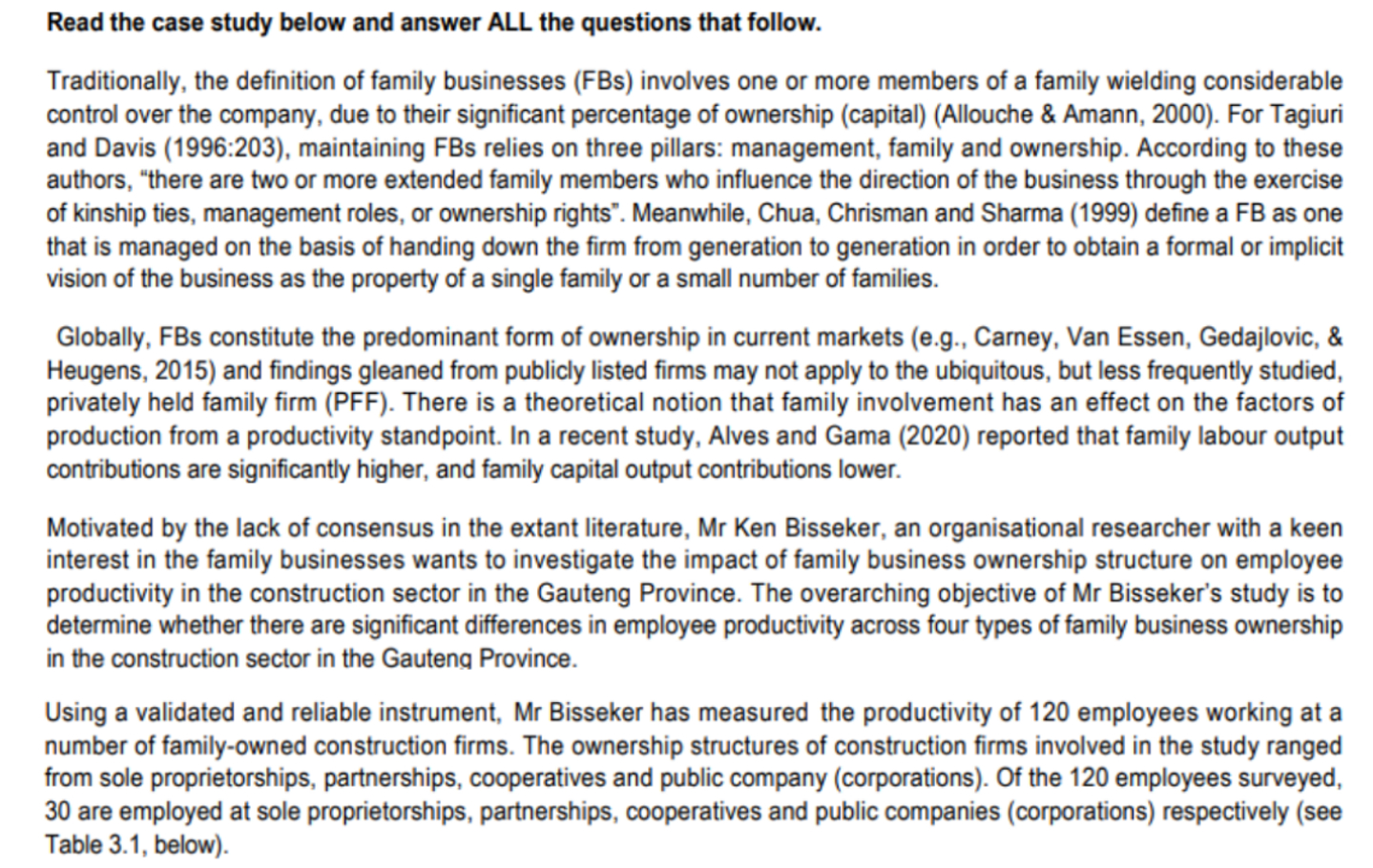
Read the case study below and answer ALL the questions that follow.
Traditionally, the definition of family businesses FBs involves one or more members of a family wielding considerable
control over the company, due to their significant percentage of ownership capitalAllouche & Amann, For Tagiuri
and Davis : maintaining FBs relies on three pillars: management, family and ownership. According to these
authors, "there are two or more extended family members who influence the direction of the business through the exercise
of kinship ties, management roles, or ownership rights". Meanwhile, Chua, Chrisman and Sharma define a FB as one
that is managed on the basis of handing down the firm from generation to generation in order to obtain a formal or implicit
vision of the business as the property of a single family or a small number of families.
Globally, FBs constitute the predominant form of ownership in current markets eg Carney, Van Essen, Gedajlovic, &
Heugens, and findings gleaned from publicly listed firms may not apply to the ubiquitous, but less frequently studied,
privately held family firm PFF There is a theoretical notion that family involvement has an effect on the factors of
production from a productivity standpoint. In a recent study, Alves and Gama reported that family labour output
contributions are significantly higher, and family capital output contributions lower.
Motivated by the lack of consensus in the extant literature, Mr Ken Bisseker, an organisational researcher with a keen
interest in the family businesses wants to investigate the impact of family business ownership structure on employee
productivity in the construction sector in the Gauteng Province. The overarching objective of Mr Bisseker's study is to
determine whether there are significant differences in employee productivity across four types of family business ownership
in the construction sector in the Gauteng Province.
Using a validated and reliable instrument, Mr Bisseker has measured the productivity of employees working at a
number of familyowned construction firms. The ownership structures of construction firms involved in the study ranged
from sole proprietorships, partnerships, cooperatives and public company corporations Of the employees surveyed,
are employed at sole proprietorships, partnerships, cooperatives and public companies corporations respectively see
Table below
Step by Step Solution
There are 3 Steps involved in it
1 Expert Approved Answer
Step: 1 Unlock

Question Has Been Solved by an Expert!
Get step-by-step solutions from verified subject matter experts
Step: 2 Unlock
Step: 3 Unlock
 Study Help