







Question: READ THE CASE STUDY BELOW AND ANSWER THE FOLLOWING QUESTIONS. Warm and Cosy is a medium-sized, Cape Town based, family business that produces various winter
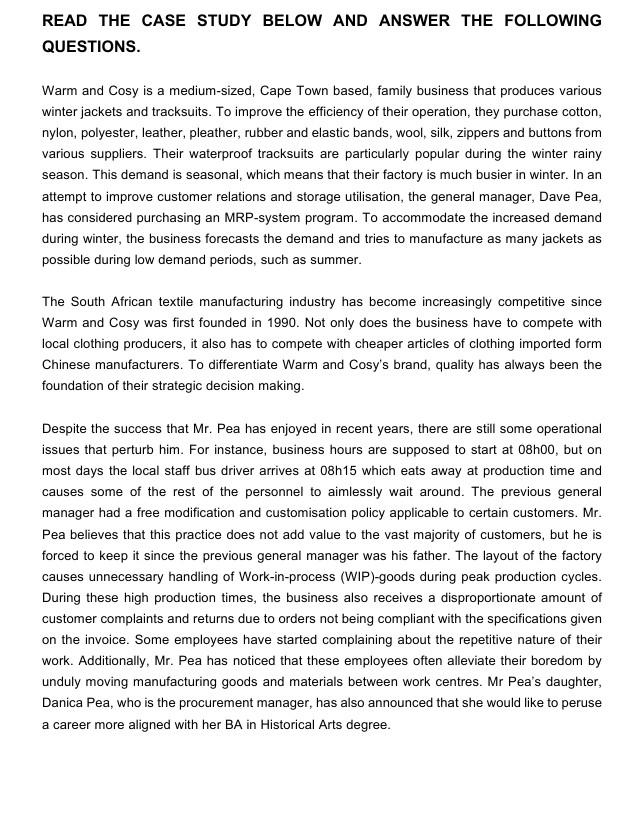
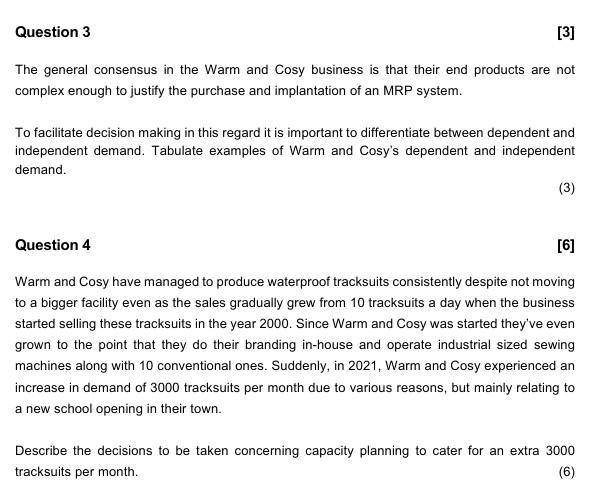
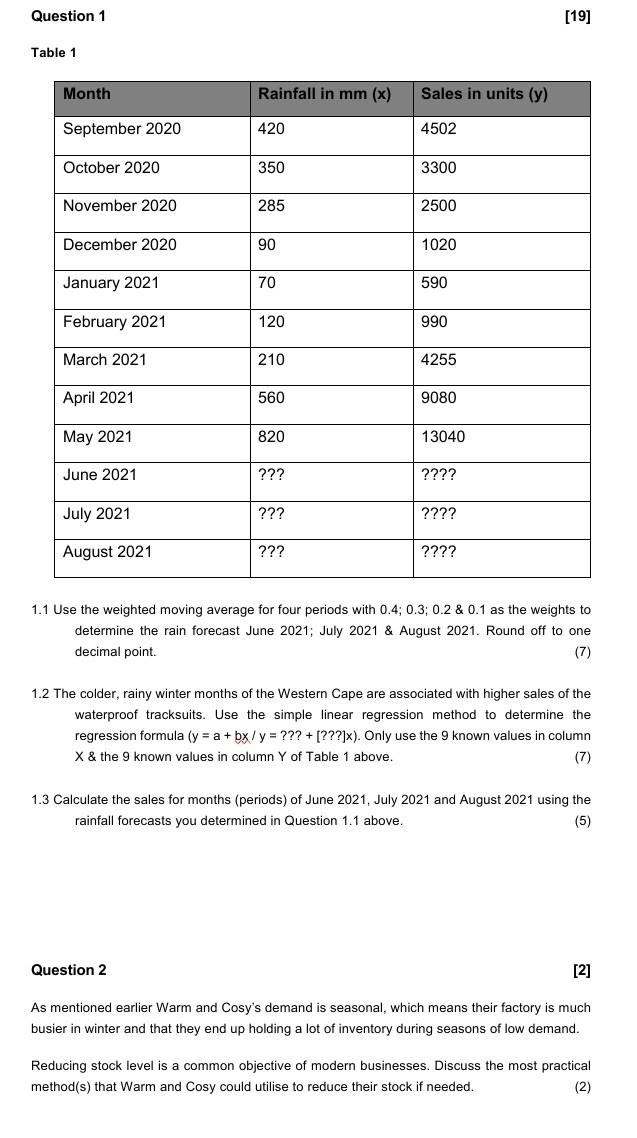
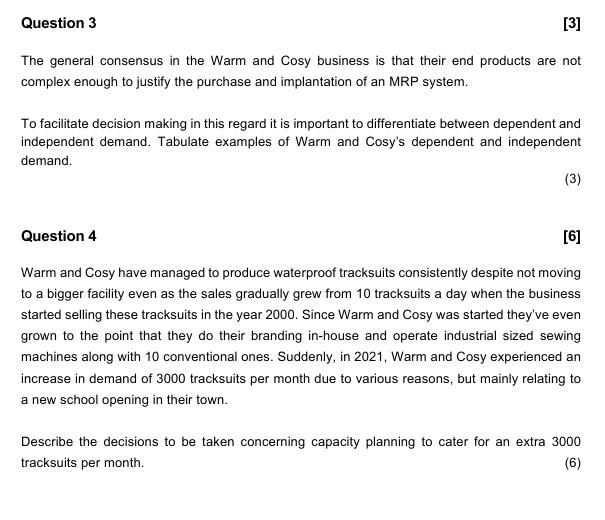
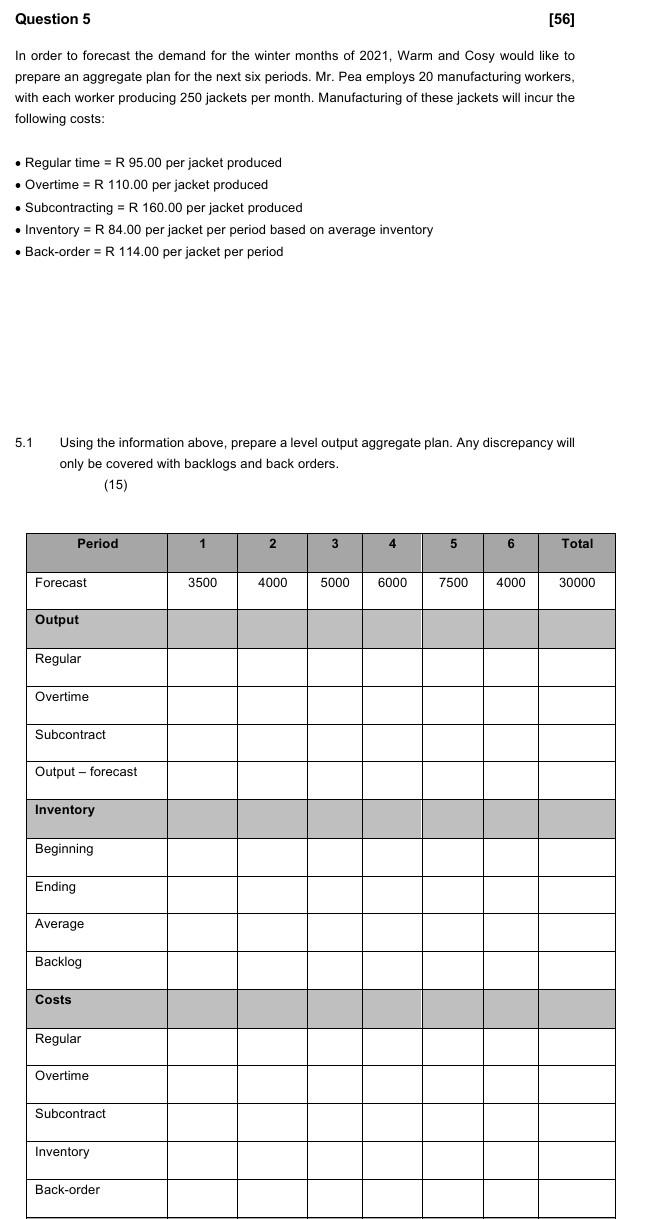
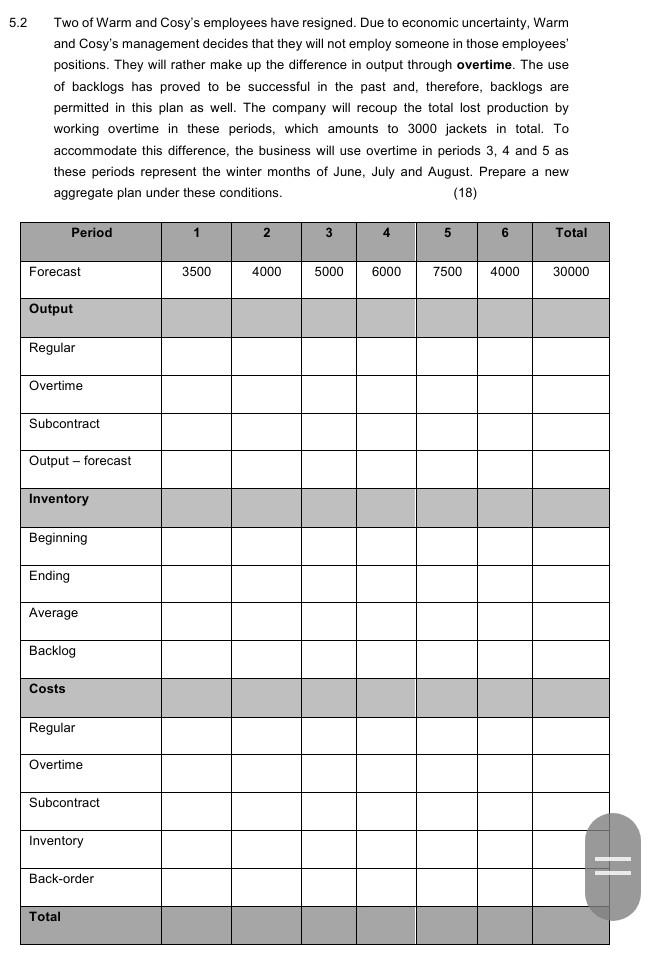
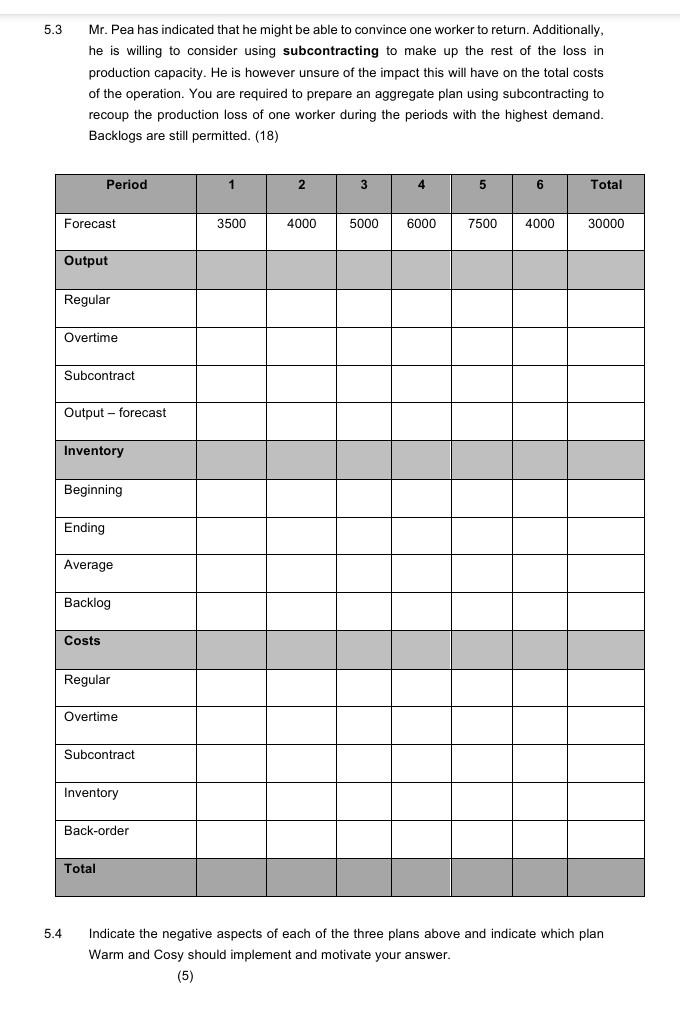
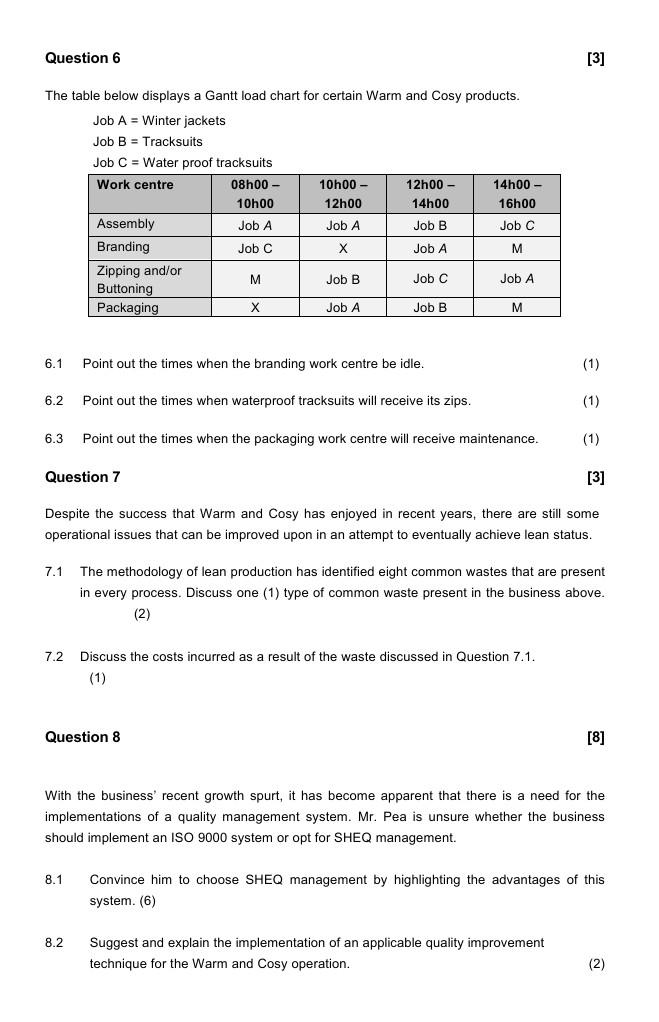
READ THE CASE STUDY BELOW AND ANSWER THE FOLLOWING QUESTIONS. Warm and Cosy is a medium-sized, Cape Town based, family business that produces various winter jackets and tracksuits. To improve the efficiency of their operation, they purchase cotton, nylon, polyester, leather, pleather, rubber and elastic bands, wool, silk, zippers and buttons from various suppliers. Their waterproof tracksuits are particularly popular during the winter rainy season. This demand is seasonal, which means that their factory is much busier in winter. In an attempt to improve customer relations and storage utilisation, the general manager, Dave Pea, has considered purchasing an MRP-system program. To accommodate the increased demand during winter, the business forecasts the demand and tries to manufacture as many jackets as possible during low demand periods, such as summer. The South African textile manufacturing industry has become increasingly competitive since Warm and Cosy was first founded in 1990. Not only does the business have to compete with local clothing producers, it also has to compete with cheaper articles of clothing imported form Chinese manufacturers. To differentiate Warm and Cosy's brand, quality has always been the foundation of their strategic decision making. Despite the success that Mr. Pea has enjoyed in recent years, there are still some operational issues that perturb him. For instance, business hours are supposed to start at 08h00, but on most days the local staff bus driver arrives at 08h15 which eats away at production time and causes some of the rest of the personnel to aimlessly wait around. The previous general manager had a free modification and customisation policy applicable to certain customers. Mr. Pea believes that this practice does not add value to the vast majority of customers, but he is forced to keep it since the previous general manager was his father. The layout of the factory causes unnecessary handling of Work-in-process (WIP)-goods during peak production cycles. During these high production times, the business also receives a disproportionate amount of customer complaints and returns due to orders not being compliant with the specifications given on the invoice. Some employees have started complaining about the repetitive nature of their work. Additionally, Mr. Pea has noticed that these employees often alleviate their boredom by unduly moving manufacturing goods and materials between work centres. Mr Pea's daughter, Danica Pea, who is the procurement manager, has also announced that she would like to peruse a career more aligned with her BA in Historical Arts degree. Question 3 [3] The general consensus in the warm and Cosy business is that their end products are not complex enough to justify the purchase and implantation of an MRP system. To facilitate decision making in this regard it is important to differentiate between dependent and independent demand. Tabulate examples of Warm and Cosy's dependent and independent demand. (3) Question 4 [6] Warm and Cosy have managed to produce waterproof tracksuits consistently despite not moving to a bigger facility even as the sales gradually grew from 10 tracksuits a day when the business started selling these tracksuits in the year 2000. Since Warm and Cosy was started they've even grown to the point that they do their branding in-house and operate industrial sized sewing machines along with 10 conventional ones. Suddenly, in 2021, Warm and Cosy experienced an increase in demand of 3000 tracksuits per month due to various reasons, but mainly relating to a new school opening in their town. Describe the decisions to be taken concerning capacity planning to cater for an extra 3000 tracksuits per month. (6) Question 1 [19] Table 1 Month Rainfall in mm (x) Sales in units (y) September 2020 420 4502 October 2020 350 3300 November 2020 285 2500 December 2020 90 1020 January 2021 70 590 February 2021 120 990 March 2021 210 4255 April 2021 560 9080 May 2021 820 13040 June 2021 ??? ???? July 2021 ??? ???? August 2021 ??? ???? 1.1 Use the weighted moving average for four periods with 0.4; 0.3; 0.2 & 0.1 as the weights to determine the rain forecast June 2021; July 2021 & August 2021. Round off to one decimal point. (7) 1.2 The colder, rainy winter months of the Western Cape are associated with higher sales of the waterproof tracksuits. Use the simple linear regression method to determine the regression formula (y = a + bx/y = ??? + [???]x). Only use the 9 known values in column X & the 9 known values in column Y of Table 1 above. (7) 1.3 Calculate the sales for months (periods) of June 2021, July 2021 and August 2021 using the rainfall forecasts you determined in Question 1.1 above. (5) Question 2 [2] As mentioned earlier Warm and Cosy's demand is seasonal, which means their factory is much busier in winter and that they end up holding a lot of inventory during seasons of low demand. Reducing stock level is a common objective of modern businesses. Discuss the most practical method(s) that Warm and Cosy could utilise to reduce their stock if needed. (2) Question 3 [3] The general consensus in the warm and Cosy business is that their end products are not complex enough to justify the purchase and implantation of an MRP system. To facilitate decision making in this regard it is important to differentiate between dependent and independent demand. Tabulate examples of Warm and cosy's dependent and independent demand. (3) Question 4 [6] Warm and Cosy have managed to produce waterproof tracksuits consistently despite not moving to a bigger facility even as the sales gradually grew from 10 tracksuits a day when the business started selling these tracksuits in the year 2000. Since Warm and Cosy was started they've even grown to the point that they do their branding in-house and operate industrial sized sewing machines along with 10 conventional ones. Suddenly, in 2021, Warm and Cosy experienced an increase in demand of 3000 tracksuits per month due to various reasons, but mainly relating to a new school opening in their town. Describe the decisions to be taken concerning capacity planning to cater for an extra 3000 tracksuits per month (6) Question 5 [56] In order to forecast the demand for the winter months of 2021, Warm and Cosy would like to prepare an aggregate plan for the next six periods. Mr. Pea employs 20 manufacturing workers, with each worker producing 250 jackets per month. Manufacturing of these jackets will incur the following costs: Regular time = R 95.00 per jacket produced Overtime = R 110.00 per jacket produced Subcontracting = R 160.00 per jacket produced Inventory = R 84.00 per jacket per period based on average inventory . Back-order = R 114.00 per jacket per period 5.1 Using the information above, prepare a level output aggregate plan. Any discrepancy will only be covered with backlogs and back orders. (15) Period 1 2 3 4 5 6 Total Forecast 3500 4000 5000 6000 7500 4000 30000 Output Regular Overtime Subcontract Output - forecast Inventory Beginning Ending Average Backlog Costs Regular Overtime Subcontract Inventory Back-order 5.2 Two of Warm and Cosy's employees have resigned. Due to economic uncertainty, Warm and Cosy's management decides that they will not employ someone in those employees' positions. They will rather make up the difference in output through overtime. The use of backlogs has proved to be successful in the past and, therefore, backlogs are permitted in this plan as well. The company will recoup the total lost production by working overtime in these periods, which amounts to 3000 jackets in total. To accommodate this difference, the business will use overtime in periods 3, 4 and 5 as these periods represent the winter months of June, July and August. Prepare a new aggregate plan under these conditions. (18) Period 1 2 3 4 5 6 Total Forecast 3500 4000 5000 6000 7500 4000 30000 Output Regular Overtime Subcontract Output - forecast Inventory Beginning Ending Average Backlog Costs Regular Overtime Subcontract Inventory Back-order Total 5.3 Mr. Pea has indicated that he might be able to convince one worker to return. Additionally, he is willing to consider using subcontracting to make up the rest of the loss in production capacity. He is however unsure of the impact this will have on the total costs of the operation. You are required to prepare an aggregate plan using subcontracting to recoup the production loss of one worker during the periods with the highest demand. Backlogs are still permitted. (18) Period 1 2 3 5 Total Forecast 3500 4000 5000 6000 7500 4000 30000 Output Regular Overtime Subcontract Output - forecast Inventory Beginning Ending Average Backlog Costs Regular Overtime Subcontract Inventory Back-order Total 5.4 Indicate the negative aspects of each of the three plans above and indicate which plan Warm and Cosy should implement and motivate your answer. (5) Question 6 [3] The table below displays a Gantt load chart for certain Warm and Cosy products. Job A = Winter jackets Job B = Tracksuits Job C = Water proof tracksuits Work centre 08h00 10h00 - 12h00 14h00 - 10h00 12h00 14h00 16h00 Assembly Job A Job A Job B Job C Branding Job C X Job A M Zipping and/or M Job B Job C Job A Buttoning Packaging X Job A Job B M 6.1 Point out the times when the branding work centre be idle. (1) 6.2 Point out the times when waterproof tracksuits will receive its zips. (1) 6.3 Point out the times when the packaging work centre will receive maintenance. Question 7 [3] Despite the success that Warm and Cosy has enjoyed in recent years, there are still some operational issues that can be improved upon in an attempt to eventually achieve lean status. 7.1 The methodology of lean production has identified eight common wastes that are present in every process. Discuss one (1) type of common waste present in the business above. (2) 7.2 Discuss the costs incurred as a result of the waste discussed in Question 7.1. (1) Question 8 [8] With the business' recent growth spurt, it has become apparent that there is a need for the implementations of a quality management system. Mr. Pea is unsure whether the business should implement an ISO 9000 system or opt for SHEQ management. 8.1 Convince him to choose SHEQ management by highlighting the advantages of this system. (6) 8.2 Suggest and explain the implementation of an applicable quality improvement technique for the warm and Cosy operation. (2)
Step by Step Solution
There are 3 Steps involved in it
1 Expert Approved Answer
Step: 1 Unlock

Question Has Been Solved by an Expert!
Get step-by-step solutions from verified subject matter experts
Step: 2 Unlock
Step: 3 Unlock
 Study Help