







Question: Read the case study carefully and answer the questions that follow. [70 MARKS] The Good Apples When you ask people inside highly successful groups to
![[70 MARKS] The Good Apples When you ask people inside highly successful](https://dsd5zvtm8ll6.cloudfront.net/si.experts.images/questions/2024/10/671ea15c86f41_636671ea15c09386.jpg)
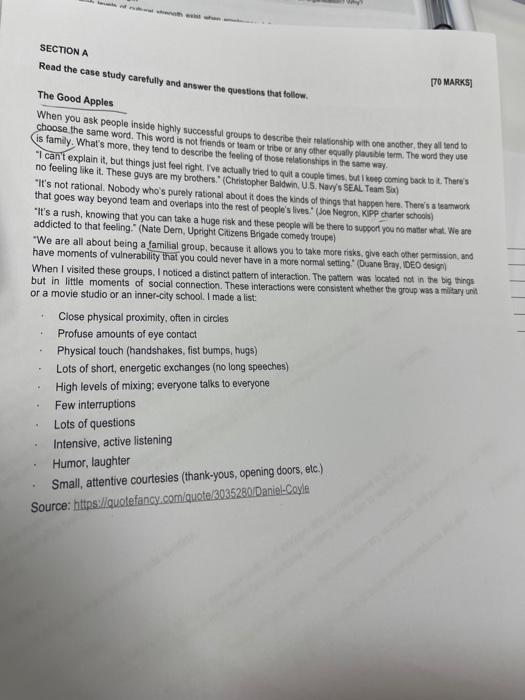
Read the case study carefully and answer the questions that follow. [70 MARKS] The Good Apples When you ask people inside highly successful groups to describe their telationship with one another, they all tend to choose the same word. This word is not fraends or leam or tribe of any other equaly pleusble term. The word they use (is family. What's more, they tend to describe the foeling of those relatonships in the same way. I can't explain it, but things just foel right, Tve actually tried to quit a couple limes, tut 1 koep coming back to t. There's no feeling like it. These guys are my brothers." (Cheistopher Baldwin, U.S. Navys SEAL Team Sox), "It's not rational. Nobody who's purely rational about it does the kinds of things that happen here. There's a leamwork that goes way beyond team and overlaps into the rest of people's lives:" (Joe Negron, Kipp charer schoobs) "It's a rush, knowing that you can take a huge risk and these people will be there to support you no mater what. We are addicted to that feeling." (Nate Dern, Upright Crizens Bnigade comedy troupe) "We are all about being a familial group, because it allows you to take more tisks, give each ohter permission, and have moments of vulnerability that you could never have in a more normal setting," (Duane Bray, IDEO design). When I visited these groups, I noticed a distinct patteen of interaction. The pattern was located not in the by tinge. but in little moments of social connection. These interactions were consistint whether the group was a miliary unat or a movie studio or an inner-city school. I made a list: - Close physical proximity, often in circles - Profuse amounts of eye contact - Physical touch (handshakes, fist bumps, hugs) - Lots of short, energetic exchanges (no long speeches) - High levels of mixing; everyone talks to everyone - Few interruptions - Lots of questions - Intensive, active listening - Humor, laughter - Small, attentive courtesies (thank-yous, opening doors, etc.) Source: httpsiliquotefancy, comiquote 3035280 DDaniel-Covle 1.1 Many organisations strive to have employees spesking about their oryarisulona, much lbe te colleagues and their leaders as the respondents in the case study, Cricaly decaus fout (4) ganere rpen of organisational culture. Apply the case stydy to the relevart types do dillue and dascrbe hom organisations can avoid cullures that negatively atlect productivety and job saistacton. 1.2 The respondents in the case study speak positively of their commiments tawads Eeir orgarisation (4aven) Describe what is meant by organisatioral commitment and analye the THREE (3) types d organisationat commitment by making reference to the case study. 1.3 The respondents in the case study all sound sausfied with the current state of thes organisabon. Defice R4 Marks) job satisfaction and its facets, while applying the case study and oher relevant examples to show your understanding. 1.4 One of the main behaviours that employees usually display as a refiection of how satefied they are with (8 Uarks) your answer. [20 NARs: SECTION B Answer ALL the questions in this section. QUESTION TWO Contemporary businesses are facing a new generabion of workers who do nol beleve in a vertical organisational structure. Most businesses have flat-structures, lead (15 Marks) reasons for the inporance the THREE (3) types of team inisidep
Step by Step Solution
There are 3 Steps involved in it

Get step-by-step solutions from verified subject matter experts
 Study Help