







Question: Read the Case study on Gateway Engineering and data tables (enclosed) The newly appointed Chief Executive of Gateway Engineering has recently completed a management development
Read the Case study on Gateway Engineering and data tables (enclosed)
The newly appointed Chief Executive of Gateway Engineering has recently completed a management development course about good Human Resource Management in organizations and knows a lot about the ideas of writers and researchers in the area of HR.
You have been asked by the new CEO to write:
A management report of about 1500 words (excluding appendices) outlining what you see as the most significant HR Management problems in this organization, bearing in mind the business aims and objectives that have been agreed with the Directors. This report must make references to appropriate theory and outline the benefits of adopting an HR approach and recommendations for change.
Gateway Engineering Limited - Case Study
Background
Gateway Engineering Limited has been in business for 47 years. The company was founded and managed by Derek Cresswell and his family until earlier this year when it was acquired by a multi-national company.
The new Directors have appointed a new Chief Executive Officer (CEO) and have emphasized that they require the organization to move towards a customer focus and over the next year, demonstrate to the parent organization that they are embracing the idea of Valuing Diversity. (This is because the UK Government has let it be known that all public sector organizations should only sub-contract with organizations that can demonstrate
diversity in employment.) The organization has also managed to win a substantial new contract that will mean around 850 new jobs over the next two years (providing they can deliver the level of customer service they have promised!)
The organization has a turnover of 40 million and currently employs around 1400 staff in 4 different Divisions at different locations in the North East of England, providing management services to both businesses and the general public.
Fifteen years ago the company employed 3,500 people. It had developed special techniques and management systems that made it an attractive contractor to many companies who were looking to contract out parts of their own businesses. These customers were not confined to the engineering and construction industries, and the organization was proud of their broad customer base.
As operating costs rose, and IT systems developed, these business customers began to dwindle, and in an attempt to limit the number of redundancies, the company started offering some of its services to the general public. These services include the contract purchase of telecommunications time, gas, electricity and oil, which are sold on to the public at a premium. However, in spite of many restructuring exercises, it has continued to shed staff and has never really been very profitable. In recent years the company has seen its staff turnover rise and increased difficulty in attracting new employees.
Each Division has its own way of tackling its own Human Resource issues and negotiating pay and operating systems with their own staff.
The CEO visited each location soon after appointment and made the following observations on each Division:
Operations (950 staff)
This is the traditional heart of the organisation. Employees are divided into project teams of various sizes, depending upon the particular service they are providing, and the particular customer group. Groups can earn team bonus if their service is profitable, and managers are responsible for the distribution of the bonus amongst team members.
The groups are set up on the basis that when a new project is required, the Divisional General Manager appoints a project manager (internally) who recruits their own project team, either from other project teams, or from outside. There is no formal induction and new staff appear to learn on the job.
Most managers are male, and most of the teams are single gender (mostly male, with very few people from ethnic minorities). Teams appear to work independently and there is a strong spirit of competition between all the teams, with lots of good humoured backchat evident.
Support Services (69 staff)
This covers areas such as Finance and Accounts, Estates Management (Maintenance, Security, Porters and Catering), Internal IT support and Personnel Services.
The Finance Manager is responsible for the whole Division. He has 4 Heads of Department, each providing appropriate administrative support to the rest of the organization.
The Finance Manager believes in ensuring that his staff are suitably qualified for their work. They are either recruited with the right qualification (ranging from Professional Qualifications e.g. ACCA, CIPD, through to NVQs in Security, Catering etc) or they are required to attend suitable courses to gain a qualification. All staff are encouraged to continue their education and will be supported by the company to part-time degree courses in areas such as Management or Information Technology.
However, it seems to take a long time to get things done, and things are only done when the paperwork is correct. This means that most things have to have the permission of a manager.
Information Technology Services (350 staff)
This is the star Division. It is profitable, providing information and Help Desk services to a wide range of customers.
It appears to have an informal atmosphere and people obviously talk to colleagues outside their own team. They are able to respond quickly to requests for new services from customers, (these usually come through sales representatives) or the staff themselves have ideas for improving services. Team leaders encourage staff to keep up to date on new IT applications, both through attendance on courses and through finding information on the Internet. The IT Manger also encourages weekly team briefings and regularly meets his staff for one to one progress meetings.
Staff turnover lower than average for IT in this area, although still quite high. Recruitment is formal, managers etc, but there is always a good response when it becomes known that Gateway are looking for IT staff.
Marketing & Sales (23 staff)
The Marketing Manager says he knows when staff are any good and can spot good job candidates as soon as they walk through the door. He feels there will be no problem in getting the right staff into the right positions to ensure that customer needs are met in the future. Like all other divisions, the Marketing Manager uses interviews as the sole method of selecting new staff, although is increasingly finding it difficult to attract candidates to the business and feels the quality of candidates replying to advertisements in the local press are poor.
Managers in the Division normally agree the details of any new contract or amendment to a contract before it is implemented, as sales staff are not really experienced enough to understand all the loopholes that could occur in a contract
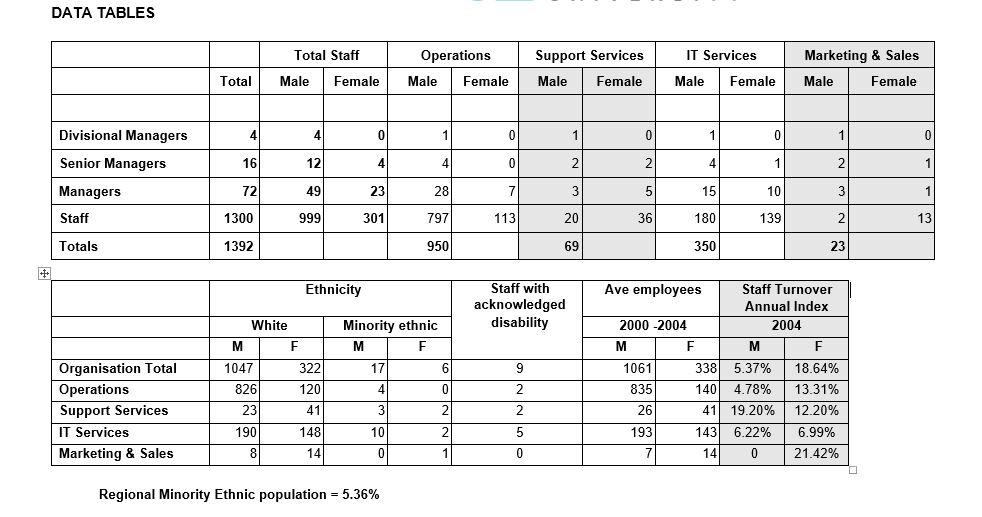
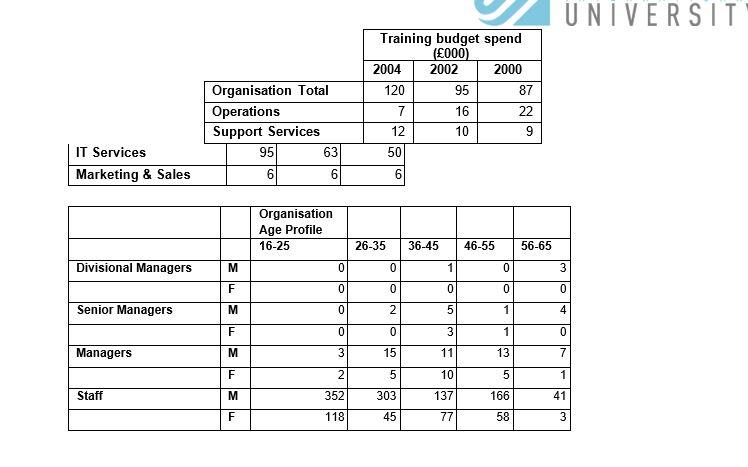
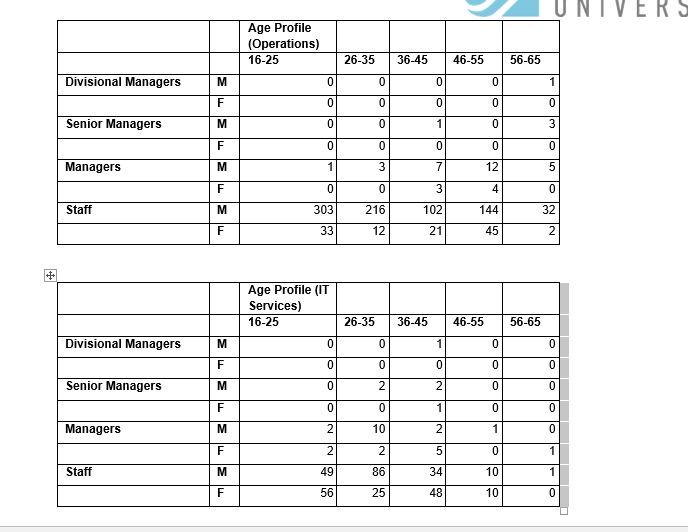
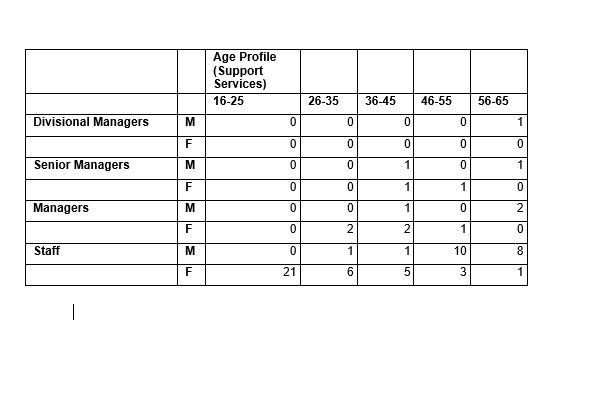
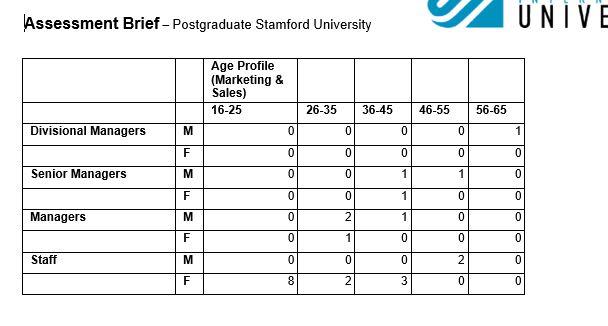
DATA TABLES Regional Minority Ethnic population =5.36% UN I V E R S IT \begin{tabular}{|l|l|l|r|r|r|r|} \hline & & \multicolumn{1}{|l|}{AgeProfile(Operations)} & & & & \\ \hline & & 1625 & 2635 & 3645 & 4655 & 5665 \\ \hline Divisional Managers & M & 0 & 0 & 0 & 0 & 1 \\ \hline & F & 0 & 0 & 0 & 0 & 0 \\ \hline Senior Managers & M & 0 & 0 & 1 & 0 & 3 \\ \hline & F & 0 & 0 & 0 & 0 & 0 \\ \hline Managers & M & 1 & 3 & 7 & 12 & 5 \\ \hline & F & 0 & 0 & 3 & 4 & 0 \\ \hline Staff & M & 303 & 216 & 102 & 144 & 32 \\ \hline & F & 33 & 12 & 21 & 45 & 2 \\ \hline \end{tabular} \begin{tabular}{|l|l|l|l|l|r|r|} \hline & & \multicolumn{1}{|l|}{AgeProfile(ITServices)} & & & & \\ \hline & & 16-25 & \multicolumn{1}{|l|}{ 26-35 } & \multicolumn{1}{|l|}{3645} & \multicolumn{1}{|l|}{4655} & 5665 \\ \hline Divisional Managers & M & 0 & 0 & 1 & 0 & 0 \\ \hline & F & 0 & 0 & 0 & 0 & 0 \\ \hline Senior Managers & M & 0 & 2 & 2 & 0 & 0 \\ \hline & F & 0 & 0 & 1 & 0 & 0 \\ \hline Managers & M & 2 & 10 & 2 & 1 & 0 \\ \hline & F & 2 & 2 & 5 & 0 & 1 \\ \hline Staff & M & 49 & 86 & 34 & 10 & 1 \\ \hline & F & 56 & 25 & 48 & 10 & 0 \\ \hline \end{tabular} \begin{tabular}{|l|l|l|r|r|r|r|} \hline & \multicolumn{2}{|l|}{AgeProfile(SupportServices)} & & & & \\ & & 1625 & 2635 & 3645 & 4655 & 5665 \\ \hline & M & 0 & 0 & 0 & 0 & 1 \\ \hline Divisional Managers & F & 0 & 0 & 0 & 0 & 0 \\ \hline Senior Managers & M & 0 & 0 & 1 & 0 & 1 \\ \hline & F & 0 & 0 & 1 & 1 & 0 \\ \hline Managers & M & 0 & 0 & 1 & 0 & 2 \\ \hline & F & 0 & 2 & 2 & 1 & 0 \\ \hline Staff & M & 0 & 1 & 1 & 10 & 8 \\ \hline & F & 21 & 6 & 5 & 3 & 1 \\ \hline \end{tabular} Assessment Brief-Postgraduate Stamford University UNIVE
Step by Step Solution
There are 3 Steps involved in it

Get step-by-step solutions from verified subject matter experts
 Study Help