Read the Case Study on Maria's Pizza on page 23 of the text. Answer the following questions in 2-3 paragraphs.
Questions:
1. You have learned, throughout you experience as a customer, that the customer is always right. Did you ever do something that would lead one to conclude that you, as a customer, were wrong? Explain.
2. What are some problematic, but ubiquitous, consumer behaviors faced by restaurants?
3. When is it appropriate for a business to terminate a relationship? Discuss the situation Marias Pizza faces, and suggest to Maria how she should handle these problem customers, beyond taking them off her mailing list.
4. Should Maria think about her best customers, the top 20 percent, and do something for them to increase their loyalty? Why or why not? If yes, what would you suggest?
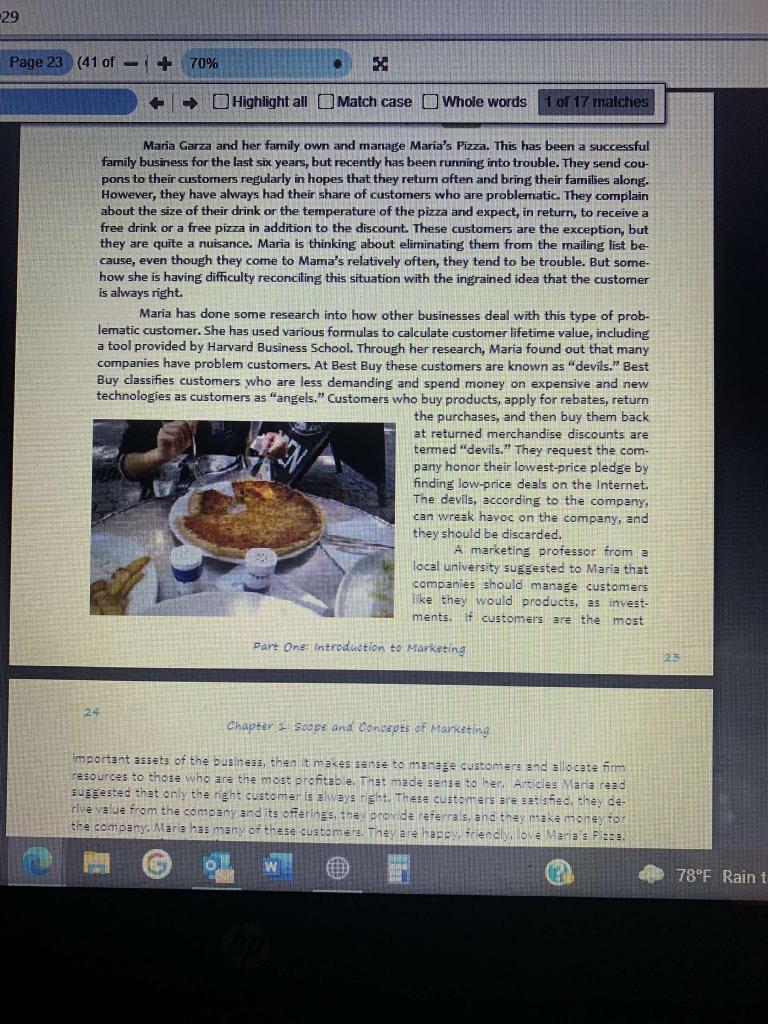
29 Page 23 (41 of + 70% 54 + Highlight all Match case Whole words 1 of 17 matches Maria Garza and her family own and manage Maria's Pizza. This has been a successful family business for the last six years, but recently has been running into trouble. They send cou pons to their customers regularly in hopes that they return often and bring their families along. However, they have always had their share of customers who are problematic. They complain about the size of their drink or the temperature of the pizza and expect, in return, to receive a free drink or a free pizza in addition to the discount. These customers are the exception, but they are quite a nuisance. Maria is thinking about eliminating them from the mailing list be cause, even though they come to Mama's relatively often, they tend to be trouble. But some- how she is having difficulty reconciling this situation with the ingrained idea that the customer is always right Maria has done some research into how other businesses deal with this type of prob- lematic customer. She has used various formulas to calculate customer lifetime value, including a tool provided by Harvard Business School. Through her research, Maria found out that many companies have problem customers. At Best Buy these customers are known as "devils." Best Buy classifies customers who are less demanding and spend money on expensive and new technologies as customers as "angels." Customers who buy products, apply for rebates, return the purchases, and then buy them back at returned merchandise discounts are termed "devils." They request the com- pany honor their lowest price pledge by finding low-price deals on the Internet. The devils, according to the company, can wreak havoc on the company, and they should be discarded. A marketing professor from a local university suggested to Maria that companies should manage customers like they would products, as invest- ments. If customers are the most Part One: Introduction to Marketing 23 24 Chapter 3: Scope and Concepts of Marketing important assets of the business, then it makes sense to manage customers and allocate firm resources to those who are the most profitable. That made sense to her. Articles Maria read UEFested that only the night customer is always right. These customers are satisfied, they de rive value from the company and its offerings, the provide referra s. and they make money for the company. Marie has many of these customers. They are happy friendly, love Maria's Place 78F Rain t 0929 Page 24 (42 of - 70% Highlight all Match case Whole words 1 of 17 matches 24 Chapter 1: Scope and Concepts of Marketing important assets of the business, then it makes sense to manage customers and allocate firm resources to those who are the most profitable. That made sense to her. Articles Maria read suggested that only the right customer is always right. These customers are satisfied, they de rive value from the company and its offerings, they provide referrals, and they make money for the company. Maria has many of these customers. They are happy, friendly, love Maria's Pizza, and bring their families often. An article Maria read stated that customer supremacy can be destructive, especially when a customer's demand for low prices destroys profitability. But also destructive are cus- tomer demands for product modifications, creating extra work for staff. A customer who disre spects employees can be a negative influence on other customers as well as employee morale. Clearly, for Maria, the problematic customers are seriously eroding her business' profitability. Questions: 1. You have learned, throughout you experience as a customer, that the customer is always right. Did you ever do something that would lead one to conclude that you, as a customer, were wrong? Explain. 2. What are some problematic, but ubiquitous, consumer behaviors faced by restaurants? 3. When is it appropriate for a business to terminate a relationship? Discuss the situation Maria's Pizza faces, and suggest to Maria how she should handle these problem customers, beyond taking them off her mailing list. 4. Should Maria think about her best customers, the top 20 percent, and do something for them to increase their loyalty? Why or why not? If yes, what would you suggest? Endnotes Consumer Expenditure Survey, U.S. Bureau of Labor Statistics. http://www.bls.go, accessed.ely 19, 2017 www.ama.org, accessed July 19, 2017 a los 3 Peter Drucker, Marketing and Economic Development. Journal of Marketing anothely 95 - 958) 257-99 - www.artesyn.com, accessed July 18, 3 www.nytimes.com/204/0/0 te thee ons verldof gayret www.thedaybeast.com articles 2015 Bli fast-food goes upscale Ste Hofler and Kevin Lane Kolding Brand Euty bug Corporate Social Marketing of Fuel Po 3 Vietings Song:00:11 ser Naresumes no 1934- W LED 78F Rain




