







Question: Read the case study provided and answer the following questions. SETTING UP PROJECT BUDGETS FOR RESOURCE ALLOCATION Companies across industries are finding that their customers
Read the case study provided and answer the following questions.
SETTING UP PROJECT BUDGETS FOR RESOURCE ALLOCATION
Companies across industries are finding that their customers demand more products, more frequent releases of new products, and higher levels of localized product development. Those customers also want stcentury innovations, such as digital interfaces, that many product development organizations find challenging to provide. In this environment, inaccurate project planning can lead to massive development cost overruns, lengthen times to market, and create bottlenecks in applying valuable product development expertise. It can also make bottomup cost estimates balloon as managers who anticipate cost overruns give themselves additional budgetary headroom. When controlling anticipates this headroom, a vicious circle emerges that plagues many companies. Consultants have developed a standard cost model that helps companies to overcome this challenge. Leading ones have used the model to estimate the cost of their development projects and to allocate resources among them by product and site accurately. The model is a pragmatic, easytouse tool that calculates requirements for individual projects or entire portfolios, instantly, with one click. The standard cost model has helped organisations to benchmark projects, derive best practices, and assess the potential of current projects to serve as the basis for budget discussions. At the portfolio level, the model quantifies productivity disparities among different product development locations, helps teams understand cost drivers and efficiency targets, and quickly calculates scenarios by applying cost and resource forecasts. Because the tool is based on a multivariableregression model, it requires solid historical input data to achieve the greatest accuracy.
Product development organizations can use the standard cost model to identify the underlying drivers of cost differences among individual projects before launching them. One client, for example, analyzed how four factorscomplexity, customer, location, and the number of variantsgenerate cost differences between relatively inexpensive and premium development projects. Often, the model is built on a much more granular level to also allow for deep dives into functions, systems, and modules.
By revealing the similarities and differences among projects, the model makes their relative costs transparent and facilitates budget discussions. Some companies also use the model to identify projects that implement best practices and to understand the key factors that make these practices successful. The model requires relatively few inputs. Once a company determines the parameters that drive costs and establishes a set of reference projects, it can begin using the model to create cost estimates for new projects. The model "bakes in a number of assumptions about issues such as learning or experiencecurve effects and how costs translate into development hours. It generates timebased cost estimates for each product development function. Over time, it automatically enables companies to save on costs in other projects using the same components and to translate topdown targets into project budgets.
Companies can also use the standard model to assess a portfolio of projects. By analyzing past ones, for example, they can quantify the productivity differences among product development locations. Before deciding on the final location for a particular project, one company used the model to compare the historical development times of projects conducted at four global product development locations with the times of projects at corporate headquarters. This analysis enabled the company to calculate and compare each location's project costs quickly. Another company undertook indepth analyses of how a number of factors would affect the budget. The model compared the budget implications of various growth scenarios, calculated the project costs of different locations and teams, and revealed how efficiency would affect the company's budget targets.
Source: Heuss and Scheleyer,
QUESTION
MARKS
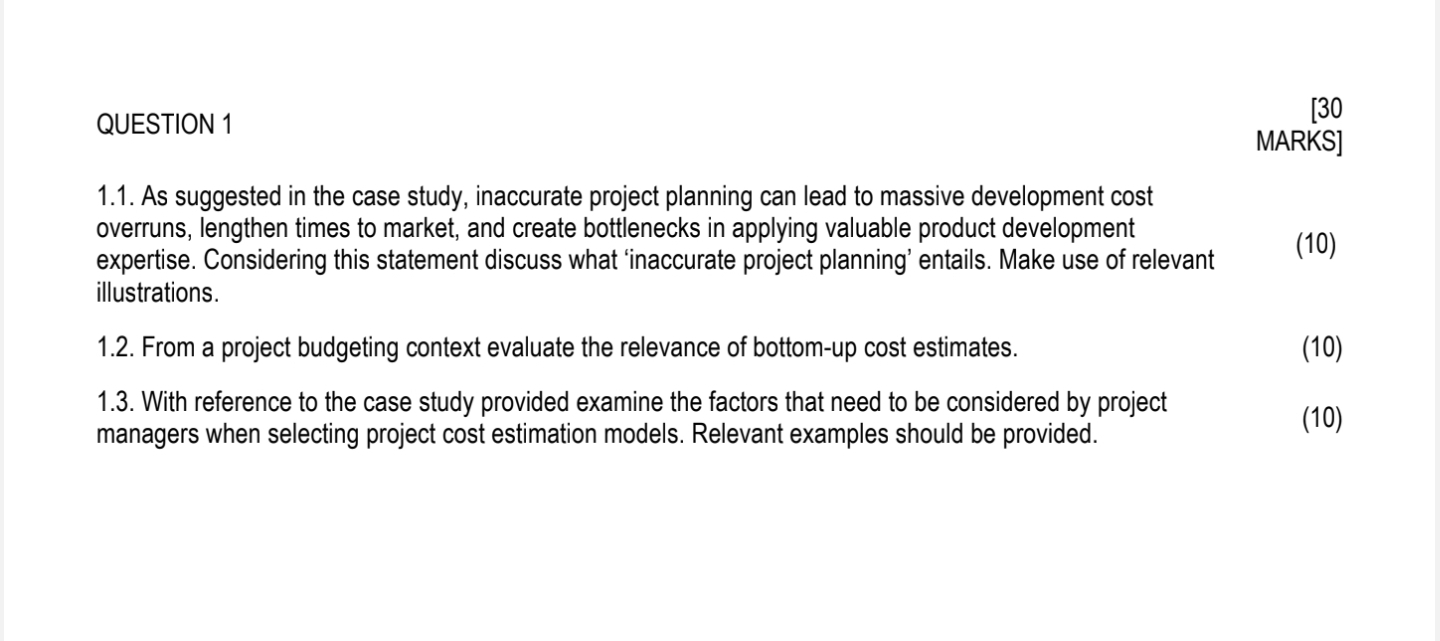
As suggested in the case study, inaccurate project planning can lead to massive development cost overruns, lengthen times to market, and create bottlenecks in applying valuable product development expertise. Considering this statement discuss what 'inaccurate project planning' entails. Make use of relevant illustrations.
From a project budgeting context evaluate the relevance of bottomup cost estimates.
With reference to the case study provided examine the factors that need to be considered by project managers when selecting project cost estimation models. Relevant examples should be provided.
Step by Step Solution
There are 3 Steps involved in it
1 Expert Approved Answer
Step: 1 Unlock

Question Has Been Solved by an Expert!
Get step-by-step solutions from verified subject matter experts
Step: 2 Unlock
Step: 3 Unlock
 Study Help