







Question: Read the case studyYou work for a small company that builds high - end consumer electronic packages for niche customers. A recent project in the
Read the case studyYou work for a small company that builds highend consumer electronic packages for niche customers.
A recent project in the company failed miserablyan electronic assembly being delivered to an
automotive manufacturer has numerous issues. The assembly is for the user interface in the center
console of the automobile to control the radio, temperature, navigation and phone synchronization.
When the package was put into service, numerous software bugs caused the software to crash and
reboot, causing outages for several minutes. Additionally, user feedback was generally not positive
regarding the interface design. Primarily, it was too slow and there was a noticeable delay between a
button push and a response from the system. Hardware issues were found that occasionally caused the
system to fail altogether and require a new unit to be installed. These hardware failures were an order
of magnitude more common than expected. Additionally, the remove and replace performed at the
dealership was significantly more complicated than expected, leading to high maintenance costs. The
project was seven months behind schedule and delivered lower performance than expected by the
customer. The customer decided to terminate the contract with your company, leading to millions of
dollars in lost revenue.
You are one of the few trained systems engineers on staff at your company. The CTO has asked you to
perform a postmortem on the project to determine the causes of these issues and to make
recommendations on how to avoid these problems on future projects. She doesnt feel like the
company can withstand another failed project like this without going out of businesstherefore she is
willing to make substantial changes to the engineering process if necessary.
You start by having a meeting with the Program Manager and Chief Engineer for the project. Your
discussion with the two of them is enlightening. The PM tells you the project was doomed from the
start. When the company was bidding on the project, they were desperate to win the contract and get a
foot in the door in the automotive market. As a result, they included too many features in their offering
for the price and the schedule was dramatically compressed to meet the time to market requirement.
To achieve this schedule compression, they dramatically cut the planned requirements gathering time
and the planned integration time. The chief engineer felt that the team was not adequately staffed to
execute the project. Due to the price cuts in the proposal, the experience level of the technical staff
were reduced in order to keep the engineering costs down. Formal milestone reviews were tailored out
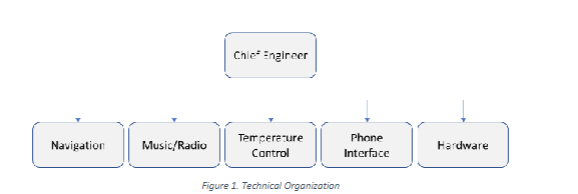
of the process in order to streamline the development activities. They organized the team around the
four primary system functions as well as the hardware. The top level of the Work Breakdown Structure
WBS was structured the same way at the top two levels. The organization is shown in Figure
Figure Technical Organization
Reviewing the project documentation provided by the Chief Engineer causes you some concern. There
was no Concept of Operations or toplevel requirements document. Each of the primary functions
navigation phone interface, etc. had an associated specification. There was also a specification for the
hardware. You are unable to find an Interface Control Document ICD Looking at the test logs for the
formal test effort, the subsystem requirements were tested in detail every requirement verified
However, at the system level, test procedures were developed to test high level functions change the
radio station, turn on defrost, etc. but the procedures didnt appear to map to any requirements.
You then spoke to the design teams. None of the design teams had a good appreciation for the depth of
the technical issues that occurred during fielding. They seemed to be comfortable with their part in the
projectthey met their requirements, after all. Looking at the Navigation Teams documentation, you
notice something alarming. The specification the Navigation Team used for development did not match
the specification you saw previously. Requirements in the Navigation Teams specification did not exist
in the requirements the Chief Engineer provided. They actually had a handful of requirements in their
specification that were completely omitted from the specification the Chief Engineer provided. You
called the Chief Engineer and confirmed the specification he gave you was the most current. You asked
the Navigation Team about the discrepancy and they told you the customer has requested those
features, so they added them to the specification. It didnt impact any other team, so they didnt bother
communicating the changes.
The hardware team was frustrated with the whole project. The hardware design kept changing due to
updated requirements from the customer. The hardware changes led to several workarounds being
developFigure Technical Organization
Step by Step Solution
There are 3 Steps involved in it
1 Expert Approved Answer
Step: 1 Unlock

Question Has Been Solved by an Expert!
Get step-by-step solutions from verified subject matter experts
Step: 2 Unlock
Step: 3 Unlock
 Study Help