Question: Read the case titled Hall Runners and answer the question given in the case. Your answer should not exceed one page. HALL RUNNERS* Robert Hall
Read the case titled Hall Runners and answer the question given in the case. Your answer should not exceed one page.
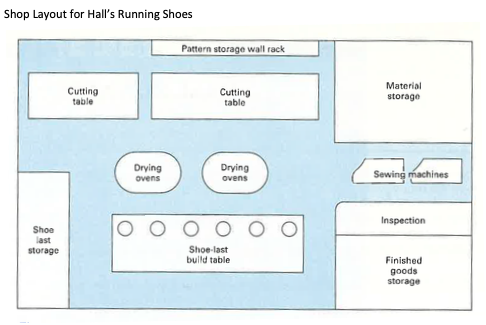
HALL RUNNERS* Robert Hall was a marathon runner. Earlier in his running career, Bob had some problems with his feet because of the running. Dr. Baines, an or- thopedist, diagnosed Bob's problem as one requiring special running shoes. While in graduate school, Bob started making running shoes for himself, and later for a few friends. These shoes were designed by Bob in consultation with Dr. Baines. During the first few years, Bob made the shoes in the garage of his parents' home using their sewing machine. For other processing equipment, he invented methods and processes to get the job done cheaply. Bob's method of manufacture was to purchase what he could and make whatever he could not purchase. At the beginning he purchased all his ma- terial in flat sheets or in rolls and cut out the patterns with scissors. He made some wooden shoe lasts (forms) on which he constructed the shoe after he had all the necessary parts. He converted an old clothes dryer into a drying oven (by removing the drum drive) to dry the glues and solvents that held most of the shoe together. Bob had started this business just before the "jogging craze" began sweeping the country. He was now selling some of his shoes through in- dependent shoe stores in three large cities within 200 miles of his home. With the help of Dr. Baines, he developed three master patterns for the ma- jority (85%) of the shoes that he now makes. The remaining shoes continue to be made for specific customers in consultation with Dr. Baines. Bob currently rents a 2000 square foot facility, which houses his oper- ation. The current manufacturing operation differs little from that which Bob started in his parents' garage, except for larger production runs and some heavier-duty equipment (including two industrial sewing machines). The layout of the shop is shown in Figure 2-7. In addition to himself, Bob's shop now employs one full-time worker, who is an experienced garment maker, and five part-time workers, who received on-the-job training. All the basic "Hall Runners" are made in the same style except for the tread design. As was noted previously, there are three of these: one for street, one for cross- country, and one for track. The only other variation is in size. To facilitate scheduling, shoes are produced in lots consisting of the same size and style shoe. Bob has also noted that more and more people are wearing running shoes as casual attire or as everyday shoes. This trend may warrant devel- oping different styles and colors. Bob feels that the market potential is great for quality running shoes, and he intends to enlarge his production capacity. Required This case contains many aspects of the product-process operations con- cepts discussed in this chapter. Discuss briefly all such concepts that are applicable to Robert Hall's operation. Be as thorough as possible, and be sure to include in your discussion concepts such as process characteristics, rele- vant product characteristics, and product-process interaction and evolution Shop Layout for Hall's Running Shoes Pattern storage wall rack Cutting table Cutting table Material storage Drying ovens Drying ovens Sewing machines Inspection Shoe last storage Shoe last build table Finished goods storage









 Study Help