Question: Read the case, Wrongful Discharge or Simply Poor Performance, which you can find on in Course readings, Course reserves on the course menu (located on
Read the case, "Wrongful Discharge or Simply Poor Performance," which you can find on in "Course readings," "Course reserves" on the course menu (located on the left of your screen).
Respond to the two prompts below. Your response to each prompt should be about one pargraph in length (about 150 words).
- Which side, Majestic or Angelo, stands a better chance to prevail in this case? Why? Be sure to mention which "exceptions" to Employment-at-Will are relevant to this case.
- How could Majestic prevent litigation of this type from occurring in the future? Mention at least one tactic discussed in class.
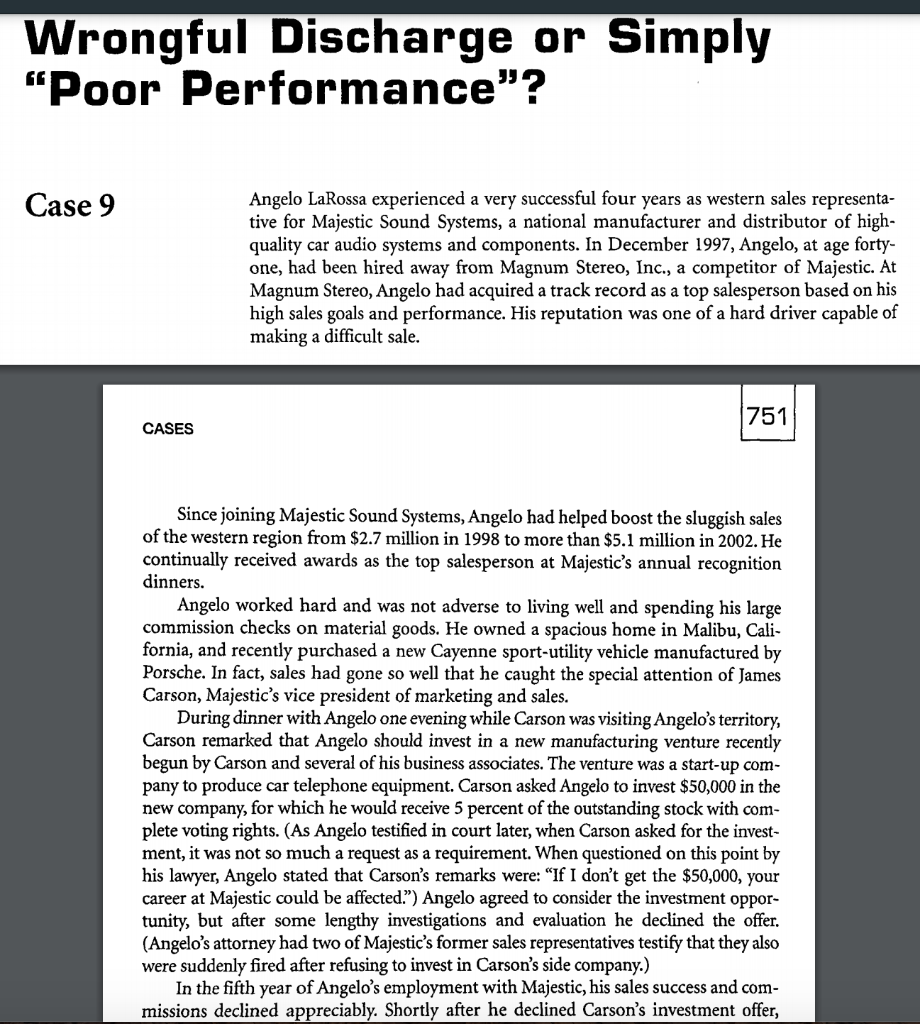
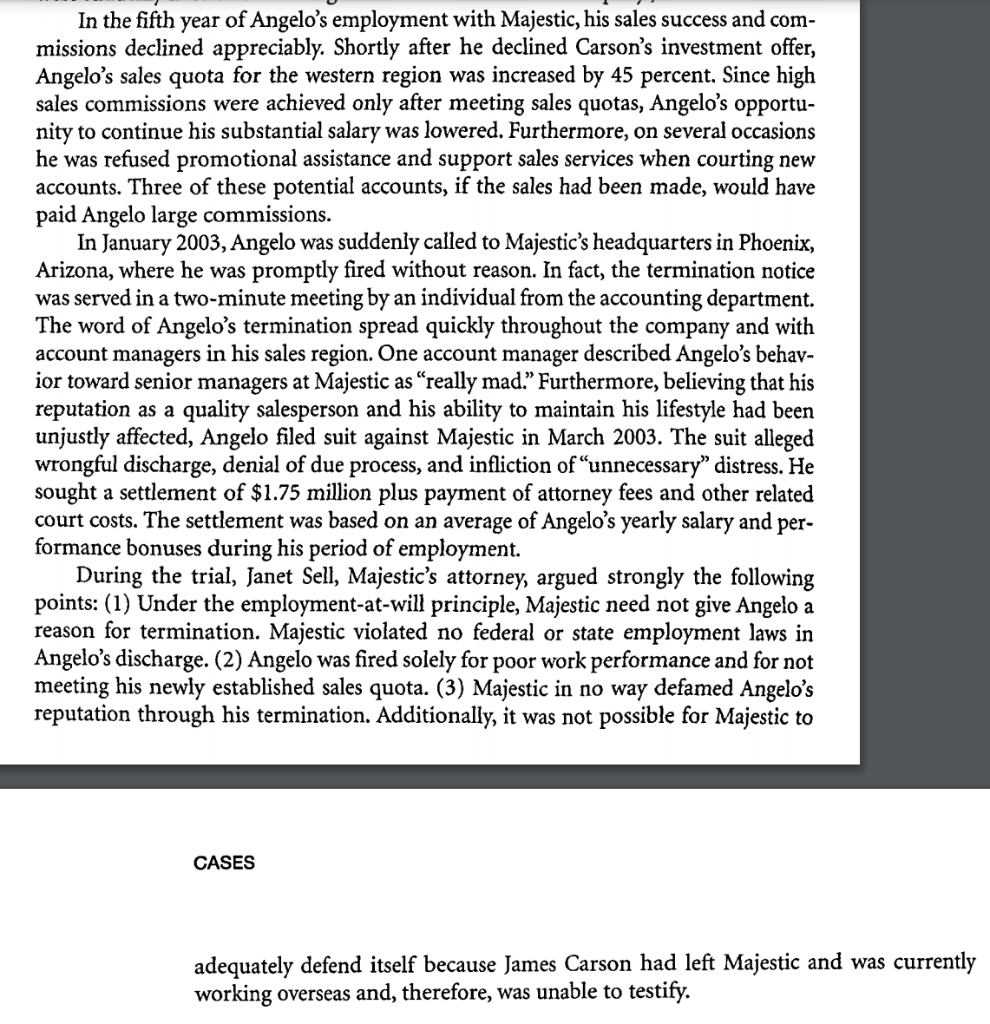
Wrongful Discharge or Simply "Poor Performance"? Case 9 Angelo LaRossa experienced a very successful four years as western sales representa- tive for Majestic Sound Systems, a national manufacturer and distributor of high- quality car audio systems and components. In December 1997, Angelo, at age forty- one, had been hired away from Magnum Stereo, Inc., a competitor of Majestic. At Magnum Stereo, Angelo had acquired a track record as a top salesperson based on his high sales goals and performance. His reputation was one of a hard driver capable of making a difficult sale. 751 CASES Since joining Majestic Sound Systems, Angelo had helped boost the sluggish sales of the western region from $2.7 million in 1998 to more than $5.1 million in 2002. He continually received awards as the top salesperson at Majestic's annual recognition dinners. Angelo worked hard and was not adverse to living well and spending his large commission checks on material goods. He owned a spacious home in Malibu, Cali- fornia, and recently purchased a new Cayenne sport-utility vehicle manufactured by Porsche. In fact, sales had gone so well that he caught the special attention of James Carson, Majestic's vice president of marketing and sales. During dinner with Angelo one evening while Carson was visiting Angelo's territory, Carson remarked that Angelo should invest in a new manufacturing venture recently begun by Carson and several of his business associates. The venture was a start-up com- pany to produce car telephone equipment. Carson asked Angelo to invest $50,000 in the new company, for which he would receive 5 percent of the outstanding stock with com- plete voting rights. (As Angelo testified in court later, when Carson asked for the invest- ment, it was not so much a request as a requirement. When questioned on this point by his lawyer, Angelo stat Carson's remarks were: "If I n't get the $50,000, your career at Majestic could be affected.") Angelo agreed to consider the investment oppor- tunity, but after some lengthy investigations and evaluation he declined the offer. (Angelo's attorney had two of Majestic's former sales representatives testify that they also were suddenly fired after refusing to invest in Carson's side company.) In the fifth year of Angelo's employment with Majestic, his sales success and com- missions declined appreciably. Shortly after he declined Carson's investment offer, In the fifth year of Angelo's employment with Majestic, his sales success and com- missions declined appreciably. Shortly after he declined Carson's investment offer, Angelo's sales quota for the western region was increased by 45 percent. Since high sales commissions were achieved only after meeting sales quotas, Angelo's opportu- nity to continue his substantial salary was lowered. Furthermore, on several occasions he was refused promotional assistance and support sales services when courting new accounts. Three of these potential accounts, if the sales had been made, would have paid Angelo large commissions. In January 2003, Angelo was suddenly called to Majestic's headquarters in Phoenix, Arizona, where he was promptly fired without reason. In fact, the termination notice was served in a two-minute meeting by an individual from the accounting department. The word of Angelo's termination spread quickly throughout the company and with account managers in his sales region. One account manager described Angelo's behav- ior toward senior managers at Majestic as really mad. Furthermore, believing that his reputation as a quality salesperson and his ability to maintain his lifestyle had been unjustly affected, Angelo filed suit against Majestic in March 2003. The suit alleged wrongful discharge, denial of due process, and infliction of unnecessary" distress. He sought a settlement of $1.75 million plus payment of attorney fees and other related court costs. The settlement was based on an average of Angelo's yearly salary and per- formance bonuses during his period of employment. During the trial, Janet Sell, Majestic's attorney, argued strongly the following points: (1) Under the employment-at-will principle, Majestic need not give Angelo a reason for termination. Majestic violated no federal or state employment laws in Angelo's discharge. (2) Angelo was fired solely for poor work performance and for not meeting his newly established sales quota. (3) Majestic in no way defamed Angelo's reputation through his termination. Additionally, it was not possible for Majestic to CASES adequately defend itself because James Carson had left Majestic and was currently working overseas and, therefore, was unable to testify









 Study Help