Question: READ THE CASELET BELOW AND ANSWER ALL QUESTIONS ALEXANDER MANN SOLUTIONS NICHOLAS KINNIE AND RUTH SMYTH Background Alexander Mann Solutions (AMS) provides Recruitment Process Outsourcing
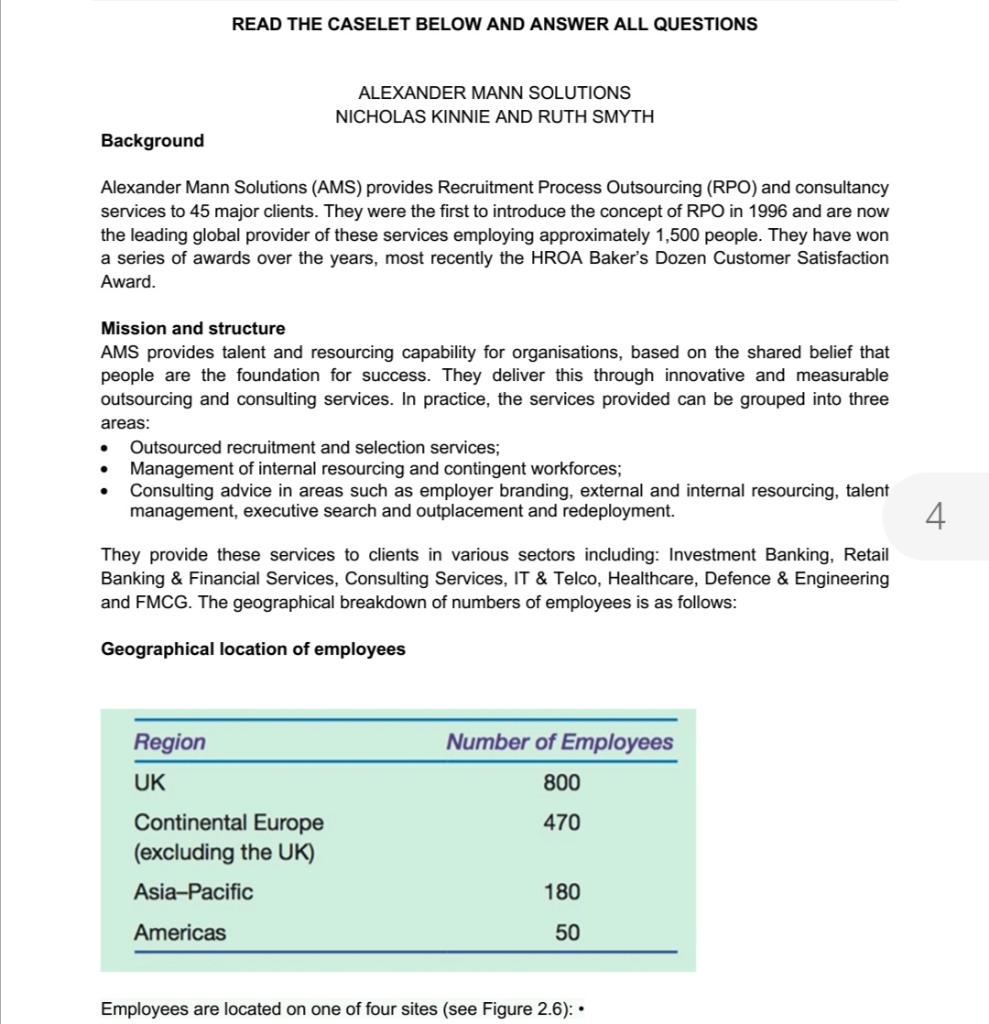
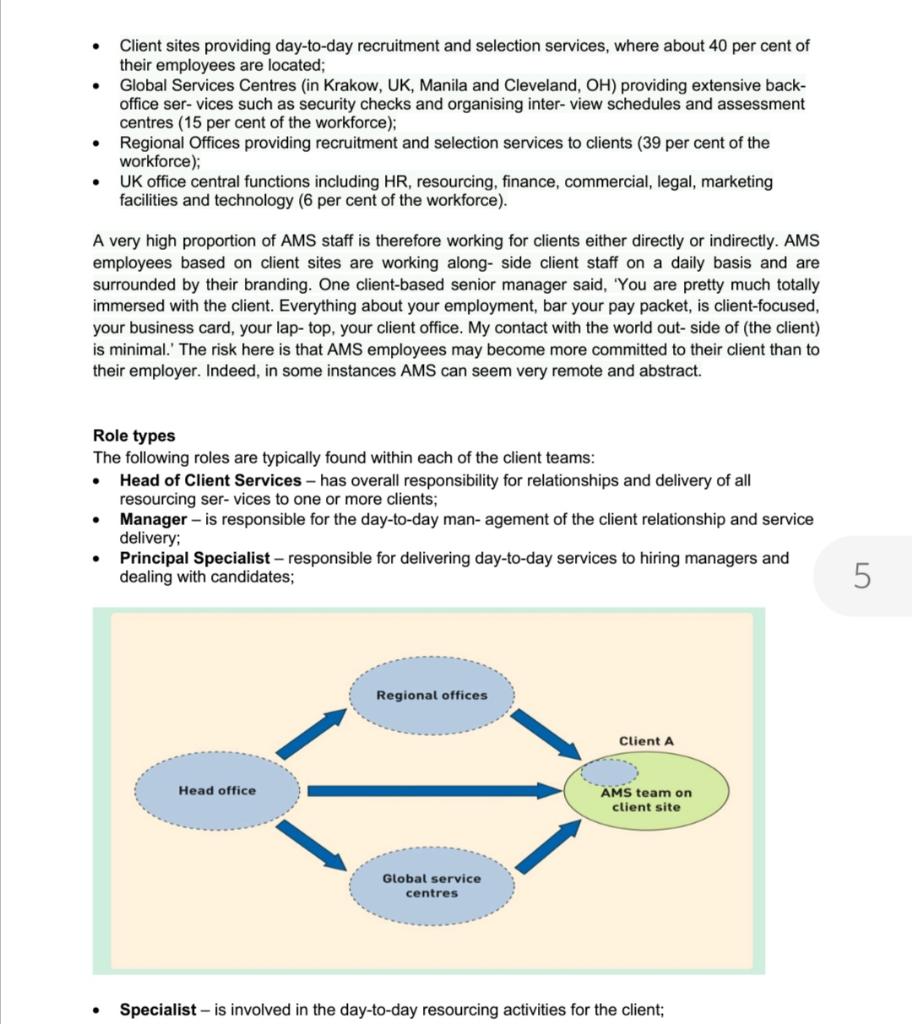
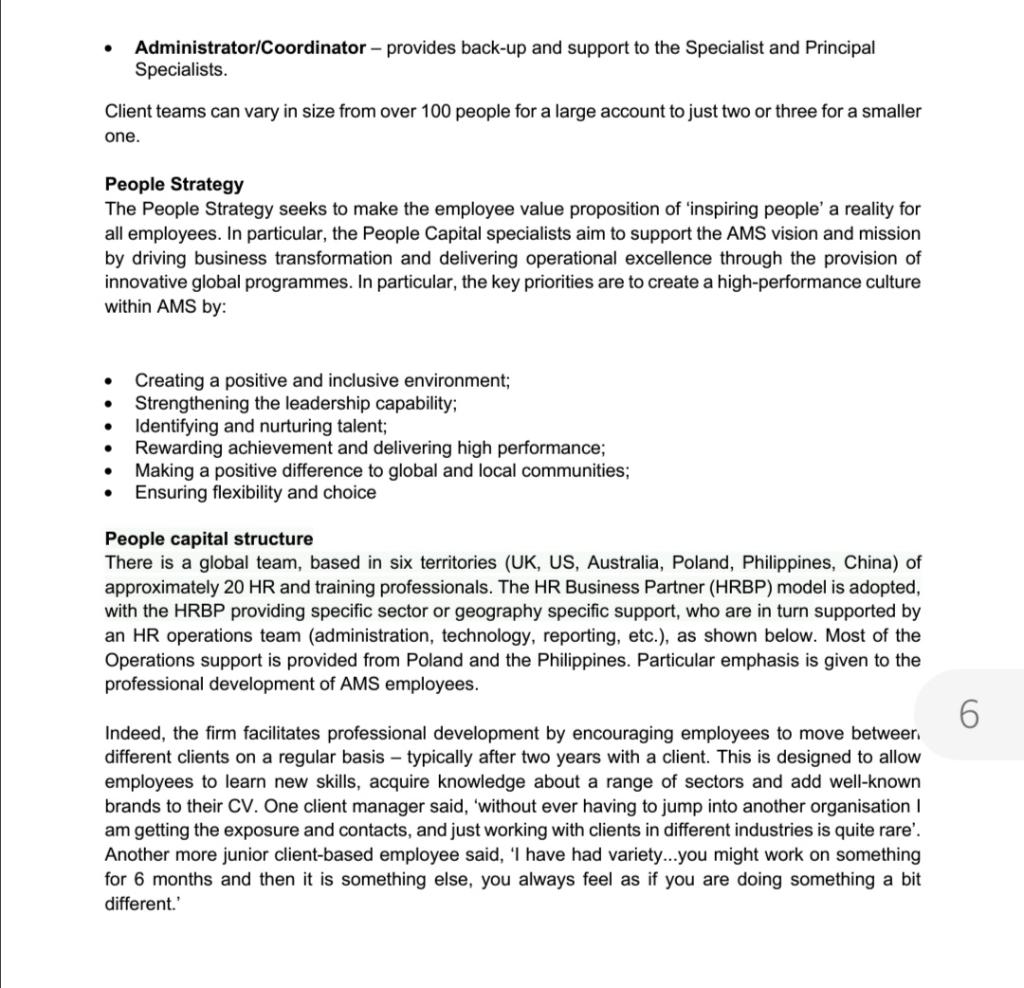
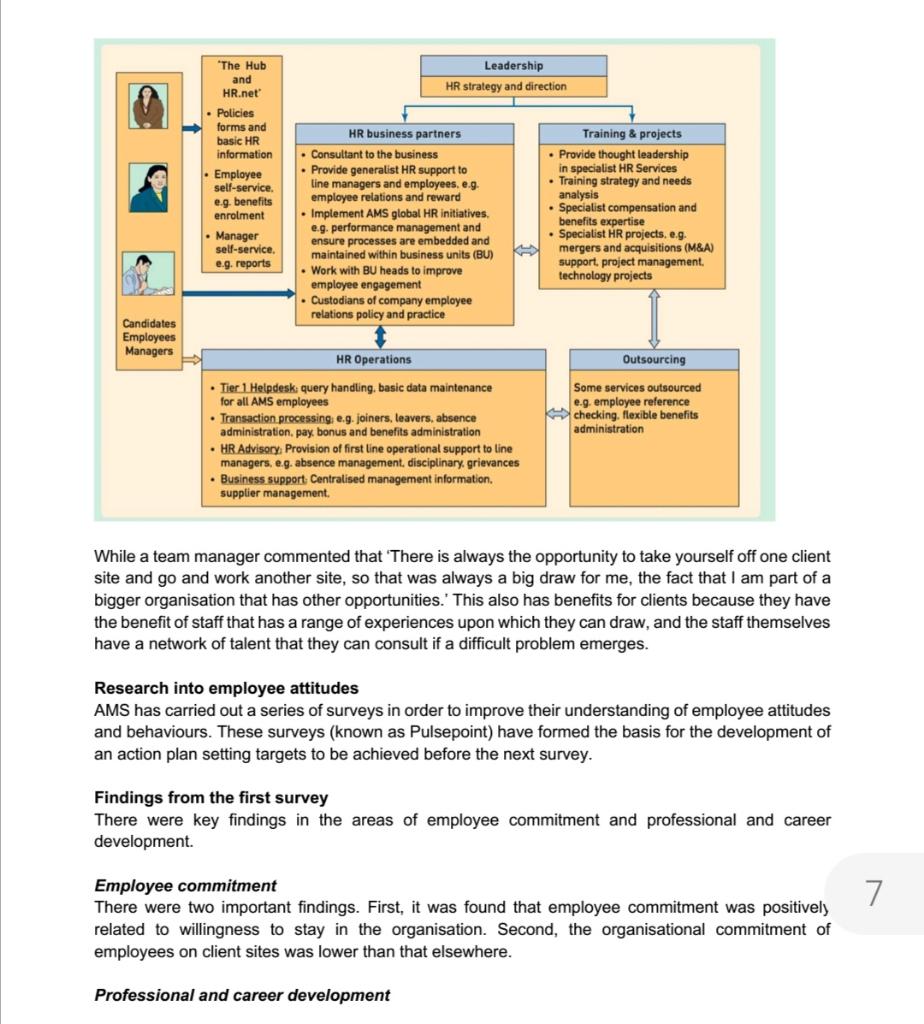
READ THE CASELET BELOW AND ANSWER ALL QUESTIONS ALEXANDER MANN SOLUTIONS NICHOLAS KINNIE AND RUTH SMYTH Background Alexander Mann Solutions (AMS) provides Recruitment Process Outsourcing (RPO) and consultancy services to 45 major clients. They were the first to introduce the concept of RPO in 1996 and are now the leading global provider of these services employing approximately 1,500 people. They have won a series of awards over the years, most recently the HROA Baker's Dozen Customer Satisfaction Award. Mission and structure AMS provides talent and resourcing capability for organisations, based on the shared belief that people are the foundation for success. They deliver this through innovative and measurable outsourcing and consulting services. In practice, the services provided can be grouped into three areas: Outsourced recruitment and selection services; Management of internal resourcing and contingent workforces; Consulting advice in areas such as employer branding, external and internal resourcing, talent management, executive search and outplacement and redeployment. . . 4 They provide these services to clients in various sectors including: Investment Banking, Retail Banking & Financial Services, Consulting Services, IT & Telco, Healthcare, Defence & Engineering and FMCG. The geographical breakdown of numbers of employees is as follows: Geographical location of employees Region Number of Employees 800 UK 470 Continental Europe (excluding the UK) Asia-Pacific 180 Americas 50 Employees are located on one of four sites (see Figure 2.6): . Client sites providing day-to-day recruitment and selection services, where about 40 per cent of their employees are located; Global Services Centres (in Krakow, UK, Manila and Cleveland, OH) providing extensive back- office services such as security checks and organising inter- view schedules and assessment centres (15 per cent of the workforce); Regional Offices providing recruitment and selection services to clients (39 per cent of the workforce); UK office central functions including HR, resourcing, finance, commercial, legal, marketing facilities and technology (6 per cent of the workforce). . . A very high proportion of AMS staff is therefore working for clients either directly or indirectly. AMS employees based on client sites are working along- side client staff on a daily basis and are surrounded by their branding. One client-based senior manager said, 'You are pretty much totally immersed with the client. Everything about your employment, bar your pay packet, is client-focused, your business card, your lap-top, your client office. My contact with the world outside of the client) is minimal.' The risk here is that AMS employees may become more committed to their client than to their employer. Indeed, in some instances AMS can seem very remote and abstract. Role types . . The following roles are typically found within each of the client teams: Head of Client Services - has overall responsibility for relationships and delivery of all resourcing services to one or more clients; Manager - is responsible for the day-to-day man- agement of the client relationship and service delivery; Principal Specialist - responsible for delivering day-to-day services to hiring managers and dealing with candidates; . 5 Regional offices Client A Head office AMS team on client site Global service centres Specialist - is involved in the day-to-day resourcing activities for the client; Administrator/Coordinator - provides back-up and support to the Specialist and Principal Specialists. Client teams can vary in size from over 100 people for a large account to just two or three for a smaller one. People Strategy The People Strategy seeks to make the employee value proposition of inspiring people' a reality for all employees. In particular, the People Capital specialists aim to support the AMS vision and mission by driving business transformation and delivering operational excellence through the provision of innovative global programmes. In particular, the key priorities are to create a high-performance culture within AMS by: . . Creating a positive and inclusive environment; Strengthening the leadership capability; Identifying and nurturing talent; Rewarding achievement and delivering high performance; Making a positive difference to global and local communities; Ensuring flexibility and choice . People capital structure There is a global team, based in six territories (UK, US, Australia, Poland, Philippines, China) of approximately 20 HR and training professionals. The HR Business Partner (HRBP) model is adopted, with the HRBP providing specific sector or geography specific support, who are in turn supported by an HR operations team (administration, technology, reporting, etc.), as shown below. Most of the Operations support is provided from Poland and the Philippines. Particular emphasis is given to the professional development of AMS employees. 6 Indeed, the firm facilitates professional development by encouraging employees to move betweer. different clients on a regular basis - typically after two years with a client. This is designed to allow employees to learn new skills, acquire knowledge about a range of sectors and add well-known brands to their CV. One client manager said, 'without ever having to jump into another organisation | am getting the exposure and contacts, and just working with clients in different industries is quite rare'. Another more junior client-based employee said, 'I have had variety...you might work on something for 6 months and then it is something else, you always feel as if you are doing something a bit different. Leadership HR strategy and direction "The Hub and HR.net Policies forms and basic HR information Employee self-service e.g. benefits enrolment Manager self-service e.g. reports HR business partners . Consultant to the business Provide generalist HR support to line managers and employees, e.g. employee relations and reward Implement AMS global HR initiatives e.g. performance management and ensure processes are embedded and maintained within business units (BU) Work with BU heads to improve employee engagement Custodians of company employee relations policy and practice Training & projects Provide thought leadership in specialist HR Services Training strategy and needs analysis Specialist compensation and benefits expertise Specialist HR projects. e.g mergers and acquisitions (M&A) support project management, technology projects Candidates Employees Managers HR Operations Outsourcing Some services outsourced e.g. employee reference checking, flexible benefits administration Tier 1 Helpdesk query handling, basic data maintenance for all AMS employees Transaction processing, e.g.joiners, leavers, absence administration, pay, bonus and benefits administration HR Advisory, Provision of first line operational support to line managers, e.g. absence management, disciplinary grievances Business support Centralised management information. supplier management While a team manager commented that 'There is always the opportunity to take yourself off one client site and go and work another site, so that was always a big draw for me, the fact that I am part of a bigger organisation that has other opportunities. This also has benefits for clients because they have the benefit of staff that has a range of experiences upon which they can draw, and the staff themselves have a network of talent that they can consult if a difficult problem emerges. Research into employee attitudes AMS has carried out a series of surveys in order to improve their understanding of employee attitudes and behaviours. These surveys (known as Pulsepoint) have formed the basis for the development of an action plan setting targets to be achieved before the next survey. Findings from the first survey There were key findings in the areas of employee commitment and professional and career development. 7 Employee commitment There were two important findings. First, it was found that employee commitment was positively related to willingness to stay in the organisation. Second, the organisational commitment of employees on client sites was lower than that elsewhere. Professional and career development The key findings were that the satisfaction of professional development needs within the organisation was positively related to willingness to stay and managers with three to four years of experience have unmet training and development needs. Subsequent actions that were taken and their outcomes. A series of actions were taken to improve employee commitment, communications and involvement and professional development opportunities. Employee commitment, communications and involvement A series of actions were taken to improve employee commitment including: first, a substantial enhancement of the corporate induction process to improve the frequency and content of the programme; second, the introduction of the knowledge exchange, an online repository of people and organisational information and finally, improved guidance to senior managers when managing communications. In addition, various actions were taken to improve communications with and involvement opportunities for employees. This included members of the Leader-ship Team visiting over 400 employees on client sites in 2010; extensive in-house communications regarding AMS achievements including the Pulsepoint results through The Point, a hard copy in-house magazine, and CheckPoint, which involved making leadership team video webcasts available to all employees and the initiation of the Global Inspiring Teamwork award. Furthermore, all members of the Leadership Team are now measured on the results from the Pulsepoint surveys, and Heads of Client Services have to develop action plans in collaboration with the people capital team to address areas of concern ensuring a high level buy-in to these issues. Impact of these changes These changes contributed to a number of improvements in employee attitudes and behaviours. First, there were important changes in employee attitudes. Employee commitment (scale 1-7) increased from 4.93 (2009) to 5.27 (2011), an 8 per cent improvement and employees' intention to quit reduced from 3.20 (2009) to 2.94 (2011) an 11 per cent reduction. This contributed towards a reduction in employee turnover leading to substantial cost savings. In terms of organisational performance more generally, there has been a substantial growth of the Questions business following the successful acquisition of two major clients and one major client re-signing. In addition, there has been a significant increase in employment with over 500 permanent hires in 2010 and an additional 220 new employees taken on between September 2010 and February 2011. These changes also contributed to the winning of two awards: the Baker's Dozen - the main accreditation award for RPO outsourcing and the corporate partner of the year by AMS's UK Charity of the Year. Professional development A series of actions were taken which sought to improve opportunities for professional development within AMS. These included increasing technical and soft skills training by 15 per cent, increasing the management development programmes by 45 per cent especially in the areas of performance management and coaching and a significant increase in the number of senior managers who attended the AMS Leadership Academy. In addition, there was an improvement in the agility of HR processes in response to employee and manager feedback, which allowed localised promotion decisions and performance management decisions within accounts and functions. The impact of these changes was an increase in the proportion of the workforce promoted internally from 10 to 15 per cent and an increased ability to move positions within AMS to improve skill development leading to 240 moves in 2010. In addition, the Investors in People Bronze Award was obtained along with the Polish Investors in Human Capital Award. QUESTION 1 [25 MARKS] Critically assess the extent a leadership theory, which directly or indirectly reflects elements of emotional intelligence (EQ) and spiritual intelligence (SQ). Do you think Costco's relational approach would work for other types of organisations, such as manufacturing and the public sector? Discuss and deliberate the impact of spiritual intelligence on organizational productivity? READ THE CASELET BELOW AND ANSWER ALL QUESTIONS ALEXANDER MANN SOLUTIONS NICHOLAS KINNIE AND RUTH SMYTH Background Alexander Mann Solutions (AMS) provides Recruitment Process Outsourcing (RPO) and consultancy services to 45 major clients. They were the first to introduce the concept of RPO in 1996 and are now the leading global provider of these services employing approximately 1,500 people. They have won a series of awards over the years, most recently the HROA Baker's Dozen Customer Satisfaction Award. Mission and structure AMS provides talent and resourcing capability for organisations, based on the shared belief that people are the foundation for success. They deliver this through innovative and measurable outsourcing and consulting services. In practice, the services provided can be grouped into three areas: Outsourced recruitment and selection services; Management of internal resourcing and contingent workforces; Consulting advice in areas such as employer branding, external and internal resourcing, talent management, executive search and outplacement and redeployment. . . 4 They provide these services to clients in various sectors including: Investment Banking, Retail Banking & Financial Services, Consulting Services, IT & Telco, Healthcare, Defence & Engineering and FMCG. The geographical breakdown of numbers of employees is as follows: Geographical location of employees Region Number of Employees 800 UK 470 Continental Europe (excluding the UK) Asia-Pacific 180 Americas 50 Employees are located on one of four sites (see Figure 2.6): . Client sites providing day-to-day recruitment and selection services, where about 40 per cent of their employees are located; Global Services Centres (in Krakow, UK, Manila and Cleveland, OH) providing extensive back- office services such as security checks and organising inter- view schedules and assessment centres (15 per cent of the workforce); Regional Offices providing recruitment and selection services to clients (39 per cent of the workforce); UK office central functions including HR, resourcing, finance, commercial, legal, marketing facilities and technology (6 per cent of the workforce). . . A very high proportion of AMS staff is therefore working for clients either directly or indirectly. AMS employees based on client sites are working along- side client staff on a daily basis and are surrounded by their branding. One client-based senior manager said, 'You are pretty much totally immersed with the client. Everything about your employment, bar your pay packet, is client-focused, your business card, your lap-top, your client office. My contact with the world outside of the client) is minimal.' The risk here is that AMS employees may become more committed to their client than to their employer. Indeed, in some instances AMS can seem very remote and abstract. Role types . . The following roles are typically found within each of the client teams: Head of Client Services - has overall responsibility for relationships and delivery of all resourcing services to one or more clients; Manager - is responsible for the day-to-day man- agement of the client relationship and service delivery; Principal Specialist - responsible for delivering day-to-day services to hiring managers and dealing with candidates; . 5 Regional offices Client A Head office AMS team on client site Global service centres Specialist - is involved in the day-to-day resourcing activities for the client; Administrator/Coordinator - provides back-up and support to the Specialist and Principal Specialists. Client teams can vary in size from over 100 people for a large account to just two or three for a smaller one. People Strategy The People Strategy seeks to make the employee value proposition of inspiring people' a reality for all employees. In particular, the People Capital specialists aim to support the AMS vision and mission by driving business transformation and delivering operational excellence through the provision of innovative global programmes. In particular, the key priorities are to create a high-performance culture within AMS by: . . Creating a positive and inclusive environment; Strengthening the leadership capability; Identifying and nurturing talent; Rewarding achievement and delivering high performance; Making a positive difference to global and local communities; Ensuring flexibility and choice . People capital structure There is a global team, based in six territories (UK, US, Australia, Poland, Philippines, China) of approximately 20 HR and training professionals. The HR Business Partner (HRBP) model is adopted, with the HRBP providing specific sector or geography specific support, who are in turn supported by an HR operations team (administration, technology, reporting, etc.), as shown below. Most of the Operations support is provided from Poland and the Philippines. Particular emphasis is given to the professional development of AMS employees. 6 Indeed, the firm facilitates professional development by encouraging employees to move betweer. different clients on a regular basis - typically after two years with a client. This is designed to allow employees to learn new skills, acquire knowledge about a range of sectors and add well-known brands to their CV. One client manager said, 'without ever having to jump into another organisation | am getting the exposure and contacts, and just working with clients in different industries is quite rare'. Another more junior client-based employee said, 'I have had variety...you might work on something for 6 months and then it is something else, you always feel as if you are doing something a bit different. Leadership HR strategy and direction "The Hub and HR.net Policies forms and basic HR information Employee self-service e.g. benefits enrolment Manager self-service e.g. reports HR business partners . Consultant to the business Provide generalist HR support to line managers and employees, e.g. employee relations and reward Implement AMS global HR initiatives e.g. performance management and ensure processes are embedded and maintained within business units (BU) Work with BU heads to improve employee engagement Custodians of company employee relations policy and practice Training & projects Provide thought leadership in specialist HR Services Training strategy and needs analysis Specialist compensation and benefits expertise Specialist HR projects. e.g mergers and acquisitions (M&A) support project management, technology projects Candidates Employees Managers HR Operations Outsourcing Some services outsourced e.g. employee reference checking, flexible benefits administration Tier 1 Helpdesk query handling, basic data maintenance for all AMS employees Transaction processing, e.g.joiners, leavers, absence administration, pay, bonus and benefits administration HR Advisory, Provision of first line operational support to line managers, e.g. absence management, disciplinary grievances Business support Centralised management information. supplier management While a team manager commented that 'There is always the opportunity to take yourself off one client site and go and work another site, so that was always a big draw for me, the fact that I am part of a bigger organisation that has other opportunities. This also has benefits for clients because they have the benefit of staff that has a range of experiences upon which they can draw, and the staff themselves have a network of talent that they can consult if a difficult problem emerges. Research into employee attitudes AMS has carried out a series of surveys in order to improve their understanding of employee attitudes and behaviours. These surveys (known as Pulsepoint) have formed the basis for the development of an action plan setting targets to be achieved before the next survey. Findings from the first survey There were key findings in the areas of employee commitment and professional and career development. 7 Employee commitment There were two important findings. First, it was found that employee commitment was positively related to willingness to stay in the organisation. Second, the organisational commitment of employees on client sites was lower than that elsewhere. Professional and career development The key findings were that the satisfaction of professional development needs within the organisation was positively related to willingness to stay and managers with three to four years of experience have unmet training and development needs. Subsequent actions that were taken and their outcomes. A series of actions were taken to improve employee commitment, communications and involvement and professional development opportunities. Employee commitment, communications and involvement A series of actions were taken to improve employee commitment including: first, a substantial enhancement of the corporate induction process to improve the frequency and content of the programme; second, the introduction of the knowledge exchange, an online repository of people and organisational information and finally, improved guidance to senior managers when managing communications. In addition, various actions were taken to improve communications with and involvement opportunities for employees. This included members of the Leader-ship Team visiting over 400 employees on client sites in 2010; extensive in-house communications regarding AMS achievements including the Pulsepoint results through The Point, a hard copy in-house magazine, and CheckPoint, which involved making leadership team video webcasts available to all employees and the initiation of the Global Inspiring Teamwork award. Furthermore, all members of the Leadership Team are now measured on the results from the Pulsepoint surveys, and Heads of Client Services have to develop action plans in collaboration with the people capital team to address areas of concern ensuring a high level buy-in to these issues. Impact of these changes These changes contributed to a number of improvements in employee attitudes and behaviours. First, there were important changes in employee attitudes. Employee commitment (scale 1-7) increased from 4.93 (2009) to 5.27 (2011), an 8 per cent improvement and employees' intention to quit reduced from 3.20 (2009) to 2.94 (2011) an 11 per cent reduction. This contributed towards a reduction in employee turnover leading to substantial cost savings. In terms of organisational performance more generally, there has been a substantial growth of the Questions business following the successful acquisition of two major clients and one major client re-signing. In addition, there has been a significant increase in employment with over 500 permanent hires in 2010 and an additional 220 new employees taken on between September 2010 and February 2011. These changes also contributed to the winning of two awards: the Baker's Dozen - the main accreditation award for RPO outsourcing and the corporate partner of the year by AMS's UK Charity of the Year. Professional development A series of actions were taken which sought to improve opportunities for professional development within AMS. These included increasing technical and soft skills training by 15 per cent, increasing the management development programmes by 45 per cent especially in the areas of performance management and coaching and a significant increase in the number of senior managers who attended the AMS Leadership Academy. In addition, there was an improvement in the agility of HR processes in response to employee and manager feedback, which allowed localised promotion decisions and performance management decisions within accounts and functions. The impact of these changes was an increase in the proportion of the workforce promoted internally from 10 to 15 per cent and an increased ability to move positions within AMS to improve skill development leading to 240 moves in 2010. In addition, the Investors in People Bronze Award was obtained along with the Polish Investors in Human Capital Award. QUESTION 1 [25 MARKS] Critically assess the extent a leadership theory, which directly or indirectly reflects elements of emotional intelligence (EQ) and spiritual intelligence (SQ). Do you think Costco's relational approach would work for other types of organisations, such as manufacturing and the public sector? Discuss and deliberate the impact of spiritual intelligence on organizational productivity









 Study Help