Question: Read the fact pattern for the assignment. Then answer the questions. The first section asks for you to analyze ethical issues related the case. The

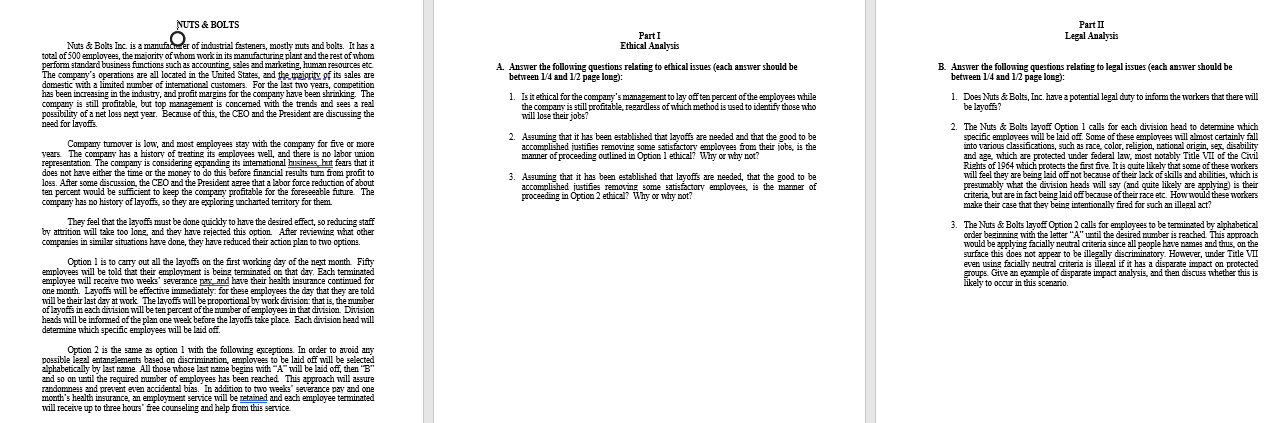
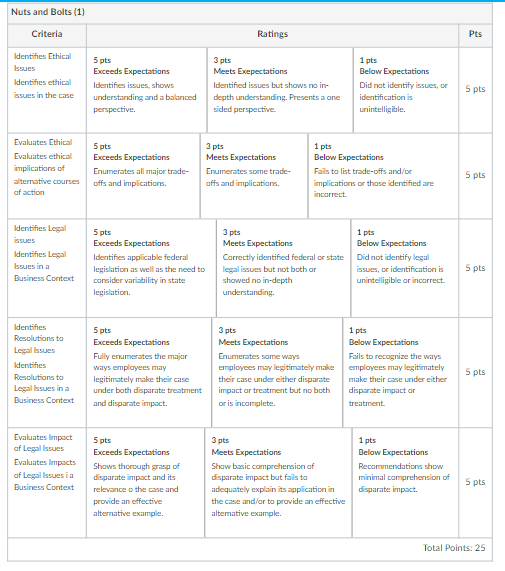
Read the fact pattern for the assignment. Then answer the questions. The first section asks for you to analyze ethical issues related the case. The second part applies employment law issues. Be sure to answer both Parts. You may not look at another student's paper to complete the assignment. Doing so will be considered a violation of the academic integrity policy. The typed answers should be no smaller than 12 point font, single spaced with one inch margins. NUTS & BOLTS Part I Ethical Analysis Part II Legal Analysis Nuts & Bolts Inc. is a manufacter of industrial fasteners, mostly nuts and bolts. It has a total of 500 employees, the majority of whom work in its manufacturing plant and the rest of whom perform standard business functions such as accounting sales and marketing, humm resources etc The company's operations are all located in the United States, and the majority of its sales are domestic with a limited number of international customers. For the last two years, competition has been increasing in the industry, and profit margins for the company have been shrinking. The company is still profitable, but top management is concemed with the trends and sees a real possibility of a net loss next year. Because of this, the CEO and the President are discussing the need for layoffs B. Answer the following questions relating to legal issues (each answer should be between 1/4 sud 12 page long): Does Nuts & Bolts, Inc. have a potential legal duty to inform the workers that there will be layoffs? A. Answer the following questions relating to ethical issues (each answer should be between 1/4 xud 1/2 page long): 1. Is it ethical for the company's management to lay offten percent of the employees while the company is still profitable, regardless of which method is used to identify those who will lose their jobs? 2. Assuming that it has been established that layoffs are needed and that the good to be accomplished justifies removing some satisfactory employees from their jobs, is the manner of proceeding outlined in Option 1 ethical? Why or wery not? 3. Assuming that it has been established that layoffs are needed, that the good to be accomplished justifies removing some satisfactory employees, is the manner of proceeding in Option 2 ethical? Why or why not? Company tumover is low, and most employee: stay with the company for five or more years. The company has a history of treating its employees well, and there is no labor union representation. The company is considering expanding its international business bort fears that it does not have either the time or the money to do this before financial results tum from profit to loss. After some discussion, the CEO and the President agree that a labor force reduction of about ten percent would be sufficient to keep the company profitable for the foreseeable future The company has no history of layoffs, so they are exploring uncharted territory for them. They feel that the layoffs must be done quickly to have the desired effect, 50 reducing staff by attrition will take too long, and they have rejected this option. After reviewing what other companies in similar situations have done, they have reduced their action plan to two options. Option 1 is to carry out all the layoffs on the first working day of the next month Fifty employees will be told that their employment is being terminated on that day. Each terminated employee will receive two weeks' severance per and have their health insurance continued for one month. Layoffs will be effective immediately for these employees the day that they are told will be their last day at work. The layoffs will be proportional by work division that is, the mumber of layoffs in each division will be ten percent of the mumber of employees in that division. Division heads will be informed of the plan one week before the layoffs take place. Each division head will determine which specific employees will be laid off. Option 2 is the same as option 1 with the following exception: In order to avoid any possible legal entanglements based on discrimination, employees to be laid off will be selected alphabetically by last name. All those whose last name begins with "A" will be laid off, then "B" and so on until the required mumber of employees has been reached This approach will assure randomness and prevent even accidental bias. In addition to two weeks' severance pay and one month's health insurance, an employment service will be retained and each employee terminated will receive up to three hours' free counseling and help from this service 2. The Nuts & Bolts layoff Option 1 calls for each division bead to determine which specific employees will be laid off. Some of these employees will almost certainly fall into various classifications, such as race, color, religion, national origin, sex, disability and age, which are protected under federal law, most notably Title VII of the Civil Rights of 1964 which protects the first five. It is quite likely that some of these workers will feel they are being laid off not because of their lack of skills and abilities, which is presumably what the division heads will say (and quite likely are applying is their criteria, but are in fact being laid off because of their race etc. How would these workers make their case that they being intentionally fired for such an illegal act? 3. The Nuts & Bolts layoff Option 2 calls for employees to be terminated by alphabetical order beginning with the letter "A" until the desired mmber is reached. This approach would be applying facially neutral criteria since all people have names and thus, on the surface this does not appear to be illegally discriminatory. However, under Title VII even using facially neutral criteria is illegal if it has a disparate impact on protected groups Give an example of disparate impact analysis, and then discuss whether this is likely to occur in this scenario. Nuts and Bolts (1) Criteria Ratings Pts 1 pts Identifies Ethical Issues Identifies ethical issues in the case 5 pts Exceeds Expectations Identifies issues, shows understanding and a balanced perspective. 3 pts Meets Exepectations Identified issues but shows no in- depth understanding. Presents a one sided perspective Below Expectations Did not identify issues, or identification is unintelligible. 5 pts Evaluates Ethical Evaluates ethical implications of alternative courses of action 5 pts Exceeds Expectations Enumerates all major trade- offs and implications. 3 pts Meets Expectations Enumerates some trade- affs and implications 1 pts Below Expectations Fails to list trade-offs and/or implications or those identified are incorrect 5 pts Identifies Legal issues Identifies Legal Issues in a Business Context 5 pts Exceeds Expectations Identifies applicable federal legislation as well as the need to consider variability in state legislation. 3 pts Meets Expectations Correctly identified federal or state legal issues but not both or showed no in-depth understanding. 1 pts Below Expectations Did not identify legal issues, or identification is unintelligible or incorrect. 5 pts Identifies Resolutions to Legal Issues Identifies Resolutions to Legal issues in a Business Context 5 pts Exceeds Expectations Fully enumerates the major ways employees may legitimately make their case under both disparate treatment and disparate impact. 3 pts Meets Expectations Enumerates some ways employees may legitimately make their case under either disparate impact or treatment but no both or is incomplete 1 pts Below Expectations Fails to recognize the ways employees may legitimately make their case under either disparate impact or treatment 5 pts luates Impact of Legal Issues Evaluates Impacts of Legal Issuesia Business Context 5 pts Exceeds Expectations Shows thorough grasp of disparate impact and its relevance the case and provide an effective alternative example, 3 pts Meets Expectations Show basic comprehension of disparate impact but fails to adequately explain its application in the case and/or to provide an effective alternative example 1 pts Below Expectations Recommendations show minimal comprehension of disparate impact. 5 pts Total Points: 25 Read the fact pattern for the assignment. Then answer the questions. The first section asks for you to analyze ethical issues related the case. The second part applies employment law issues. Be sure to answer both Parts. You may not look at another student's paper to complete the assignment. Doing so will be considered a violation of the academic integrity policy. The typed answers should be no smaller than 12 point font, single spaced with one inch margins. NUTS & BOLTS Part I Ethical Analysis Part II Legal Analysis Nuts & Bolts Inc. is a manufacter of industrial fasteners, mostly nuts and bolts. It has a total of 500 employees, the majority of whom work in its manufacturing plant and the rest of whom perform standard business functions such as accounting sales and marketing, humm resources etc The company's operations are all located in the United States, and the majority of its sales are domestic with a limited number of international customers. For the last two years, competition has been increasing in the industry, and profit margins for the company have been shrinking. The company is still profitable, but top management is concemed with the trends and sees a real possibility of a net loss next year. Because of this, the CEO and the President are discussing the need for layoffs B. Answer the following questions relating to legal issues (each answer should be between 1/4 sud 12 page long): Does Nuts & Bolts, Inc. have a potential legal duty to inform the workers that there will be layoffs? A. Answer the following questions relating to ethical issues (each answer should be between 1/4 xud 1/2 page long): 1. Is it ethical for the company's management to lay offten percent of the employees while the company is still profitable, regardless of which method is used to identify those who will lose their jobs? 2. Assuming that it has been established that layoffs are needed and that the good to be accomplished justifies removing some satisfactory employees from their jobs, is the manner of proceeding outlined in Option 1 ethical? Why or wery not? 3. Assuming that it has been established that layoffs are needed, that the good to be accomplished justifies removing some satisfactory employees, is the manner of proceeding in Option 2 ethical? Why or why not? Company tumover is low, and most employee: stay with the company for five or more years. The company has a history of treating its employees well, and there is no labor union representation. The company is considering expanding its international business bort fears that it does not have either the time or the money to do this before financial results tum from profit to loss. After some discussion, the CEO and the President agree that a labor force reduction of about ten percent would be sufficient to keep the company profitable for the foreseeable future The company has no history of layoffs, so they are exploring uncharted territory for them. They feel that the layoffs must be done quickly to have the desired effect, 50 reducing staff by attrition will take too long, and they have rejected this option. After reviewing what other companies in similar situations have done, they have reduced their action plan to two options. Option 1 is to carry out all the layoffs on the first working day of the next month Fifty employees will be told that their employment is being terminated on that day. Each terminated employee will receive two weeks' severance per and have their health insurance continued for one month. Layoffs will be effective immediately for these employees the day that they are told will be their last day at work. The layoffs will be proportional by work division that is, the mumber of layoffs in each division will be ten percent of the mumber of employees in that division. Division heads will be informed of the plan one week before the layoffs take place. Each division head will determine which specific employees will be laid off. Option 2 is the same as option 1 with the following exception: In order to avoid any possible legal entanglements based on discrimination, employees to be laid off will be selected alphabetically by last name. All those whose last name begins with "A" will be laid off, then "B" and so on until the required mumber of employees has been reached This approach will assure randomness and prevent even accidental bias. In addition to two weeks' severance pay and one month's health insurance, an employment service will be retained and each employee terminated will receive up to three hours' free counseling and help from this service 2. The Nuts & Bolts layoff Option 1 calls for each division bead to determine which specific employees will be laid off. Some of these employees will almost certainly fall into various classifications, such as race, color, religion, national origin, sex, disability and age, which are protected under federal law, most notably Title VII of the Civil Rights of 1964 which protects the first five. It is quite likely that some of these workers will feel they are being laid off not because of their lack of skills and abilities, which is presumably what the division heads will say (and quite likely are applying is their criteria, but are in fact being laid off because of their race etc. How would these workers make their case that they being intentionally fired for such an illegal act? 3. The Nuts & Bolts layoff Option 2 calls for employees to be terminated by alphabetical order beginning with the letter "A" until the desired mmber is reached. This approach would be applying facially neutral criteria since all people have names and thus, on the surface this does not appear to be illegally discriminatory. However, under Title VII even using facially neutral criteria is illegal if it has a disparate impact on protected groups Give an example of disparate impact analysis, and then discuss whether this is likely to occur in this scenario. Nuts and Bolts (1) Criteria Ratings Pts 1 pts Identifies Ethical Issues Identifies ethical issues in the case 5 pts Exceeds Expectations Identifies issues, shows understanding and a balanced perspective. 3 pts Meets Exepectations Identified issues but shows no in- depth understanding. Presents a one sided perspective Below Expectations Did not identify issues, or identification is unintelligible. 5 pts Evaluates Ethical Evaluates ethical implications of alternative courses of action 5 pts Exceeds Expectations Enumerates all major trade- offs and implications. 3 pts Meets Expectations Enumerates some trade- affs and implications 1 pts Below Expectations Fails to list trade-offs and/or implications or those identified are incorrect 5 pts Identifies Legal issues Identifies Legal Issues in a Business Context 5 pts Exceeds Expectations Identifies applicable federal legislation as well as the need to consider variability in state legislation. 3 pts Meets Expectations Correctly identified federal or state legal issues but not both or showed no in-depth understanding. 1 pts Below Expectations Did not identify legal issues, or identification is unintelligible or incorrect. 5 pts Identifies Resolutions to Legal Issues Identifies Resolutions to Legal issues in a Business Context 5 pts Exceeds Expectations Fully enumerates the major ways employees may legitimately make their case under both disparate treatment and disparate impact. 3 pts Meets Expectations Enumerates some ways employees may legitimately make their case under either disparate impact or treatment but no both or is incomplete 1 pts Below Expectations Fails to recognize the ways employees may legitimately make their case under either disparate impact or treatment 5 pts luates Impact of Legal Issues Evaluates Impacts of Legal Issuesia Business Context 5 pts Exceeds Expectations Shows thorough grasp of disparate impact and its relevance the case and provide an effective alternative example, 3 pts Meets Expectations Show basic comprehension of disparate impact but fails to adequately explain its application in the case and/or to provide an effective alternative example 1 pts Below Expectations Recommendations show minimal comprehension of disparate impact. 5 pts Total Points: 25









 Study Help