







Question: read the following article. a.) how does this relate to interest rate parity. A 10 day losing streak for the euro against the U.S. dollar
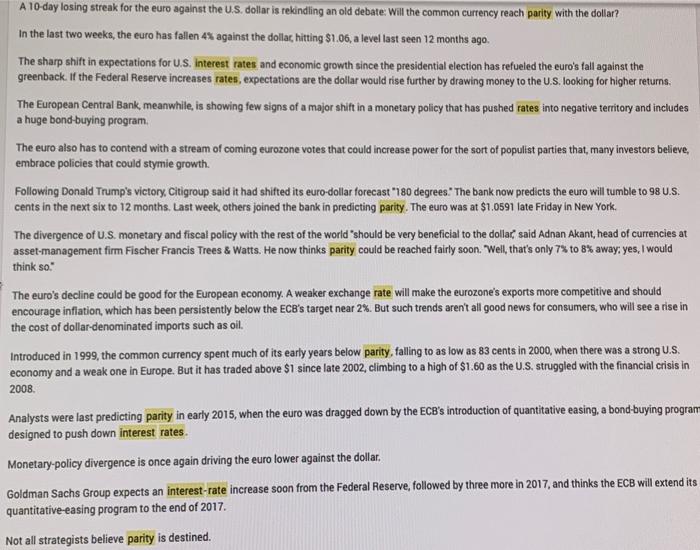
A 10 day losing streak for the euro against the U.S. dollar is rekindling an old debate: Will the common currency reach parity with the dollar? In the last two weeks, the euro has fallen 4% against the dollar, hitting $1.06, a level last seen 12 months ago The sharp shift in expectations for U.S. Interest rates and economic growth since the presidential election has refueled the euro's fall against the greenback. If the Federal Reserve increases rates, expectations are the dollar would rise further by drawing money to the U.S. looking for higher returns The European Central Bank meanwhile, is showing few signs of a major shift in a monetary policy that has pushed rates into negative territory and includes a huge bond-buying program The euro also has to contend with a stream of coming eurozone votes that could increase power for the sort of populist parties that many investors believe embrace policies that could stymie growth. Following Donald Trump's victory, Citigroup said it had shifted its euro-dollar forecast *180 degrees. The bank now predicts the euro will tumble to 98 U.S. cents in the next six to 12 months. Last week, others joined the bank in predicting parity. The euro was at $1.0591 late Friday in New York The divergence of U.S. monetary and fiscal policy with the rest of the world "should be very beneficial to the dollar said Adnan Akant, head of currencies at asset-management firm Fischer Francis Trees & Watts. He now thinks parity could be reached fairly soon. Well, that's only 7% to 8% away, yes, I would think so The euro's decline could be good for the European economy. A weaker exchange rate will make the eurozone's exports more competitive and should encourage inflation, which has been persistently below the ECB's target near 2%. But such trends aren't all good news for consumers, who will see a rise in the cost of dollar-denominated imports such as oil. Introduced in 1999, the common currency spent much of its early years below parity, falling to as low as 83 cents in 2000, when there was a strong U.S. economy and a weak one in Europe. But it has traded above $1 since late 2002, climbing to a high of $1.60 as the U.S. struggled with the financial crisis in 2008 Analysts were last predicting parity in early 2015, when the euro was dragged down by the ECB's introduction of quantitative easing, a bond-buying program designed to push down interest rates. Monetary-policy divergence is once again driving the euro lower against the dollar. Goldman Sachs Group expects an interest-rate increase soon from the Federal Reserve, followed by three more in 2017, and thinks the ECB will extend its quantitative-easing program to the end of 2017. Not all strategists believe parity is destined. A 10 day losing streak for the euro against the U.S. dollar is rekindling an old debate: Will the common currency reach parity with the dollar? In the last two weeks, the euro has fallen 4% against the dollar, hitting $1.06, a level last seen 12 months ago The sharp shift in expectations for U.S. Interest rates and economic growth since the presidential election has refueled the euro's fall against the greenback. If the Federal Reserve increases rates, expectations are the dollar would rise further by drawing money to the U.S. looking for higher returns The European Central Bank meanwhile, is showing few signs of a major shift in a monetary policy that has pushed rates into negative territory and includes a huge bond-buying program The euro also has to contend with a stream of coming eurozone votes that could increase power for the sort of populist parties that many investors believe embrace policies that could stymie growth. Following Donald Trump's victory, Citigroup said it had shifted its euro-dollar forecast *180 degrees. The bank now predicts the euro will tumble to 98 U.S. cents in the next six to 12 months. Last week, others joined the bank in predicting parity. The euro was at $1.0591 late Friday in New York The divergence of U.S. monetary and fiscal policy with the rest of the world "should be very beneficial to the dollar said Adnan Akant, head of currencies at asset-management firm Fischer Francis Trees & Watts. He now thinks parity could be reached fairly soon. Well, that's only 7% to 8% away, yes, I would think so The euro's decline could be good for the European economy. A weaker exchange rate will make the eurozone's exports more competitive and should encourage inflation, which has been persistently below the ECB's target near 2%. But such trends aren't all good news for consumers, who will see a rise in the cost of dollar-denominated imports such as oil. Introduced in 1999, the common currency spent much of its early years below parity, falling to as low as 83 cents in 2000, when there was a strong U.S. economy and a weak one in Europe. But it has traded above $1 since late 2002, climbing to a high of $1.60 as the U.S. struggled with the financial crisis in 2008 Analysts were last predicting parity in early 2015, when the euro was dragged down by the ECB's introduction of quantitative easing, a bond-buying program designed to push down interest rates. Monetary-policy divergence is once again driving the euro lower against the dollar. Goldman Sachs Group expects an interest-rate increase soon from the Federal Reserve, followed by three more in 2017, and thinks the ECB will extend its quantitative-easing program to the end of 2017. Not all strategists believe parity is destined
Step by Step Solution
There are 3 Steps involved in it

Get step-by-step solutions from verified subject matter experts
 Study Help