







Question: Read the following case study and ALL answer the questions that follow. Performance Management at Gypsy Tigers Gypsy Tigers is a medium - sized manufacturing
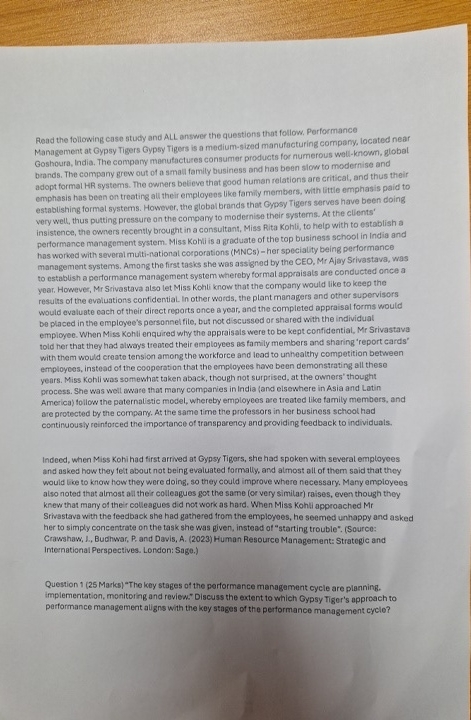
Read the following case study and ALL answer the questions that follow. Performance Management at Gypsy Tigers Gypsy Tigers is a mediumsized manufacturing company, located near Goshoura, India. The compary menutactures consumer products for numerous wellknown, global brands. The compary grew out of a small family business and has been slow to modernise and adopt formal HR systems. The owners believe that good human relations are critical, and thus their emphasis has been on treatirg all their employees like family members, with little emphasis paid to establishing formal systems. However, the global brands that Gypsy Tigers serves have been doing very well, thus putting pressure on the compary to modernise their systems. At the clients' insistence, the owners recently brought in a consultant, Miss Rita Kohli, to help with to establish a performance management system. Miss Kohli is a graduate of the top business school in India and has worked with several multinational corporations MNCs her speciality being performance management systems. Among the first tasks she was assigned by the CEO, Mr Ajay Srivastava, was to establish a performance management system whereby formal appraisals are conducted once a year. However, Mr Srivastava also let Miss Kohti know that the company would like to keep the results of the evaluations contidential. In other words, the plant managers and other supervisors would evaluate each of their direct reports ance a year, and the completed appraisal forms would be placed in the employee's personnel file, but not discussed or shared with the individual empioyee. When Miss Kohli enquired why the appraisals were to be kept confidential, Mr Srivastava told her that they had always treated their employees as family members and sharing 'report cards' with them would create tension among the workforce and lead to unhealthy competition between employces, instead of the cooperation that the employees hawo been demonstrating all these years. Miss Kohli was somewhat taken aback, though not surprised, at the owners' thought process. She was well aware that mary comparies in India and elsewhere in Asia and Latin America follow the paternalistic model, whereby employees are treated like family members, and are protected by the compary. At the same time the professors in her business school had continuously reinforced the importance of transparency and providing feedback to individuals.
Indeed, when Miss Kohi had first arrived at Gypsy Tigors, she had spoken with several employees and asked how they felt about not being evaluated formally, and almost all of them said that they would tike to know how they were doing, so they could improve where necessary. Many employees also noted that almost all their colleagues gor the same or very similar raises, even though they knew that many of their colleagues did not work as hard. When Miss Kohll approached Mr Srivastava with the feadback she had gathered from the employees, he seemed unhappy and asked her to simply concentrate on the task she was given, instead of "starting trouble". Source: Crawshaw, L Buchwar, P and Davis, A Human Resource Management: Strategic and International Perspectives. London: Sago.
Question MarksThe key stages of the performance management cycle are planning. implementation, monitoring and review D Dcuss the extent to which Gypsy Tiger's approach to performance management aligns with the key stages of the performance management cycle?
Step by Step Solution
There are 3 Steps involved in it
1 Expert Approved Answer
Step: 1 Unlock

Question Has Been Solved by an Expert!
Get step-by-step solutions from verified subject matter experts
Step: 2 Unlock
Step: 3 Unlock
 Study Help