







Question: Read the following case study and answer the questions that follow: ( 3 0 Marks ) Globalisation of Starbucks Thirty years ago, Starbucks was a
Read the following case study and answer the questions that follow:
Marks
Globalisation of Starbucks
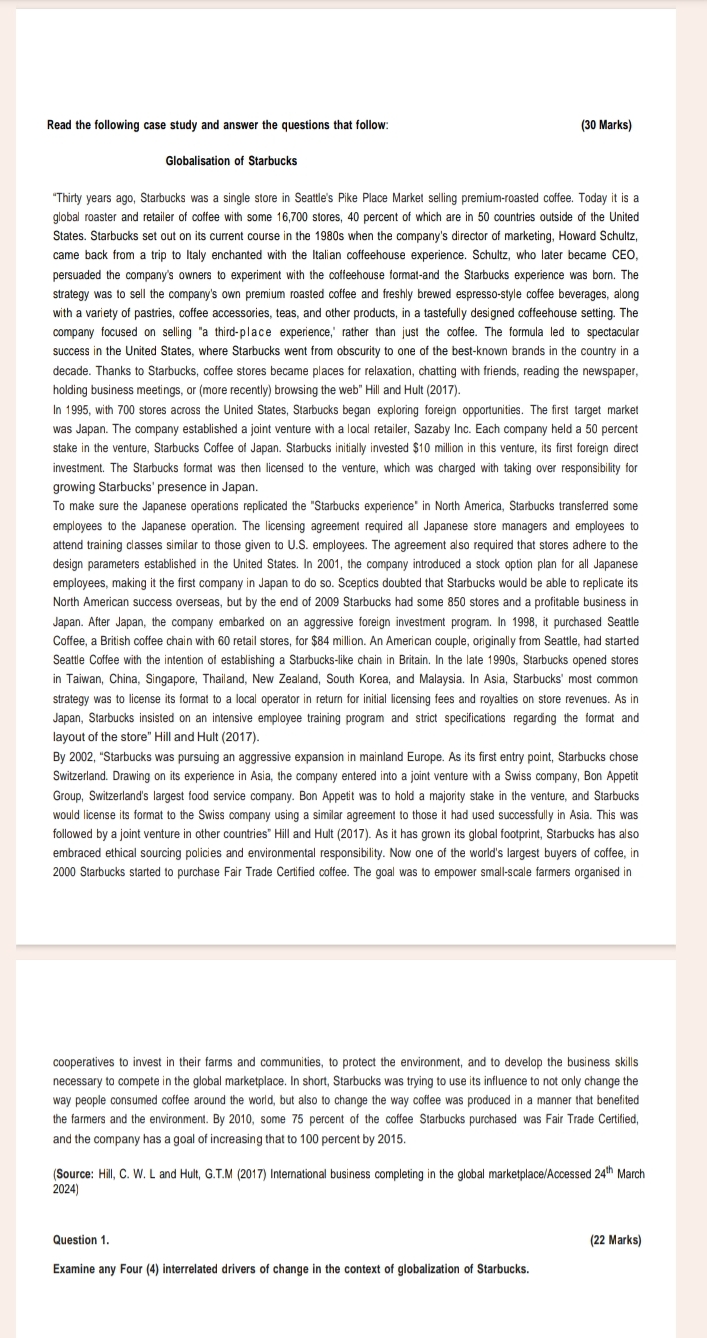
"Thirty years ago, Starbucks was a single store in Seattle's Pike Place Market selling premiumroasted coffee. Today it is a global roaster and retailer of coffee with some stores, percent of which are in countries outside of the United States. Starbucks set out on its current course in the s when the company's director of marketing, Howard Schultz, came back from a trip to Italy enchanted with the Italian coffeehouse experience. Schultz, who later became CEO, persuaded the company's owners to experiment with the coffeehouse formatand the Starbucks experience was born. The strategy was to sell the company's own premium roasted coffee and freshly brewed espressostyle coffee beverages, along with a variety of pastries, coffee accessories, teas, and other products, in a tastefully designed coffeehouse setting. The company focused on selling "a thirdplace experience," rather than just the coffee. The formula led to spectacular success in the United States, where Starbucks went from obscurity to one of the bestknown brands in the country in a decade. Thanks to Starbucks, coffee stores became places for relaxation, chatting with friends, reading the newspaper, holding business meetings, or more recently browsing the web" Hill and Hult
In with stores across the United States, Starbucks began exploring foreign opportunities. The first target market was Japan. The company established a joint venture with a local retailer, Sazaby Inc. Each company held a percent stake in the venture, Starbucks Coffee of Japan. Starbucks initially invested $ million in this venture, its first foreign direct investment. The Starbucks format was then licensed to the venture, which was charged with taking over responsibility for growing Starbucks' presence in Japan.
To make sure the Japanese operations replicated the "Starbucks experience" in North America, Starbucks transierred some employees to the Japanese operation. The licensing agreement required all Japanese store managers and employees to attend training classes similar to those given to US employees. The agreement also required that stores adhere to the design parameters established in the United States. In the company introduced a stock option plan for all Japanese employees, making it the first company in Japan to do so Sceptics doubted that Starbucks would be able to replicate its North American success overseas, but by the end of Starbucks had some stores and a profitable business in Japan. After Japan, the company embarked on an aggressive foreign investment program. In it purchased Seattle Coffee, a British coffee chain with retail stores, for $ million. An American couple, originally from Seattle, had started Seattle Coffee with the intention of establishing a Starbuckslike chain in Britain. In the late s Starbucks opened stores in Taiwan, China, Singapore, Thailand, New Zealand, South Korea, and Malaysia. In Asia, Starbucks' most common strategy was to license its format to a local operator in return for initial licensing fees and royalties on store revenues. As in Japan, Starbucks insisted on an intensive employee training program and strict specifications regarding the format and layout of the store" Hill and Hult
By "Starbucks was pursuing an aggressive expansion in mainland Europe. As its first entry point, Starbucks chose Switzerland. Drawing on its experience in Asia, the company entered into a joint venture with a Swiss company, Bon Appetit Group, Switzerland's largest food service company. Bon Appetit was to hold a majority stake in the venture, and Starbucks would license its format to the Swiss company using a similar agreement to those it had used successfully in Asia. This was followed by a joint venture in other countries" Hill and Hult As it has grown its global footprint, Starbucks has also embraced ethical sourcing policies and environmental responsibility. Now one of the world's largest buyers of coffee, in Starbucks started to purchase Fair Trade Certified coffee. The goal was to empower smallscale farmers organised in
cooperatives to invest in their farms and communities, to protect the environment, and to develop the business skills necessary to compete in the global marketplace. In short, Starbucks was trying to use its influence to not only change the way people consumed coffee around the world, but also to change the way coffee was produced in a manner that benefited the farmers and the environment. By some percent of the coffee Starbucks purchased was Fair Trade Certified, and the company has a goal of increasing that to percent by
Source: Hill, C W L and Hult, GTM International business completing in the global marketplaceAccessed
Step by Step Solution
There are 3 Steps involved in it
1 Expert Approved Answer
Step: 1 Unlock

Question Has Been Solved by an Expert!
Get step-by-step solutions from verified subject matter experts
Step: 2 Unlock
Step: 3 Unlock
 Study Help