







Question: Read the following case study and identify the External and Internal Environments. CASE 9 Amazon.con allowing them control over their inventory. Amazon's Fulfillment Web Service
Read the following case study and identify the External and Internal Environments.
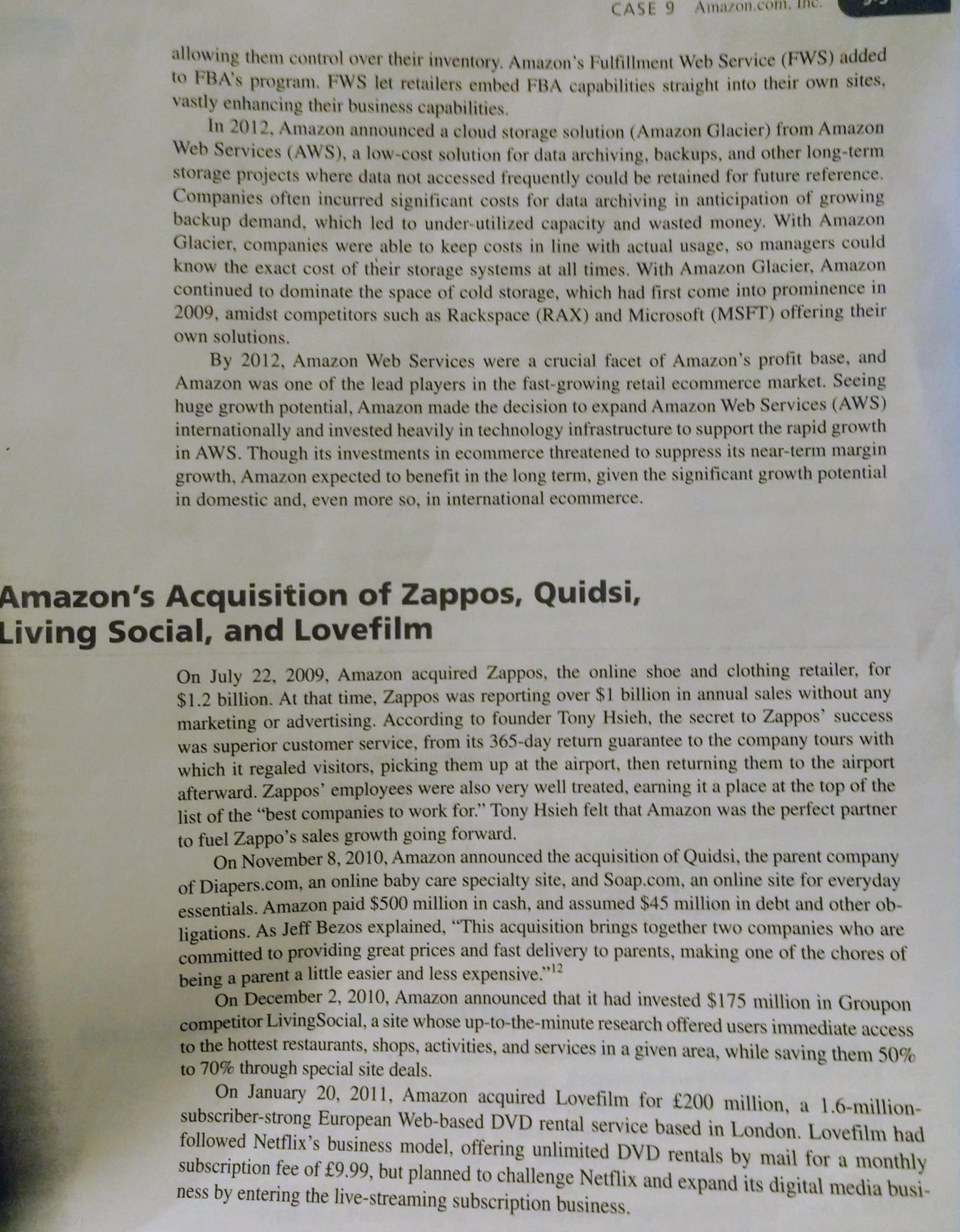
CASE 9 Amazon.con allowing them control over their inventory. Amazon's Fulfillment Web Service (FWS) added to FBA's program. FWS let retailers embed FBA capabilities straight into their own sites, vastly enhancing their business capabilities. In 2012, Amazon announced a cloud storage solution (Amazon Glacier) from Amazon Web Services (AWS), a low-cost solution for data archiving, backups, and other long-term storage projects where data not accessed frequently could be retained for future reference. Companies often incurred significant costs for data archiving in anticipation of growing backup demand, which led to under-utilized capacity and wasted money. With Amazon Glacier, companies were able to keep costs in line with actual usage, so managers could know the exact cost of their storage systems at all times, With Amazon Glacier, Amazon continued to dominate the space of cold storage, which had first come into prominence in 2009, amidst competitors such as Rackspace (RAX) and Microsoft (MSFT) offering their own solutions. By 2012, Amazon Web Services were a crucial facet of Amazon's profit base, and Amazon was one of the lead players in the fast-growing retail ecommerce market. Seeing huge growth potential, Amazon made the decision to expand Amazon Web Services (AWS) internationally and invested heavily in technology infrastructure to support the rapid growth in AWS. Though its investments in ecommerce threatened to suppress its near-term margin growth, Amazon expected to benefit in the long term, given the significant growth potential in domestic and, even more so, in international ecommerce. Amazon's Acquisition of Zappos, Quidsi, Living Social, and Lovefilm On July 22, 2009, Amazon acquired Zappos, the online shoe and clothing retailer, for $1.2 billion. At that time, Zappos was reporting over $1 billion in annual sales without any marketing or advertising. According to founder Tony Hsieh, the secret to Zappos' success was superior customer service, from its 365-day return guarantee to the company tours with which it regaled visitors, picking them up at the airport, then returning them to the airport afterward. Zappos' employees were also very well treated, earning it a place at the top of the list of the "best companies to work for." Tony Hsieh felt that Amazon was the perfect partner to fuel Zappo's sales growth going forward. On November 8, 2010, Amazon announced the acquisition of Quidsi, the parent company of Diapers.com, an online baby care specialty site, and Soap.com, an online site for everyday essentials. Amazon paid $500 million in cash, and assumed $45 million in debt and other ob- ligations. As Jeff Bezos explained, "This acquisition brings together two companies who are committed to providing great prices and fast delivery to parents, making one of the chores of being a parent a little easier and less expensive." On December 2, 2010, Amazon announced that it had invested $175 million in Groupon competitor LivingSocial, a site whose up-to-the-minute research offered users immediate access to the hottest restaurants, shops, activities, and services in a given area, while saving them 50% to 70% through special site deals. On January 20, 2011, Amazon acquired Lovefilm for 200 million, a 1.6-million- subscriber-strong European Web-based DVD rental service based in London. Lovefilm had followed Netflix's business model, offering unlimited DVD rentals by mail for a monthly subscription fee of 19.99, but planned to challenge Netflix and expand its digital media busi- ness by entering the live-streaming subscription business
Step by Step Solution
There are 3 Steps involved in it

Get step-by-step solutions from verified subject matter experts
 Study Help