







Question: Read the following case study before answering the question below: Nissan Motor Company is facing a challenge this year to meet the minimum 50 000
Read the following case study before answering the question below:
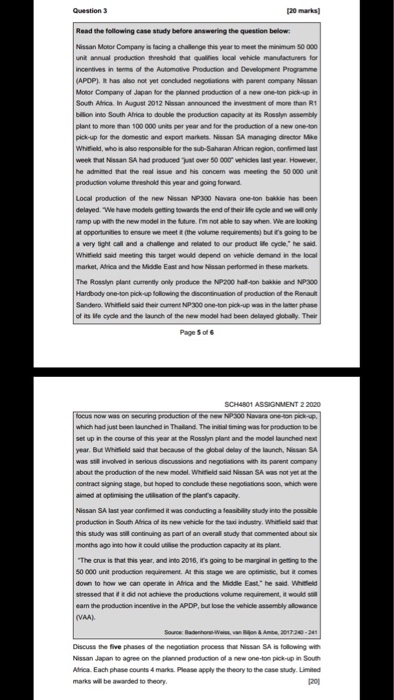
Nissan Motor Company is facing a challenge this year to meet the minimum 50 000 unit annual production threshold that qualifies local vehicle manufacturers for incentives in terms of the Automotive Production and Development Programme (APDP). It has also not yet concluded negotiations with parent company Nissan Motor Company of Japan for the planned production of a new one-ton pick-up in South Africa. In August 2012 Nissan announced the investment of more than R1billion into South Africa to double the production capacity at its Rosslyn assembly plant to more than 100 000 units per year and for the production of a new one-ton pick-up for the domestic and export markets. Nissan SA managing director Mike
Whitfield, who is also responsible for the sub-Saharan African region, confirmed last
week that Nissan SA had produced just over 50 000 vehicles last year. However, he admitted that the real issue and his concern was meeting the 50 000 unit production volume threshold this year and going forward.
Local production of the new Nissan NP300 Navara one-ton bakkie has been delayed. We have models getting towards the end of their life cycle and we will only ramp up with the new model in the future. Im not able to say when. We are looking at opportunities to ensure we meet it (the volume requirements) but its going to be a very tight call and a challenge and related to our product life cycle, he said. Whitfield said meeting this target would depend on vehicle demand in the local market, Africa and the Middle East and how Nissan performed in these markets.
The Rosslyn plant currently only produce the NP200 half-ton bakkie and NP300
Hardbody one-ton pick-up following the discontinuation of production of the Renault Sandero. Whitfield said their current NP300 one-ton pick-up was in the latter phase of its life cycle and the launch of the new model had been delayed globally. Their focus now was on securing production of the new NP300 Navara one-ton pick-up, which had just been launched in Thailand. The initial timing was for production to be set up in the course of this year at the Rosslyn plant and the model launched next year. But Whitfield said that because of the global delay of the launch, Nissan SA
was still involved in serious discussions and negotiations with its parent company about the production of the new model. Whitfield said Nissan SA was not yet at the contract signing stage, but hoped to conclude these negotiations soon, which were aimed at optimising the utilisation of the plants capacity.
Nissan SA last year confirmed it was conducting a feasibility study into the possible
production in South Africa of its new vehicle for the taxi industry. Whitfield said that this study was still continuing as part of an overall study that commented about six months ago into how it could utilise the production capacity at its plant.
The crux is that this year, and into 2016, its going to be marginal in getting to the 50 000 unit production requirement. At this stage we are optimistic, but it comes
down to how we can operate in Africa and the Middle East, he said. Whitfield stressed that if it did not achieve the productions volume requirement, it would still earn the production incentive in the APDP, but lose the vehicle assembly allowance
(VAA).
Discuss the five phases of the negotiation process that Nissan SA is following with Nissan Japan to agree on the planned production of a new one-ton pick-up in South Africa. Each phase counts 4 marks. Please apply the theory to the case study. Limited
marks will be awarded to theory.
Step by Step Solution
There are 3 Steps involved in it
1 Expert Approved Answer
Step: 1 Unlock

Question Has Been Solved by an Expert!
Get step-by-step solutions from verified subject matter experts
Step: 2 Unlock
Step: 3 Unlock
 Study Help