







Question: Read the following ethical case and solve the case based on utilitarianism. You need to argue for your solution based on utilitarianism . (3 Marks).
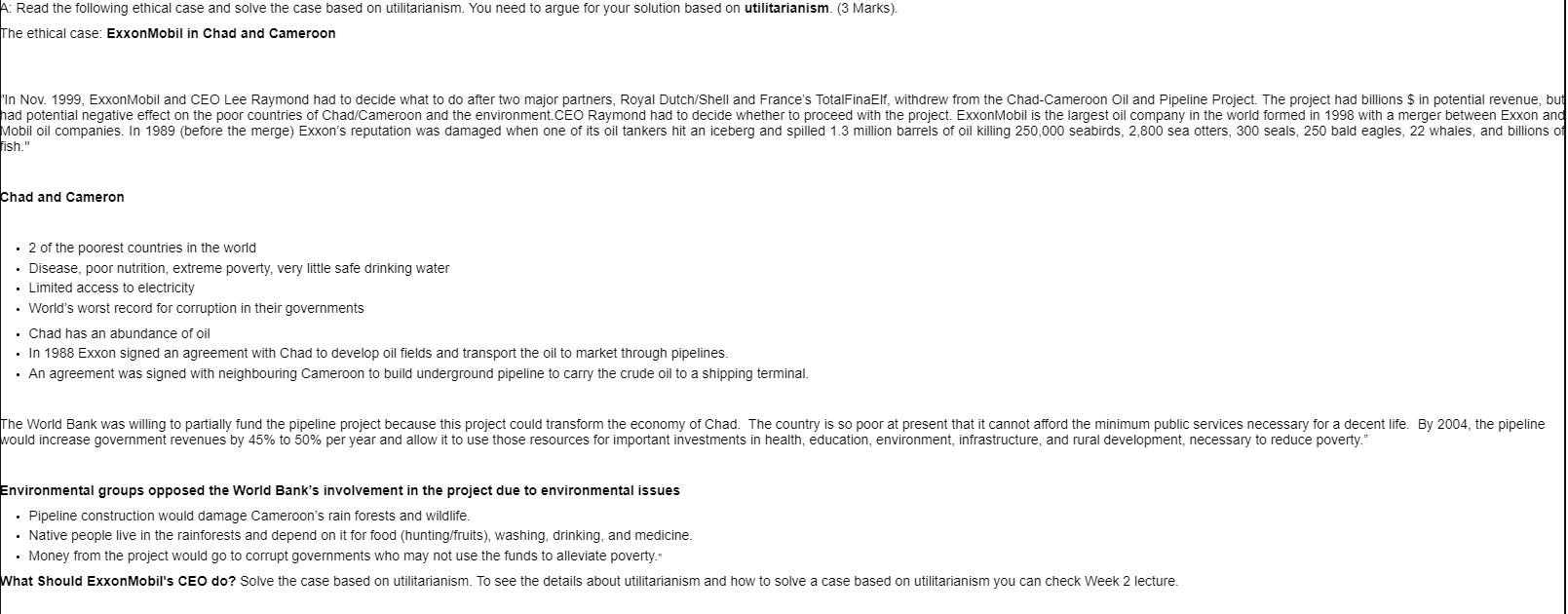
Read the following ethical case and solve the case based on utilitarianism. You need to argue for your solution based on utilitarianism. (3 Marks).
The ethical case: ExxonMobil in Chad and Cameroon
"In Nov. 1999, ExxonMobil and CEO Lee Raymond had to decide what to do after two major partners, Royal Dutch/Shell and Frances TotalFinaElf, withdrew from the Chad-Cameroon Oil and Pipeline Project. The project had billions $ in potential revenue, but had potential negative effect on the poor countries of Chad/Cameroon and the environment.CEO Raymond had to decide whether to proceed with the project. ExxonMobil is the largest oil company in the world formed in 1998 with a merger between Exxon and Mobil oil companies. In 1989 (before the merge) Exxons reputation was damaged when one of its oil tankers hit an iceberg and spilled 1.3 million barrels of oil killing 250,000 seabirds, 2,800 sea otters, 300 seals, 250 bald eagles, 22 whales, and billions of fish."
Chad and Cameron
- 2 of the poorest countries in the world
- Disease, poor nutrition, extreme poverty, very little safe drinking water
- Limited access to electricity
- Worlds worst record for corruption in their governments
- Chad has an abundance of oil
- In 1988 Exxon signed an agreement with Chad to develop oil fields and transport the oil to market through pipelines.
- An agreement was signed with neighbouring Cameroon to build underground pipeline to carry the crude oil to a shipping terminal.
The World Bank was willing to partially fund the pipeline project because this project could transform the economy of Chad. The country is so poor at present that it cannot afford the minimum public services necessary for a decent life. By 2004, the pipeline would increase government revenues by 45% to 50% per year and allow it to use those resources for important investments in health, education, environment, infrastructure, and rural development, necessary to reduce poverty.
Environmental groups opposed the World Banks involvement in the project due to environmental issues
- Pipeline construction would damage Cameroons rain forests and wildlife.
- Native people live in the rainforests and depend on it for food (hunting/fruits), washing, drinking, and medicine.
- Money from the project would go to corrupt governments who may not use the funds to alleviate poverty."
What Should ExxonMobil's CEO do? Solve the case based on utilitarianism. To see the details about utilitarianism and how to solve a case based on utilitarianism you can check Week 2 lecture.
Reference: Derived from Teaching Notes of Business Ethics: A Managerial Approach. Author: Andrew Wicks, R. Edward Freeman, Patricia H. Werhane, Kirsten E. Martin. Publisher: Pearson. (2010).(Business Ethics: A Managerial Approach. pp. 335-347)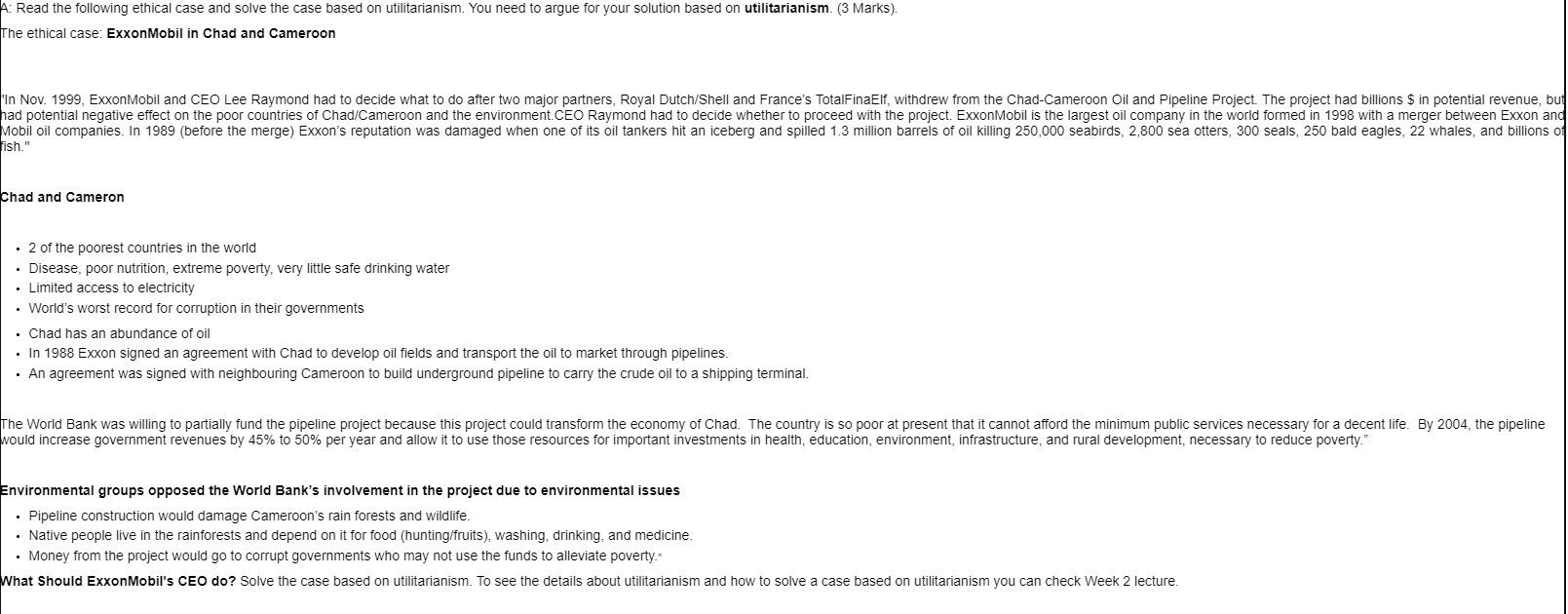
Step by Step Solution
There are 3 Steps involved in it

Get step-by-step solutions from verified subject matter experts
 Study Help