



Question: Read the following Passages and summarize 2 main points. D. Stock Splits and Trading Activity? 3 We often are asked why Berkshire does not split
Read the following Passages and summarize 2 main points.
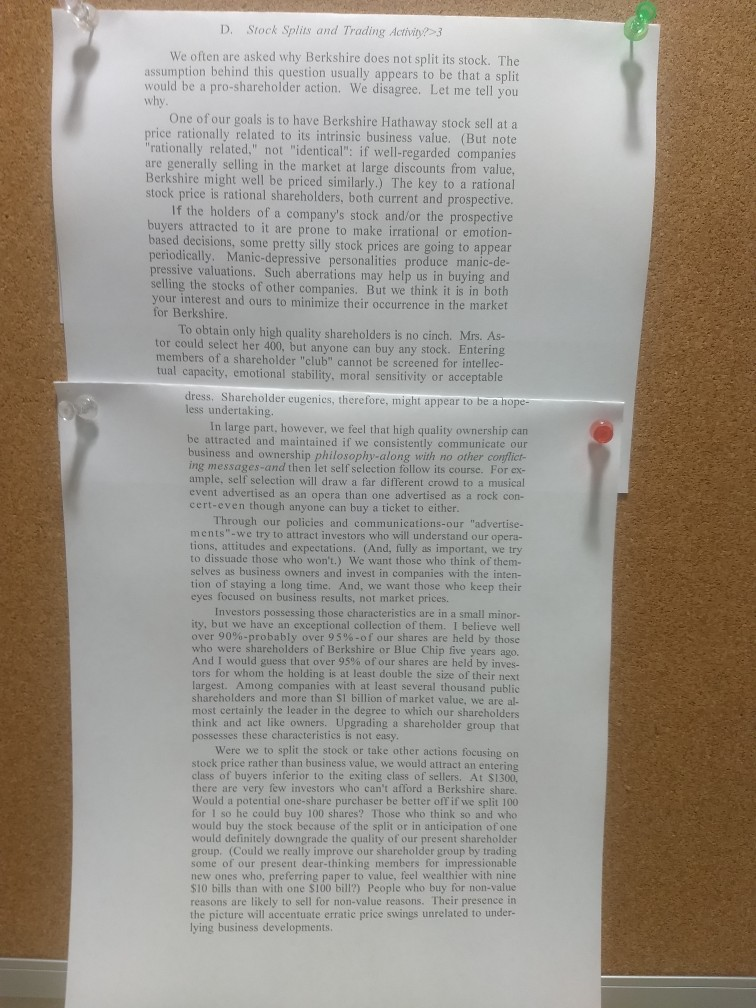
D. Stock Splits and Trading Activity? 3 We often are asked why Berkshire does not split its stock. The assumption behind this question usually appears to be that a split would be a pro-shareholder action. We disagree. Let me tell you One of our goals is to have Berkshire Hathaway stock sell at a price rationally related to its intrinsic business value. (But note rationally related," not "identical": if well-regarded companies are generally selling in the market at large discounts from value, Berkshire might well be priced similarly.) The key to a rational stock price is rational shareholders, both current and prospective. If the holders of a company's stock and/or the prospective buyers attracted to it are prone to make irrational or emotion- based decisions, some pretty silly stock prices are going to appear periodi pressive valuations. Such aberrations may help us in buying an selling the stocks of other companies. But we think it is in both your interest and ours to minimize their occurrence in the market for Berkshire ically. Manic-depressive personalities produce manic-de- To obtain only high quality shareholders is no cinch. Mrs. As- tor could select her 400, but anyone can buy any stock. Entering members of a shareholder "club" cannot be screened for intellec- tual capacity, emotional stability, moral sensitivity or acceptable dress, Shareholder eugenics, therefore, might appear to be a hope- less undertaking. In large part, however, we feel that high quality ownership can be attracted and maintained if we consistently communicate our business and ownership philosophy-along with no other conflict- ing messages-and then let self selection follow its course. For ex- ample, self selection will draw a far different crowd to a musical event advertised as an opera than one advertised as a rock con- cert-even though anyone can buy a ticket to either. Through our policies and communications-our "advertise- ments"-we try to attract investors who will understand our opera- ons, attitudes and expectations. (And, fully as important, we try to dissuade those who won't.) We want those who think of them- selves as business owners and invest in companies with the inten- tion of staying a long time. And, we want those who keep their eyes focused on business results, not market prices Investors possessing those characteristics are in a small minor- ity, but we have an exceptional collection of them. I believe well over 90%-probably over 95%-of our shares are held by those who were shareholders of Berkshire or Blue Chip five years ago. And I would guess that over 95% of our shares are held by inves- tors for whom the holding is at least double the size of their next largest. Among companies with at least several thousand public shareholders and more than SI billion of market value, we are al- most certainly the leader in the degree to which our shareholders hink and act like owners. Upgrading a shareholder group that pos sesses these characteristics is not easy Were we to split the stock or take other actions focusing on stock price rather than business value, we would attract an entering class of buyers inferior to the exiting class of sellers. At $1300 there are very few investors who can't afford a Berkshire share. Would a potential one-share purchaser be better off if we split 100 for I so he could buy 100 shares? Those who think so and who would buy the stock because of the split or in anticipation of one would definitely downgrade the quality of our present shareholder group. (Could we really improve our shareholder group by trading some of our present dear-thinking members for impressionable new ones who, preferring paper to value, feel wealthier with nine $10 bills than with one $100 bill?) People who buy for non-value reasons are likely to sell for non-value reasons. Their presence in the picture will accentuate erratic price swings unrelated to under- lying business developments
Step by Step Solution
There are 3 Steps involved in it

Get step-by-step solutions from verified subject matter experts