







Question: Read the GVV case Lisa Baxter: Developing a Voice. Respond to the following questions: What do you think of the ways in which Baxter handled
Read the GVV case Lisa Baxter: Developing a Voice. Respond to the following questions:
What do you think of the ways in which Baxter handled each of the situations? What did she do well? What might she have done better?
If you were in Baxter's position, how would you have prepared for her actions?
What can you learn from Baxter's experiences? About voice/? About risk? About priorities?
Remember your initial post must be a minimum of 200 words.
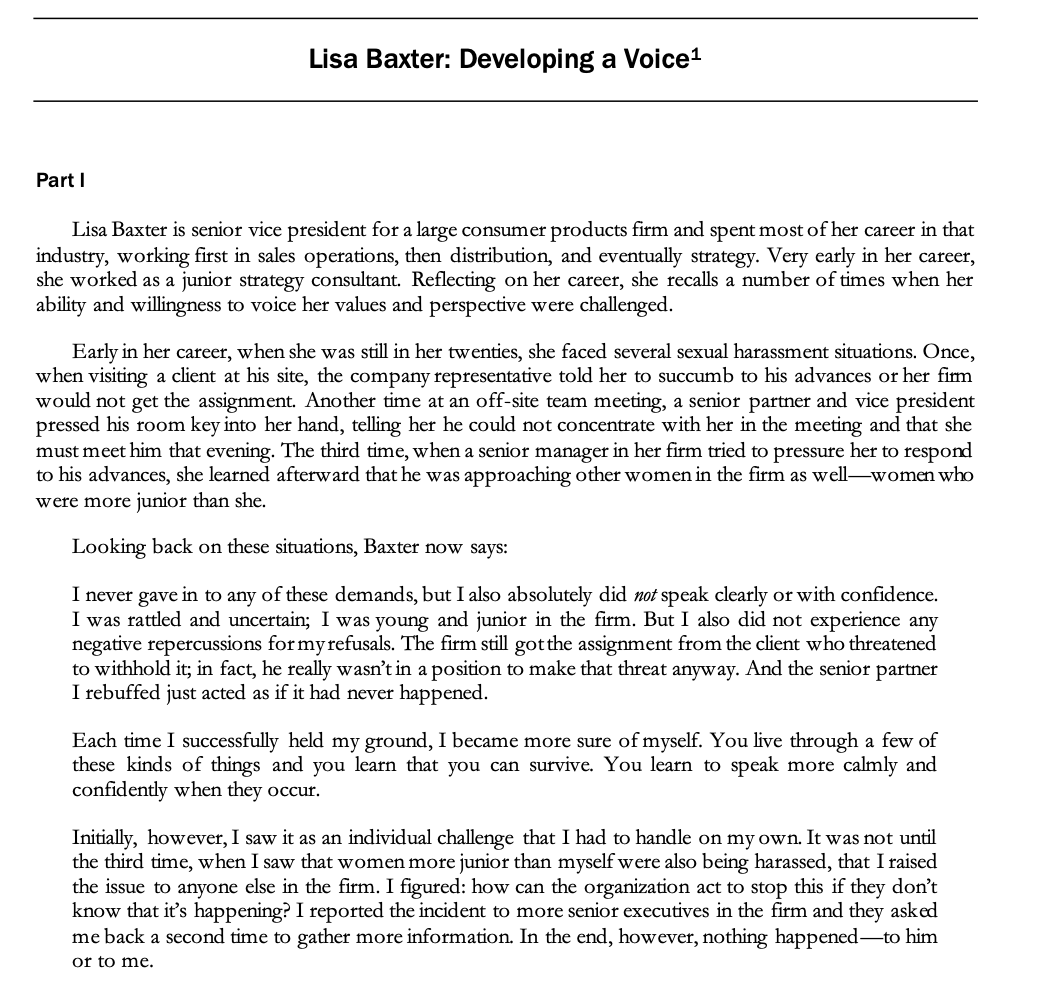
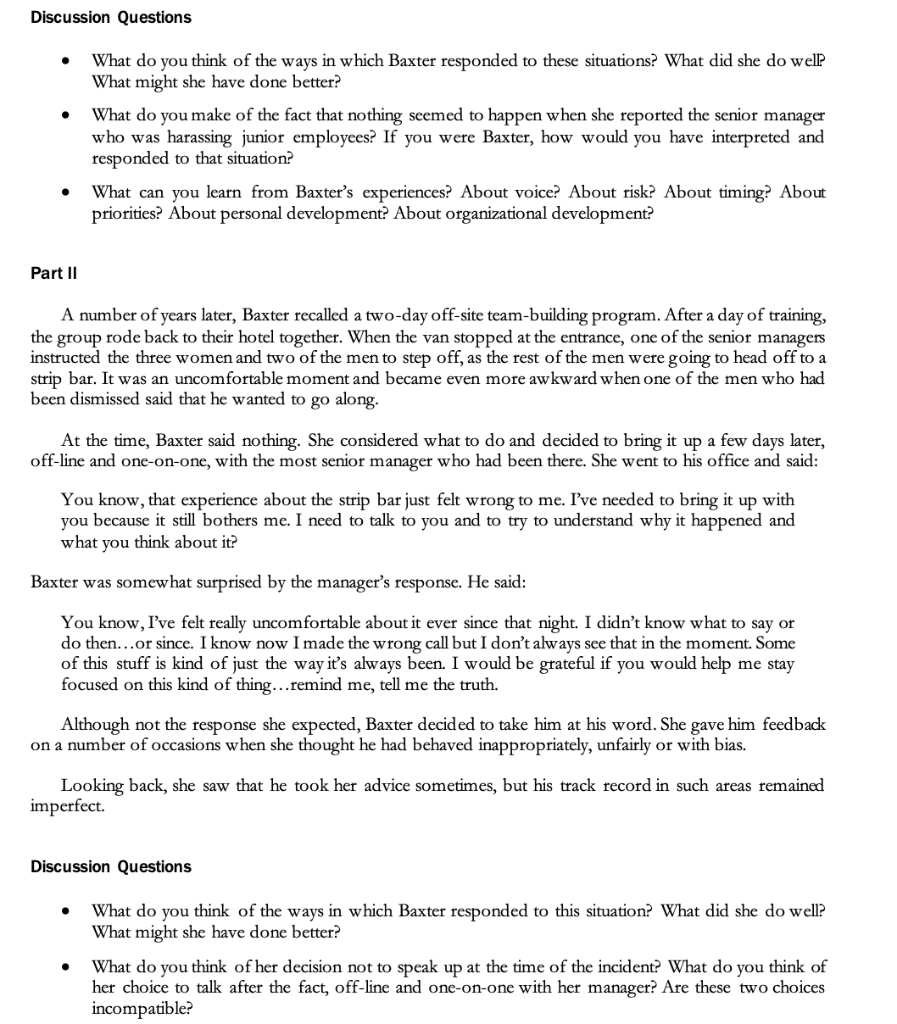
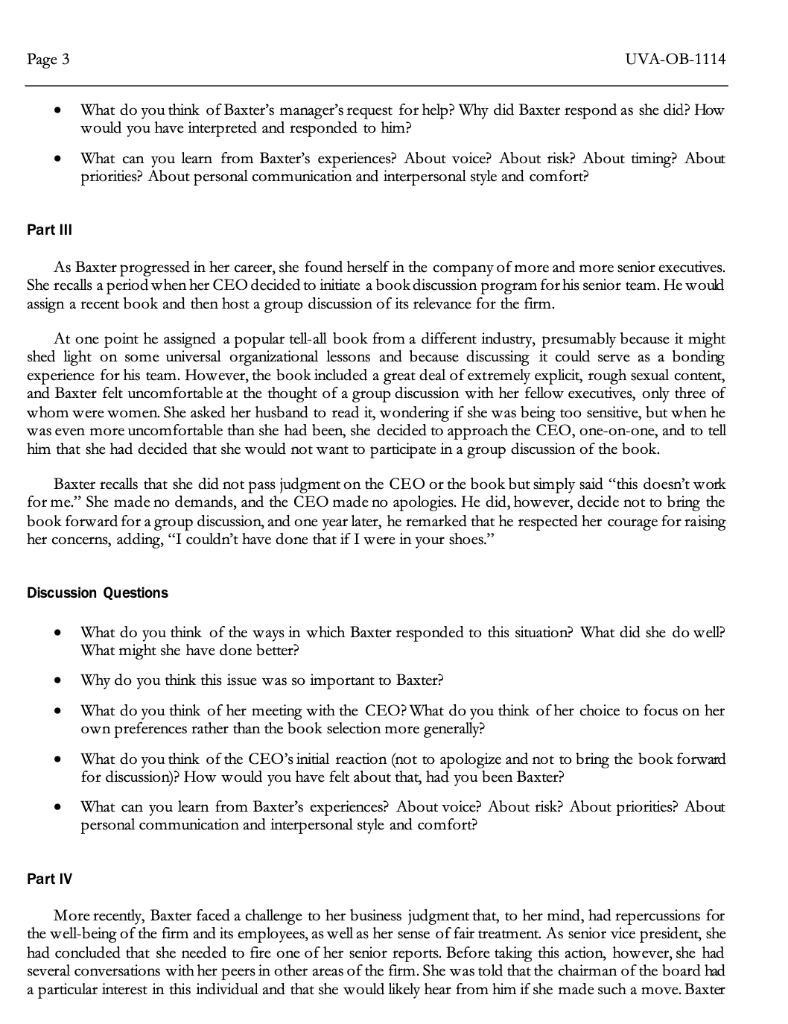
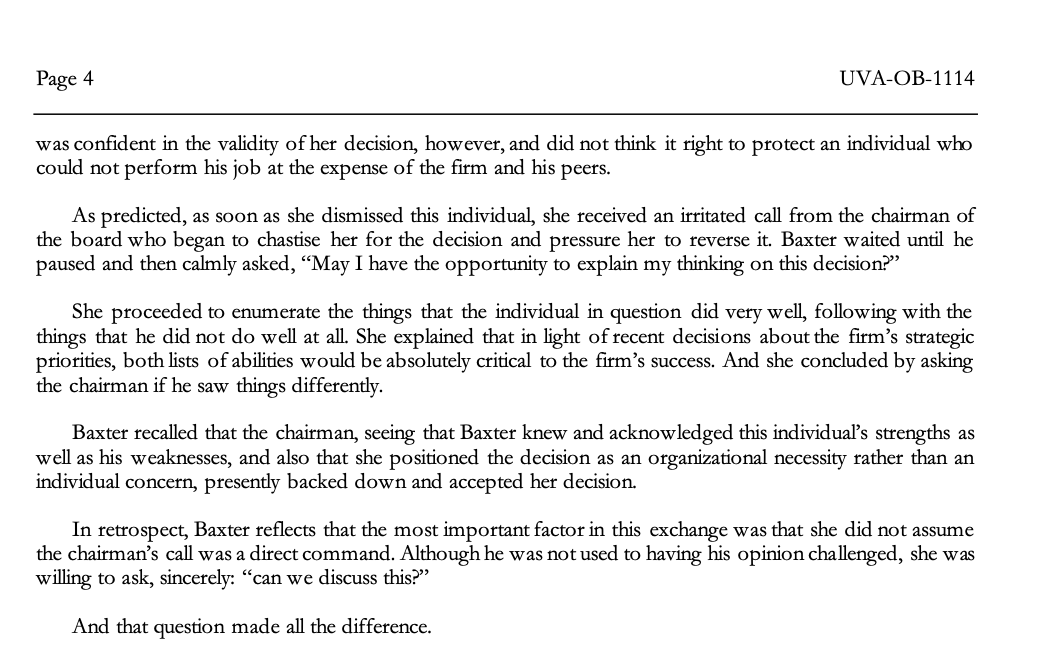
Lisa Baxter is senior vice president for a large consumer products firm and spent most of her career in that ndustry, working first in sales operations, then distribution, and eventually strategy. Very early in her career, he worked as a junior strategy consultant. Reflecting on her career, she recalls a number of times when her bility and willingness to voice her values and perspective were challenged. Early in her career, when she was still in her twenties, she faced several sexual harassment situations. Once, then visiting a client at his site, the company representative told her to succumb to his advances or her firm rould not get the assignment. Another time at an off-site team meeting, a senior partner and vice president ressed his room key into her hand, telling her he could not concentrate with her in the meeting and that she nust meet him that evening. The third time, when a senior manager in her firm tried to pressure her to respond o his advances, she learned afterward that he was approaching other women in the firm as well-women who vere more junior than she. Looking back on these situations, Baxter now says: I never gave in to any of these demands, but I also absolutely did not speak clearly or with confidence. I was rattled and uncertain; I was young and junior in the firm. But I also did not experience any negative repercussions for my refusals. The firm still got the assignment from the client who threatened to withhold it; in fact, he really wasn't in a position to make that threat anyway. And the senior partner I rebuffed just acted as if it had never happened. Each time I successfully held my ground, I became more sure of myself. You live through a few of these kinds of things and you learn that you can survive. You learn to speak more calmly and confidently when they occur. Initially, however, I saw it as an individual challenge that I had to handle on my own. It was not until the third time, when I saw that women more junior than myself were also being harassed, that I raised the issue to anyone else in the firm. I figured: how can the organization act to stop this if they don't know that it's happening? I reported the incident to more senior executives in the firm and they asked me back a second time to gather more information. In the end, however, nothing happened-to him or to me. Discussion Questions - What do you think of the ways in which Baxter responded to these situations? What did she do well? What might she have done better? - What do you make of the fact that nothing seemed to happen when she reported the senior manager who was harassing junior employees? If you were Baxter, how would you have interpreted and responded to that situation? - What can you learn from Baxter's experiences? About voice? About risk? About timing? About priorities? About personal development? About organizational development? Part II A number of years later, Baxter recalled a two-day off-site team-building program. After a day of training, the group rode back to their hotel together. When the van stopped at the entrance, one of the senior managers instructed the three women and two of the men to step off, as the rest of the men were going to head off to a strip bar. It was an uncomfortable moment and became even more awkward when one of the men who had been dismissed said that he wanted to go along. At the time, Baxter said nothing. She considered what to do and decided to bring it up a few days later, off-line and one-on-one, with the most senior manager who had been there. She went to his office and said: You know, that experience about the strip bar just felt wrong to me. I've needed to bring it up with you because it still bothers me. I need to talk to you and to try to understand why it happened and what you think about it? Baxter was somewhat surprised by the manager's response. He said: You know, I've felt really uncomfortable about it ever since that night. I didn't know what to say or do then...or since. I know now I made the wrong call but I don't always see that in the moment. Some of this stuff is kind of just the way it's always been. I would be grateful if you would help me stay focused on this kind of thing...remind me, tell me the truth. Although not the response she expected, Baxter decided to take him at his word. She gave him feedback on a number of occasions when she thought he had behaved inappropriately, unfairly or with bias. Looking back, she saw that he took her advice sometimes, but his track record in such areas remained imperfect. Discussion Questions - What do you think of the ways in which Baxter responded to this situation? What did she do well? What might she have done better? - What do you think of her decision not to speak up at the time of the incident? What do you think of her choice to talk after the fact, off-line and one-on-one with her manager? Are these two choices incompatible? - What do you think of Baxter's manager's request for help? Why did Baxter respond as she did? How would you have interpreted and responded to him? - What can you learn from Baxter's experiences? About voice? About risk? About timing? About priorities? About personal communication and interpersonal style and comfort? Part III As Baxter progressed in her career, she found herself in the company of more and more senior executives. She recalls a period when her CEO decided to initiate a book discussion program for his senior team. He would assign a recent book and then host a group discussion of its relevance for the firm. At one point he assigned a popular tell-all book from a different industry, presumably because it might shed light on some universal organizational lessons and because discussing it could serve as a bonding experience for his team. However, the book included a great deal of extremely explicit, rough sexual content, and Baxter felt uncomfortable at the thought of a group discussion with her fellow executives, only three of whom were women. She asked her husband to read it, wondering if she was being too sensitive, but when he was even more uncomfortable than she had been, she decided to approach the CEO, one-on-one, and to tell him that she had decided that she would not want to participate in a group discussion of the book. Baxter recalls that she did not pass judgment on the CEO or the book but simply said "this doesn't work for me." She made no demands, and the CEO made no apologies. He did, however, decide not to bring the book forward for a group discussion, and one year later, he remarked that he respected her courage for raising her concerns, adding, "I couldn't have done that if I were in your shoes." Discussion Questions - What do you think of the ways in which Baxter responded to this situation? What did she do well? What might she have done better? - Why do you think this issue was so important to Baxter? - What do you think of her meeting with the CEO? What do you think of her choice to focus on her own preferences rather than the book selection more generally? - What do you think of the CEO's initial reaction (not to apologize and not to bring the book forward for discussion)? How would you have felt about that, had you been Baxter? - What can you learn from Baxter's experiences? About voice? About risk? About priorities? About personal communication and interpersonal style and comfort? Part IV More recently, Baxter faced a challenge to her business judgment that, to her mind, had repercussions for the well-being of the firm and its employees, as well as her sense of fair treatment. As senior vice president, she had concluded that she needed to fire one of her senior reports. Before taking this action, however, she had several conversations with her peers in other areas of the firm. She was told that the chairman of the board had a particular interest in this individual and that she would likely hear from him if she made such a move. Baxter was confident in the validity of her decision, however, and did not think it right to protect an individual who could not perform his job at the expense of the firm and his peers. As predicted, as soon as she dismissed this individual, she received an irritated call from the chairman of the board who began to chastise her for the decision and pressure her to reverse it. Baxter waited until he paused and then calmly asked, "May I have the opportunity to explain my thinking on this decision?" She proceeded to enumerate the things that the individual in question did very well, following with the things that he did not do well at all. She explained that in light of recent decisions about the firm's strategic priorities, both lists of abilities would be absolutely critical to the firm's success. And she concluded by asking the chairman if he saw things differently. Baxter recalled that the chairman, seeing that Baxter knew and acknowledged this individual's strengths as well as his weaknesses, and also that she positioned the decision as an organizational necessity rather than an individual concern, presently backed down and accepted her decision. In retrospect, Baxter reflects that the most important factor in this exchange was that she did not assume the chairman's call was a direct command. Although he was not used to having his opinion challenged, she was willing to ask, sincerely: "can we discuss this?" And that question made all the difference
Step by Step Solution
There are 3 Steps involved in it

Get step-by-step solutions from verified subject matter experts
 Study Help