







Question: Read the MoGen Inc. Case study and write a two page report, describe MoGens financial strategy. Include information regarding capital structure, how you perceive they
Read the MoGen Inc. Case study and write a two page report, describe MoGens financial strategy. Include information regarding capital structure, how you perceive they create value, and other relevant aspects of their strategy.
MoGen Inc. case study
MoGens Financial Strategy
As of December 31, 2005, the company had approximately $4 billion of long-term debt on the books (Exhibit 5). About $2 billion of the debt was in the form of straight debt with the remaining $1.8 billion as seven-year convertible notes. The combination of industry and company-specific risks had led MoGen to keep its long-term debt at or below 20% of total capitalization. There was a common belief that because of the industry risks, credit-rating agencies tended to penalize biotech firms by placing a ceiling on their credit ratings. MoGens relatively low leverage, however, allowed it to command a Standard and Poors (S&P) rating of A??, which was the highest rating within the industry. Based on discussions with S&P, MoGen management was confident that the company would be able to maintain its rating for the $5 billion new straight debt or convertible issuance. For the current market conditions, Merrill Lynch had estimated a cost to MoGen of 5.75%, if it issued straight five-year bonds. (See Exhibit 6 for capital market data.)
MoGens seven-year convertible notes had been issued in 2003 and carried a con- version price of $90.000 per share. Because the stock price was currently at $77.98 per share, the bondholders had not yet had the opportunity to exercise the conversion option.3 Thus, the convertibles had proven to be a low-cost funding source for MoGen, as it was paying a coupon of only 1.125%. If the stock price continued to remain below the conversion price, the issue would not be converted and MoGen would simply retire the bonds in 2010 (or earlier, if called) at an all-in annual cost of 1.125%.
On the other hand, if the stock price appreciated substantially by 2010, then the bond- holders would convert and MoGen would need to issue 11.1 shares per bond out- standing or approximately 20 million new shares. Issuing the shares would not necessarily be a bad outcome, because it would amount to issuing shares at $90 rather than at $61, the stock price at the time of issuance.
Since its initial public offering (IPO), MoGen had avoided issuing new equity, except for the small amounts of new shares issued each year as part of managements incentive compensation plan. The addition of these shares had been more than offset, however, by MoGens share repurchase program, so that shares outstanding had fallen from 1,280 million in 2004, to 1,224 million in 2005. Repurchasing shares served two purposes for MoGen: (1) It had a favorable impact upon EPS by reducing the shares outstanding; and (2) It served as a method for distributing cash to shareholders. Although MoGen could pay dividends, management preferred the flexibility of repurchasing shares. If MoGen were to institute a dividend, there was always the risk that the dividend might need to be decreased or eliminated during hard times which, when announced, would likely result in a significant drop of the stock price.
Merrill Lynch Equity-Linked Origination Team
The U.S. Equity-Linked Origination Team was part of Merrill Lynchs Equity Capital Markets Division that resided in the Investment Banking Division. The team was the product group that focused on convertible, corporate derivative, and special equity transaction origination for Merrill Lynchs U.S. corporate clients. As product experts, members worked with the industry bankers to educate clients on the benefits of utilizing equity-linked instruments. They also worked closely with derivatives and convertible traders, the equity and equity-linked sales teams, and institutional investors including hedge funds, to determine the market demand for various strategies and securities. Members had a high level of expertise in tax, accounting, and legal issues. The technical aspects of equity-linked securities were rigorous, requiring significant financial modeling skills, including the use of option pricing models, such as Black- Scholes and other proprietary versions of the model used to price convertible bonds. Within the equities division and investment banking, the team was considered one of the most technically capable and had proven to be among the most profitable businesses at Merrill Lynch.
Pricing Decision
Dar Maanavi was excited by the prospect that Merrill Lynch would be the lead book runner of the largest convertible offering in history. At $5 billion, MoGens issue would represent more than 12% of the total proceeds for convertible debt in the United States during 2005. Although the convert market was quite liquid and the Merrill Lynch team was confident that the issue would be well received, the unprecedented
size heightened the need to make it as marketable as possible. Maanavi knew that MoGen wanted a maturity of five years, but was less certain as to what he should propose regarding the conversion premium and coupon rate. These two terms needed to be satisfactory to MoGens senior management team while at the same time being attractive to potential investors in the marketplace. Exhibit 7 shows the terms of the offering that had already been determined.
Most convertibles carried conversion premiums in the range of 10% to 40%. The coupon rates for a convertible depended upon many factors, including the conversion premium, maturity, credit rating, and the markets perception of the volatility of the issuing companys stock. Issuing companies wanted low coupon rates and high con- version premiums, whereas investors wanted the opposite: high coupons and low con- version premiums. Companies liked a high conversion premium, because it effectively set the price at which its shares would be issued in the future. For example, if MoGens bond was issued with a conversion price of $109, it would represent a 40% conversion premium over its current stock price of $77.98. Thus, if the issue were eventually converted, the number of MoGen shares issued would be 40% less than what MoGen would have issued at the current stock price. Of course, a high conversion premium also carried with it a lower probability that the stock would ever reach the conversion price. To compensate investors for this reduced upside potential, MoGen would need to offer a higher coupon rate. Thus, the challenge for Maanavi was to find the right combination of conversion premium and coupon rate that would be acceptable to MoGen management as well as desirable to investors.
There were two types of investor groups for convertibles: fundamental investors and hedge funds. Fundamental investors liked convertibles, because they viewed them as a safer form of equity investment. Hedge fund investors viewed convertibles as an opportunity to engage in an arbitrage trading strategy that typically involved holding long positions of the convertible and short positions of the common stock. Companies preferred to have fundamental investors, because they took a longer-term view of their investment than hedge funds. If the conversion premium was set above 40%, fundamental investors tended to lose interest because the convertible became a more speculative investment with less upside potential. Thus, if the conversion premium were set at 40% or higher, it could be necessary to offer an abnormally high coupon rate for a convertible. In either case, Maanavi thought a high conversion premium was not appropriate for such a large offering. It could work for a smaller, more volatile stock, but not for MoGen and not for a $5 billion offering.
Early in his conversations with MoGen, Maanavi had discussed the accounting treatment required for convertibles. Recently, most convertibles were being structured to use the treasury stock method, which was desirable because it reduced the impact upon the reported fully diluted EPS. To qualify for the treasury stock method the convertible needed to be structured as a net settled security. This meant that investors would always receive cash for the principal amount of $1,000 per bond, but could receive either cash or shares for the excess over $1,000 upon conversion. The alternative method of accounting was the if-converted method, which would require MoGen to compute fully diluted EPS, as if investors received shares for the full amount of the bond when they converted; which is to say the new shares equaled the principal amount divided by the conversion price per share. The treasury stock method, however, would allow MoGen to report far fewer fully diluted shares for EPS purposes because it only included shares representing the excess of the bonds con- version value over the principal amount. Because much of the issues proceeds would be used to fund the stock repurchase program, MoGens management felt that using the treasury stock method would be a better representation to the market of MoGens likely EPS, and therefore agreed to structure the issue accordingly (see conversion rights in Exhibit 7).
In light of MoGen managements objectives, Maanavi decided to propose a con- version premium of 25%, which was equivalent to conversion price of $97.000.6 MoGen management would appreciate that the conversion premium would appeal to a broad segment of the market, which was important for a $5 billion offering. On the other hand, Maanavi knew that management would be disappointed that the conversion premium was not higher. Management felt that the stock was selling at a depressed price and represented an excellent buy. In fact, part of the rationale for having the stock repurchase program was to take advantage of the stock price being low. Maanavi suspected that management would express concern that a 25% premium would be sending a bad signal to the market: a low conversion premium could be interpreted as managements lack of confidence in the upside potential of the stock. For a five-year issue, the stock would only need to rise by 5% per year to reach the conversion price by maturity. If management truly believed the stock had strong appreciation potential, then the conversion premium should be set much higher.
If Maanavi could convince MoGen to accept the 25% conversion premium, then choosing the coupon rate was the last piece of the pricing puzzle to solve. Because he was proposing a mid-range conversion premium, investors would be satisfied with a modest coupon. Based on MoGens bond rating, the company would be able to issue straight five-year bonds with a 5.75% yield. Therefore, Maanavi knew that the convertible should carry a coupon rate noticeably lower than 5.75%. The challenge was to estimate the coupon rate that would result in the debt being issued at exactly the face value of $1000 per bond.
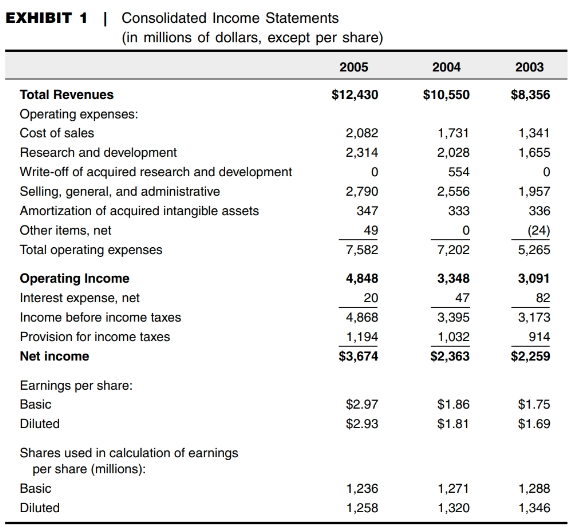
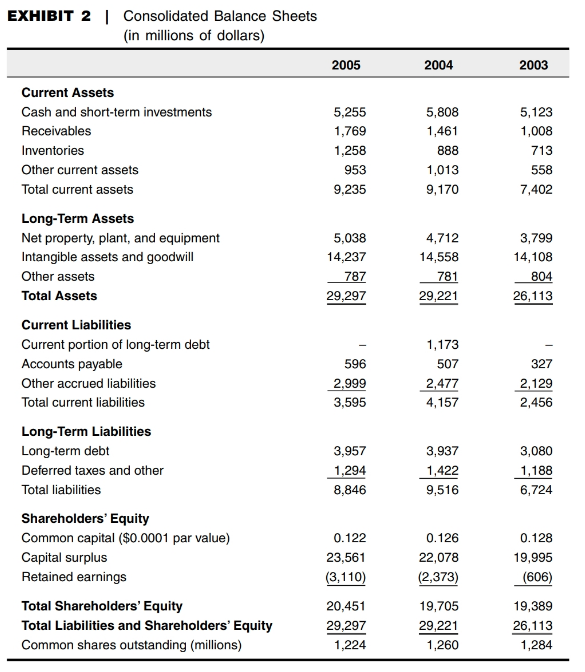
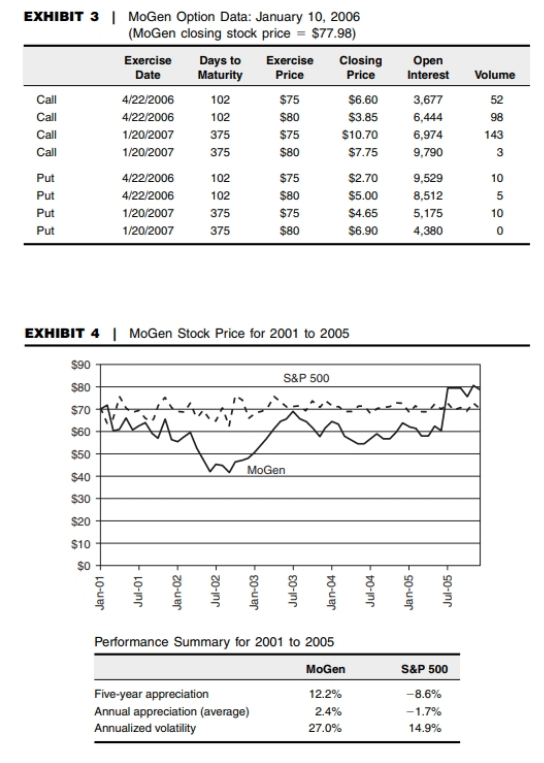
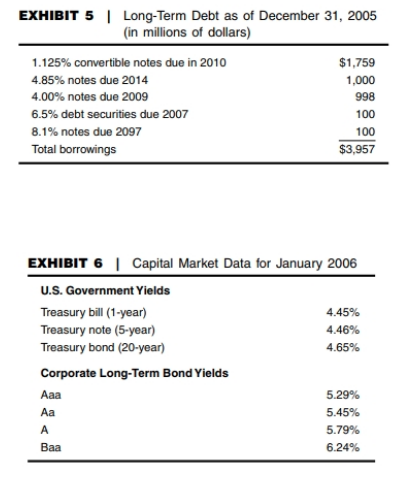
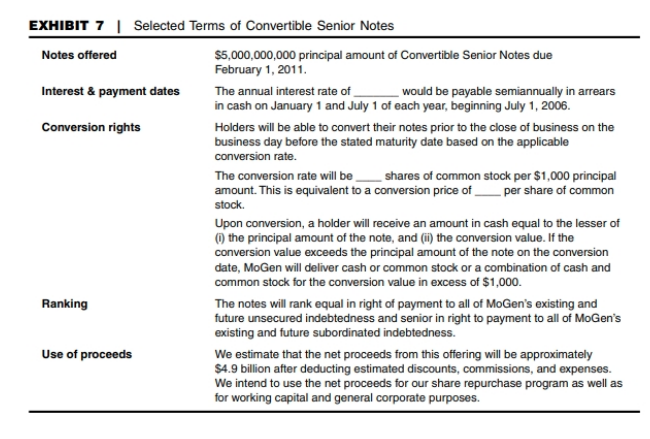
EXHIBIT1 Consolidated Income Statements (in millions of dollars, except per share) 2005 2004 2003 $12,430 Total Revenues Operating expenses Cost of sales Research and development Write-off of acquired research and development Selling, general, and administrative Amortization of acquired intangible assets Other items, net Total operating expenses $10,550 $8,356 2,082 2,314 0 2,790 347 49 7,582 1,731 2,028 554 2,556 1,341 1,655 0 1,957 336 (24) 5,265 Operating Income Interest expense, net Income before income taxes Provision for income taxes Net income 4,848 20 4,868 1,194 $3,674 0 7,202 3,348 47 3,395 1,032 $2,363 3,091 82 3,173 914 $2,259 Earnings Basic Diluted per share $2.97 $2.93 $1.86 $1.81 $1.75 $1.69 Shares used in calculation of earnings per share (millions) Basic Diluted 1,236 1,258 1,271 1,320 1,288 1,346
Step by Step Solution
There are 3 Steps involved in it

Get step-by-step solutions from verified subject matter experts
 Study Help