







Question: Read the notes below then Identify the challenges managers face today because of the paradigm shift Shifting Paradigins of Organizational Behavior (Schermerhom, et al 9
Read the notes below then Identify the challenges managers face today because of the paradigm shift 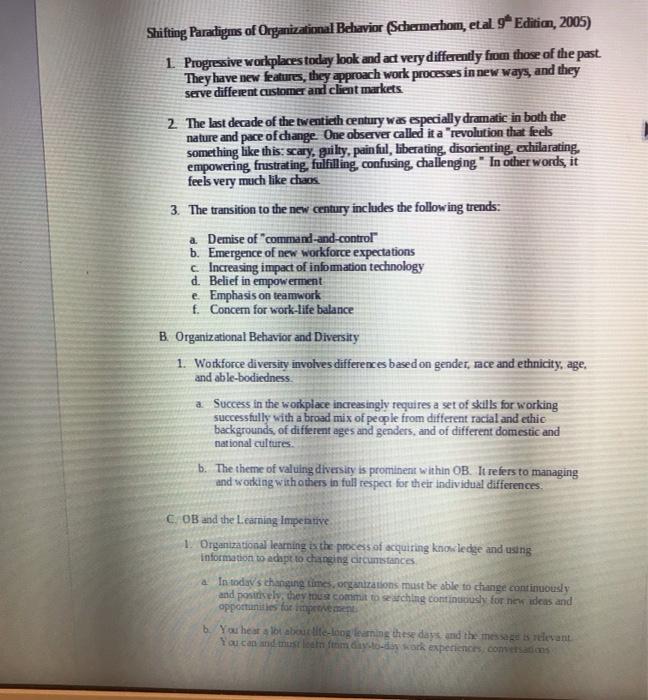
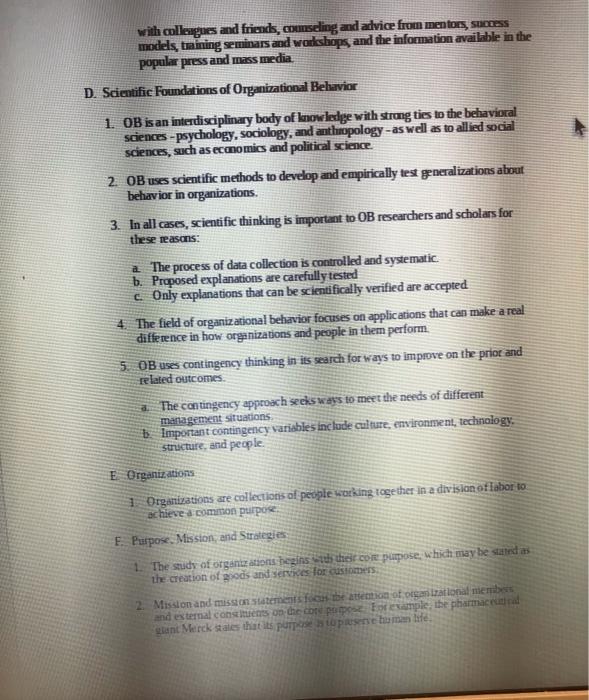
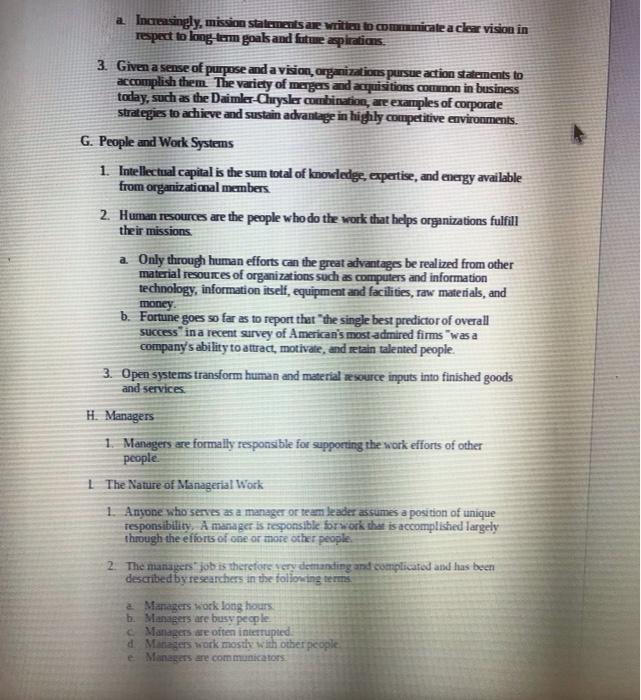
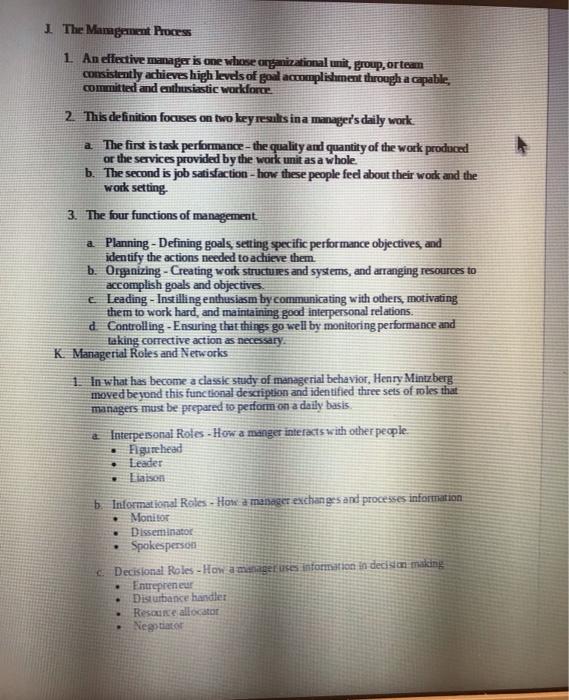
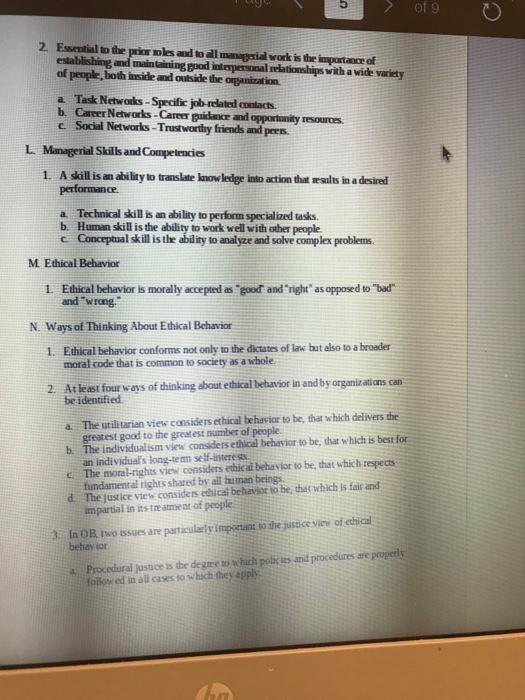
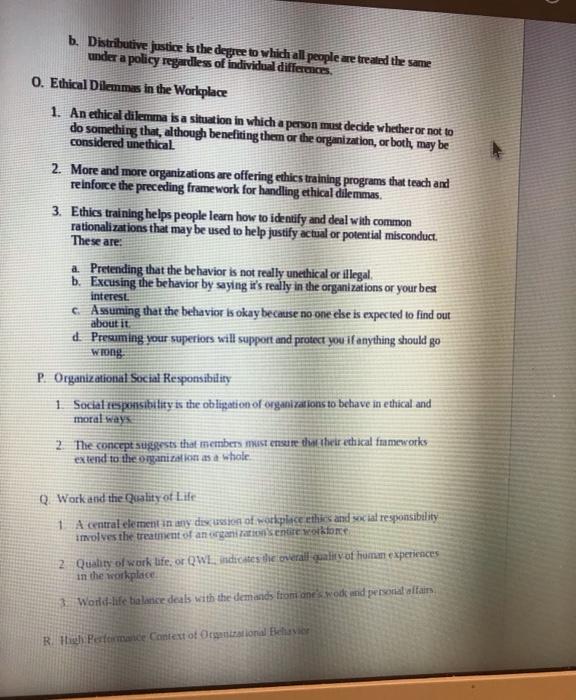
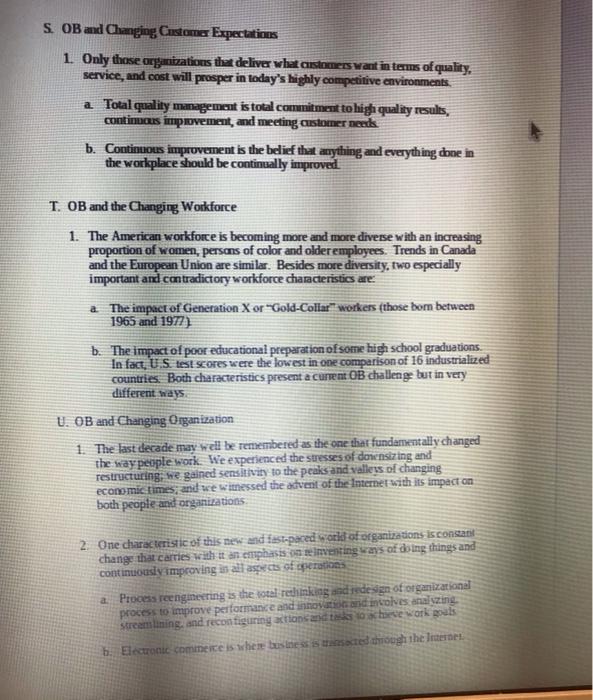
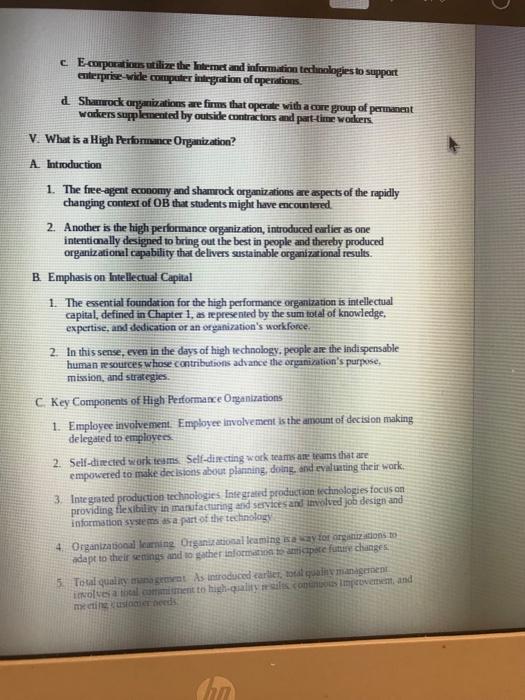
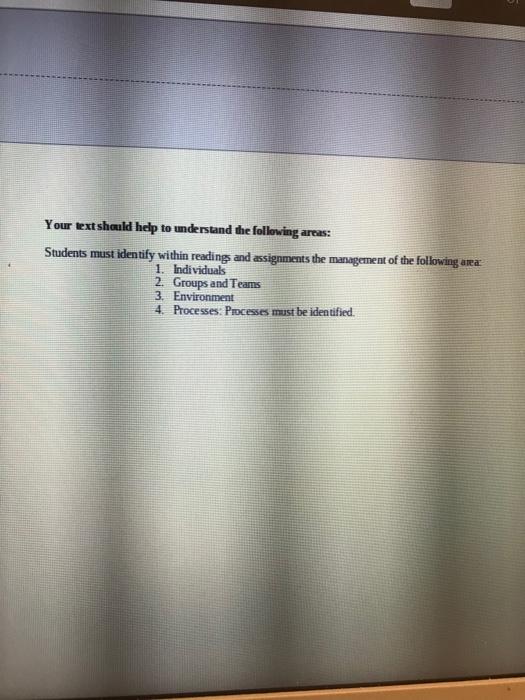
Shifting Paradigins of Organizational Behavior (Schermerhom, et al 9 Edition, 2005) 1. Progressive workplaces today look and a very differently from those of the past. They have new features, they approach work processes in new ways, and they serve different customer and client markets 2 The last decade of the twentieth century was especially dramatic in both the nature and pace of change. One observer called it a "revolution that feels something like this: scary, guilty, painful, liberating disorienting exhilarating, empowering frustrating, fulfilling, confusing challenging" In other words, it feels very much like chaos. 3. The transition to the new century includes the following trends: a Demise of command-and-control b. Emergence of new workforce expectations Increasing impact of infomation technology d. Belief in empowerment e. Emphasis on teamwork f. Concern for work-life balance B. Organizational Behavior and Diversity 1. Workforce diversity involves differences based on gender, race and ethnicity, age. and able-bodiedness a. Success in the workplace increasingly requires a set of skills for working successfully with a broad mix of people from different racial and ethic backgrounds, of different ages and genders, and of different domestic and national cultures. b. The theme of valuing diversity is prominent within OB. It refers to managing and working with others in full respect for their individual differences C. OB and the Learning Imperative 1. Organizational learning is the process of acquiring knowledge and using Information to adapt to changing circumstances 4 In today's changing times, organizations must be able to change continuously and positively, they tus commit to searching continuously for new ideas and opportunities for improvement b. You hear a lot about life-long learning these days and the message is relevant You can and trust in tim days ork experiences, como with colleagues and friends, counseling and advice from mentes, sucres models, training seminars and workshops, and the information available in the popular press and mass media D. Scientific Foundations of Organizational Behavior 1. OB is an interdisciplinary body of knowledge with strong ties to the behavioral sciences - psychology, sociology, and anthropology-as well as to allied social sciences, such as economics and political science 2. OB uses scientific methods to develop and empirically test generalizations about behavior in organizations 3. In all cases, scientific thinking is important to OB researchers and scholars for these reasons: a The process of data collection is controlled and systematic b. Proposed explanations are carefully tested Only explanations that can be scientifically verified are accepted 4. The field of organizational behavior focuses on applications that can make a real difference in how organizations and people in them perform. 5. OB uses contingency thinking in its search for ways to improve on the prior and Related outcomes The contingency approach seeks ways to meet the needs of different management situations b Important contingency variables include culture, environment, technology structure, and people E Organizations 1 Organisations are collections of people working together in a division of labor to achieve a common purpose E Purpose. Mission, and Strategies 1. The study of organizations begins with their come purpose, which may be stardas the creation of goods and services for customers 2. Mission and mission statements for the attention of organizational members and external contents on the core pupostosample the pharmaceutid allant Merck sales that its purpose supusese human life a. Increasingly, mission statements are written to communicate a clear vision in respect to long-term goals and future aspirations. 3. Given a sense of purpose and a vision, organizations pursue action statements to accomplish them The variety of mergers and acquisitions common in business today, such as the Daimler-Chrysler combination are examples of corporate strategies to achieve and sustain advantage in highly competitive environments. G. People and Work Systems 1. Intellectual capital is the sum total of knondedge, expertise, and energy available from organizational members 2. Human resources are the people who do the work that helps organizations fulfill their missions a. Only through human efforts can the great advantages be realized from other material resources of organizations such as computers and information technology, information itself, equipment and facilities, raw materials, and money b. Fortune goes so far as to report that the single best predictor of overall success in a recent survey of American's most admired firms was a company's ability to attract, motivate, and retain talented people 3. Open systems transform human and material resource inputs into finished goods and services H. Managers 1. Managers are formally responsible for supporting the work efforts of other people | The Nature of Managerial Work 1. Anyone who serves as a manager or team leader assumes a position of unique responsibility, A manager is responsible for work that is accomplished largely through the efforts of one or more other people. 2. The nuanagers job is therefore very demanding and complicated and has been described by researchers in the following terms. a Managers work long hours b. Managers are busy people Managers are often interrupted d Managers work mostly with other people e Managers are communicators 1 The Mamganent Process 1. An effective manager is one whese organizational unit, group,orteam consistently achieves high levels of goal accomplishment through a capable, committed and enthusiastic workforce. 2. This definition focuses on two key results in a manager's daily work a The first is task performance - the quality and quantity of the work produced or the services provided by the work unit as a whole b. The second is job satisfaction - how these people feel about their work and the work setting 3. The four functions of management a Planning - Defining goals, setting specific performance objectives, and identify the actions needed to achieve them b. Organizing - Creating work structures and systems, and arranging resources to accomplish goals and objectives Leading - Instilling enthusiasm by communicating with others, motivating them to work hard, and maintaining good interpersonal relations. d Controlling - Ensuring that things go well by monitoring performance and taking corrective action as necessary. K Managerial Roles and Networks 1. In what has become a classic study of managerial behavior, Henry Mintzberg moved beyond this functional description and identified three sets of roles that managers must be prepared to perform on a daily basis & Interpersonal Roles - How a manger interacts with other people. Figurehead Leader Liaison b. Informational Roles - How a manager exchanges and processes information Monitor Disseminator . Spokesperson Decisional Roles - How amtaget uses information in decision making Entrepreneur Disturbance handler Resource allocator Negotiator . 5 Of 9 2 Essential to the price ples and to dil maial work is the importance of establishing and maintaining good interpersonal relationships with a wide variety of people, both inside and outside the organization a Task Networks - Specific job-related contacts. b. Career Networks-Career guidance and opportunity resources. c Social Networks - Trustworthy friends and pees. L Managerial Skills and Competencies 1. A skill is an ability to translate knowledge into action that results in a desired performance. a Technical skill is an ability to perform specialized tasks. b. Human skill is the ability to work well with other people. c Conceptual skill is the ability to analyze and solve complex problems. M Ethical Behavior 1 Ethical behavior is morally accepted as "good and right" as opposed to "bad" N. Ways of Thinking About Ethical Behavior 1. Ethical behavior conforms not only to the dictates of low but also to a broader moral code that is common to society as a whole 2. At least four ways of thinking about ethical behavior in and by organizations can be identified 4. The utilitarian view considers ethical behavior to be, that which delivers the greatest good to the greatest number of people. b. The individualism View considers ethical behavior to be, that which is best for an individual's long-term self-interesa 4. The moral-rights view considers ethical behavior to be, that which respects fundamental rights shared by all taman beings d. The justice View considers thical behavior to be, that which is fair and impartial in its treatment of people 3 In OR two sues are particularly imprimant to the justice vi i echical behavior Procedural justice is the degree to which pobles and procedures are properly followed in all cases to which they apply b. Distributive justice is the degree to which all people are treated the same under a policy regardless of individual differences, 0. Ethical Dilemmas in the Workplace 1. An ethical dilemma is a situation in which a person must decide whether or not to do something that, although benefiting them or the organization, or both, may be considered unethical 2. More and more organizations are offering ethics training programs that teach and reinforce the preceding framework for handling ethical dilemmas. 3. Ethics training helps people learn how to identify and deal with common rationalizations that may be used to help justify actual or potential misconduct. These are: a. Pretending that the behavior is not really unethical or illegal b. Excusing the behavior by saying is really in the organizations or your best interest Assuming that the behavior is okay because no one else is expected to find out about it & Presuming your superiors will support and protect you if anything should go Wong P. Organizational Social Responsibility 1 Serial is prisibility is the obligation of organizations to behave in ethical and moral ways 2 The concept suggests that members must ensure that their ethical frameworks extend to the organization as a whole Q. Work and the Quality of Life 1 A central element in my de 1930s of workplace ethics and social responsibility involves the treatment of an arganisentie wokon 2. Quality of work life, or QWEndicates de metall quality of human experiences in the workplace 1 World-life balance deals with the demands from anes.wod wad personal altaita. Righ Performance Context of Ottional Behavior S OB and Changing Customer Expectations 1. Only those organizations that deliver what customers want in terms of quality, service, and cost will prosper in today's highly competitive environments. a Total quality management is total commitment to high quality results, continuous improvement, and meeting customer neeck b. Continuous improvement is the belief that anything and everything done in the workplace should be continually improved T. OB and the Changing Workforce 1. The American workforce is becoming more and more diverse with an increasing proportion of women, persons of color and olderemployees. Trends in Canada and the European Union are similar. Besides more diversity, two especially important and contradictory workforce characteristics are: & The impact of Generation X or "Gold-Collar workers (those bom between 1965 and 1977) b. The impact of poor educational preparation of some high school graduations In fact, U.S. test scores were the lowest in one comparison of 16 industrialized countries. Both characteristics present a current OB challenge but in very different ways U. OB and Changing Organization 1. The last derade may well be remembered as the one that fundamentally changed the way people work. We experienced the stresses of donensizing and restructuring, we gained sensitivity to the peaks and valleus of changing economic times, and we winessed the advent of the Internet with its impact on both people and organizations 2. One characteristic of this new and fast-paced world of organizations is constant change that carries with an emphasis on teinvesting ways of doing things and continuously improving as all aspects of operations 4. Process reengineering is the total recinking and redesign of organizational process to improve performance and innovation and incalves analyzing. stream lining, and recontiguring action and to be work goals b. Electronic commerce is where business is transacted through the Internet C E corporations utilize the Intermed and information technologies to support enterprise-wide computer integration of operations. d Shamrock cryanizations are firms that operate with a core group of permanent Workers supplemented by outside contractors and part-time workers V. What is a High Performance Organization? A. Introduction 1. The face-agent economy and shamrock organizations are aspects of the rapidly changing context of OB that students might have encountered 2. Another is the high performance organization, introduced earlier as one intentionally designed to bring out the best in people and thereby produced organizational capability that delivers sustainable organizational results. B Emphasis on Intellectual Capital 1 The essential foundation for the high performance organization is intellectual capital, defined in Chapter 1, as represented by the sum total of knowledge. expertise, and dedication or an organization's workforce. 2. In this sense, even in the days of high technology, people are the Indispensable human resources whose contributions advance the organization's purpose, mission, and strategies. C Key Components of High Performance Organizations 1. Employee involvement. Employer involvement is the amount of decision making delegated to employees 2. Self-directed work teams. Self-directing work teams are teams that are empowered to make decisions about planning, doing and evaluating their work, 3. Integrated production technologies Integrated production technologies focus on providing flexibility in manifacturing and services and involved job design and information systems as a part of the technology 4. Organizational learning Organizational leaming isa ay tot ons to adapt to their settings and other information to care future changes 5. Total quality management As Introduced earlier, total quality management ito sa bital comment to high-quality contro Improvemem and meeting customer beds hun Your text should help to understand the following areas: Students must identify within reading and assignments the management of the following area 1. Individuals 2. Groups and Teams 3. Environment 4. Processes: Processes must be identified Step by Step Solution
There are 3 Steps involved in it
1 Expert Approved Answer
Step: 1 Unlock

Question Has Been Solved by an Expert!
Get step-by-step solutions from verified subject matter experts
Step: 2 Unlock
Step: 3 Unlock
 Study Help