







Question: Read the problem carefully and be clear in answer the images are clear and fonts as well images are properly visible and crystal clear (1
Read the problem carefully and be clear in answer
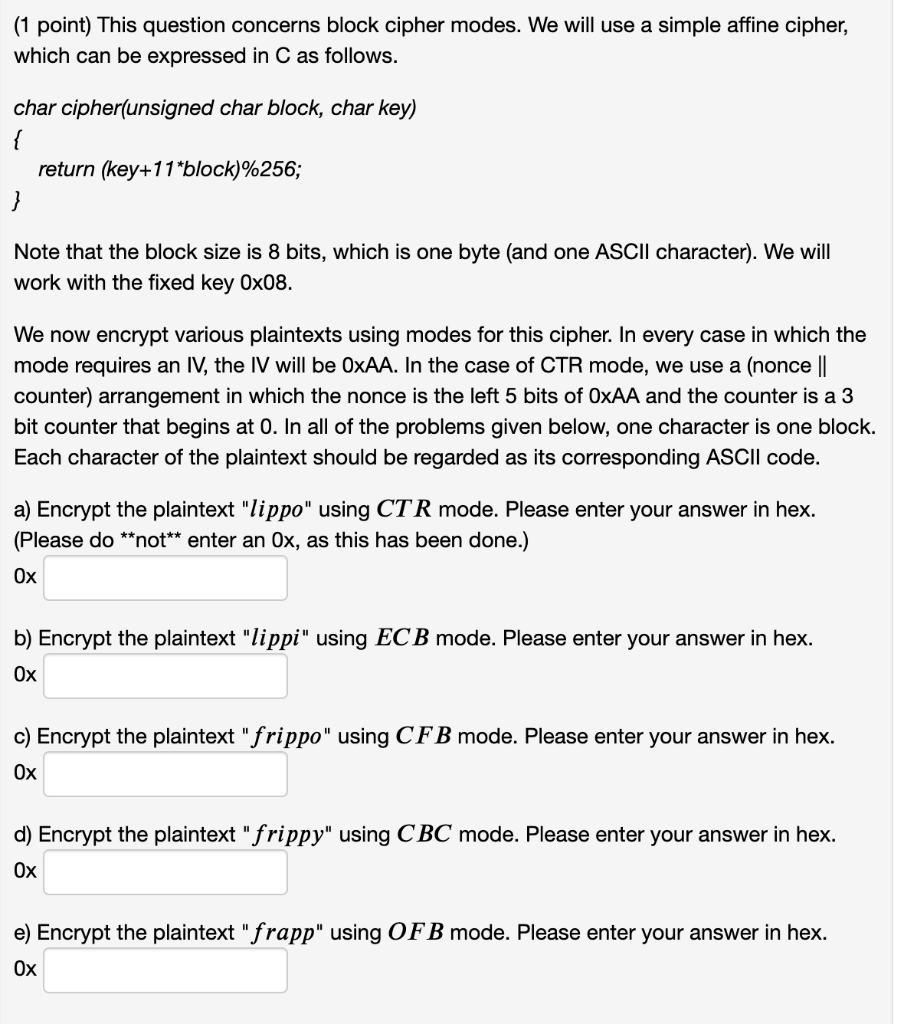
(1 point) This question concerns block cipher modes. We will use a simple affine cipher, which can be expressed in C as follows. char cipher(unsigned char block, char key) { return (key+11*block)%256; } Note that the block size is 8 bits, which is one byte (and one ASCII character). We will work with the fixed key Ox08. We now encrypt various plaintexts using modes for this cipher. In every case in which the mode requires an IV, the IV will be OxAA. In the case of CTR mode, we use a (nonce || counter) arrangement in which the nonce is the left 5 bits of OxAA and the counter is a 3 bit counter that begins at 0. In all of the problems given below, one character is one block. Each character of the plaintext should be regarded as its corresponding ASCII code. a) Encrypt the plaintext "lippo" using CTR mode. Please enter your answer in hex. (Please do **not** enter an Ox, as this has been done.) Ox b) Encrypt the plaintext "lippi" using ECB mode. Please enter your answer in hex. Ox c) Encrypt the plaintext "frippo" using CFB mode. Please enter your answer in hex. d) Encrypt the plaintext "frippy" using CBC mode. Please enter your answer in hex. e) Encrypt the plaintext "frapp" using OFB mode. Please enter your answer in hex. (1 point) This question concerns block cipher modes. We will use a simple affine cipher, which can be expressed in C as follows. char cipher(unsigned char block char key) return (key+11'block)%256; ) Note that the block size is 8 bits, which is one byte (and one ASCII character). We will work with the fixed key Ox08. We now encrypt various plaintexts using modes for this cipher. In every case in which the mode requires an IV, the IV will be OxAA. In the case of CTR mode. we use a (nonce || counter) arrangement in which the nonce is the left 5 bits of OxAA and the counter is a 3 bit counter that begins at O. In all of the problems given below, one character is one block. Each character of the plaintext should be regarded as its corresponding ASCII code. a) Encrypt the plaintext "lippo using CTR mode. Please enter your answer in hex. (Please do not** enter an Ox, as this has been done.) b) Encrypt the plaintext "lippi" using ECB mode. Please enter your answer in hex c) Encrypt the plaintext * frippo" using CFB mode. Please enter your answer in hex Ox d) Encrypt the plaintext * frippy using CBC mode. Please enter your answer in hex Ox e) Encrypt the plaintext"frapp using OFB mode. Please enter your answer in hex Ox (1 point) This question concerns block cipher modes. We will use a simple affine cipher, which can be expressed in C as follows. char cipher(unsigned char block, char key) { return (key+11*block)%256; } Note that the block size is 8 bits, which is one byte (and one ASCII character). We will work with the fixed key Ox08. We now encrypt various plaintexts using modes for this cipher. In every case in which the mode requires an IV, the IV will be OxAA. In the case of CTR mode, we use a (nonce || counter) arrangement in which the nonce is the left 5 bits of OxAA and the counter is a 3 bit counter that begins at 0. In all of the problems given below, one character is one block. Each character of the plaintext should be regarded as its corresponding ASCII code. a) Encrypt the plaintext "lippo" using CTR mode. Please enter your answer in hex. (Please do **not** enter an Ox, as this has been done.) Ox b) Encrypt the plaintext "lippi" using ECB mode. Please enter your answer in hex. Ox c) Encrypt the plaintext "frippo" using CFB mode. Please enter your answer in hex. d) Encrypt the plaintext "frippy" using CBC mode. Please enter your answer in hex. e) Encrypt the plaintext "frapp" using OFB mode. Please enter your answer in hex. (1 point) This question concerns block cipher modes. We will use a simple affine cipher, which can be expressed in C as follows. char cipher(unsigned char block char key) return (key+11'block)%256; ) Note that the block size is 8 bits, which is one byte (and one ASCII character). We will work with the fixed key Ox08. We now encrypt various plaintexts using modes for this cipher. In every case in which the mode requires an IV, the IV will be OxAA. In the case of CTR mode. we use a (nonce || counter) arrangement in which the nonce is the left 5 bits of OxAA and the counter is a 3 bit counter that begins at O. In all of the problems given below, one character is one block. Each character of the plaintext should be regarded as its corresponding ASCII code. a) Encrypt the plaintext "lippo using CTR mode. Please enter your answer in hex. (Please do not** enter an Ox, as this has been done.) b) Encrypt the plaintext "lippi" using ECB mode. Please enter your answer in hex c) Encrypt the plaintext * frippo" using CFB mode. Please enter your answer in hex Ox d) Encrypt the plaintext * frippy using CBC mode. Please enter your answer in hex Ox e) Encrypt the plaintext"frapp using OFB mode. Please enter your answer in hex Ox
Step by Step Solution
There are 3 Steps involved in it

Get step-by-step solutions from verified subject matter experts
 Study Help