Question: Read the problem, solve case and answer the following questions How did you make your forecasts for this problem? Explain in some detail. What assumptions
Read the problem, solve case and answer the following questions
-
How did you make your forecasts for this problem? Explain in some detail.
-
What assumptions are implicit in your forecast? Be specific.
-
What insights into forecasting did you gain from this problem?
-
What are some particular advantages and disadvantages of the forecasting methodologies that you used for this problem?
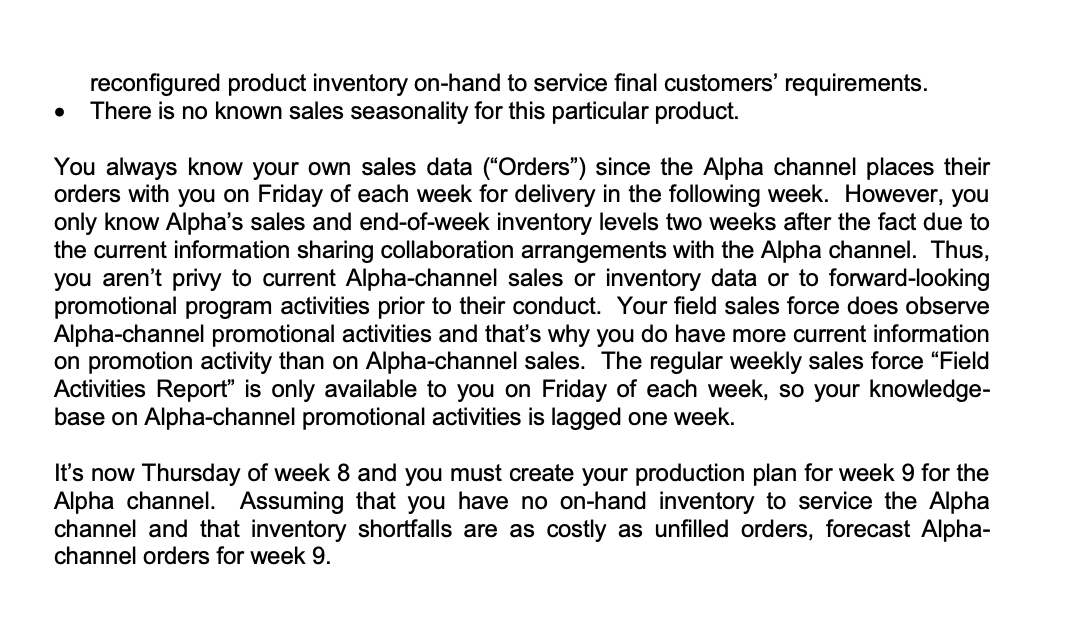
Forecaster Forecaster Simulation Problem #5 Simulation "We substitute information for inventory." - Michael Dell As a manufacturer selling directly to final end-users, your sales and inventory transaction systems normally have up-to-date information on sales and inventory from which you create production plans. In selling through intermediaries, a variety of complications arise. Channel members maintain inventory buffer stocks to service their customers. Suppliers may or may not be aware of channel members' inventory policies and levels. In addition, channel members may or may not share their generate-demand program plans and/or their customer sales data with upstream suppliers. For upstream suppliers, collaboration and information sharing with downstream channel members has value. Various possibilities for supply chain collaboration exist. Plan sharing, plan coordination, and EDI (elect nic data interchange) are three examples of supply chain collaboration. However, downstream channel members aren't always willing or able to collaborate in a timely fashion and at the level of information disaggregation of interest and value to upstream suppliers. Alpha-channel historical orders, sales, and promotional activity data are shown in the table below: Alpha-Channel Activities Week Orders Sales Inventory Promotion? 1 11,700 9,468 2.232 No 2 15,500 16,585 1,147 Yes 3 12,200 12,030 1,317 Yes 4 8,100 6,953 2,464 No 5 10,900 11,629 1,735 No 6 17,600 17,945 1,390 Yes 7 7,500 No 8 18,400 . Regarding these data and this product and channel: The Alpha channel is one particular distributor of one of your products. "Orders" are the orders (in units) from the channel (i.e., your sales) for delivery in the specified week, "Sales" are the sales in units) to final customers made by the Alpha channel, and "Promotion?" describes whether the Alpha channel conducted any special promotion/merchandising program during a particular week. This product was reconfigured prior to week 1 so the week-1 orders reflect expected sales plus any inventory build-up by the Alpha channel to have a suitable amount of reconfigured product inventory on-hand to service final customers' requirements. There is no known sales seasonality for this particular product. . You always know your own sales data ("Orders) since the Alpha channel places their orders with you on Friday of each week for delivery in the following week. However, you only know Alpha's sales and end-of-week inventory levels two weeks after the fact due to the current information sharing collaboration arrangements with the Alpha channel. Thus, you aren't privy to current Alpha-channel sales or inventory data or to forward-looking promotional program activities prior to their conduct. Your field sales force does observe Alpha-channel promotional activities and that's why you do have more current information on promotion activity than on Alpha-channel sales. The regular weekly sales force Field Activities Report" is only available to you on Friday of each week, so your knowledge- base on Alpha-channel promotional activities is lagged one week. It's now Thursday of week 8 and you must create your production plan for week 9 for the Alpha channel. Assuming that you have no on-hand inventory to service the Alpha channel and that inventory shortfalls are as costly as unfilled orders, forecast Alpha- channel orders for week 9









 Study Help