Question: read the question and then look and read the steps below to help on the elements of peruasion from chapter 11, then complete the assignment.
read the question and then look and read the steps below to help on the elements of peruasion from chapter 11, then complete the assignment. thank you.

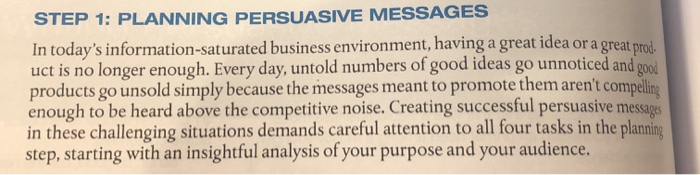
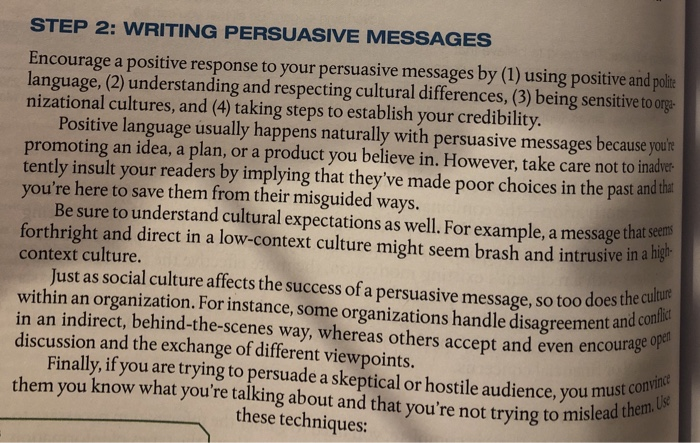
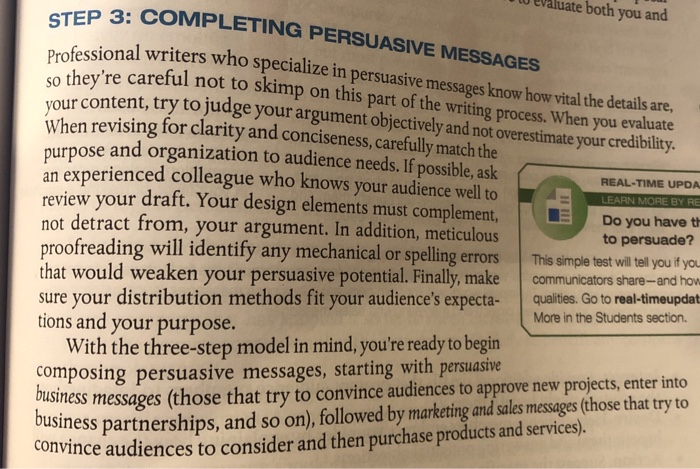
Find what you think is a very persuasive (but tasteful) ad on social media and capture its image. Upload it with this assignment. Review the ad and write in 150 words why you think it is so persuasive. What elements of persuasion from Chapter 11 does it 2 STEP 1: PLANNING PERSUASIVE MESSAGES In today's information-saturated business environment, having a great idea or a great and uct is no longer enough. Every day, untold numbers of good ideas go unnoticed and good products go unsold simply because the messages meant to promote them aren't compelling enough to be heard above the competitive noise. Creating successful persuasive message in these challenging situations demands careful attention to all four tasks in the planning step, starting with an insightful analysis of your purpose and your audience. STEP 2: WRITING PERSUASIVE MESSAGES Encourage a positive response to your persuasive messages by (1) using positive and polite language, (2) understanding and respecting cultural differences, (3) being sensitive to org nizational cultures, and (4) taking steps to establish your credibility. Positive language usually happens naturally with persuasive messages because you're promoting an idea, a plan, or a product you believe in. However, take care not to inadver tently insult your readers by implying that they've made poor choices in the past and ina you're here to save them from their misguided ways. Be sure to understand cultural expectations as well. For example, a message that se forthright and direct in a low-context culture might seem brash and intrusive in ang context culture. Just as social culture affects the success of a persuasive message, so too does the within an organization. For instance, some organizations handle disagreement and in an indirect, behind-the-scenes way, whereas others accept and even encourag discussion and the exchange of different viewpoints. Finally, if you are trying to persuade a skeptical or hostile audience, you mus them you know what you're talking about and that you're not trying to mislead these techniques: greement and conflict encourage open You must convinc to mislead them. Us . COMPLETING PERSUASIVE MESSAGES w evaluate both you and STEP 3: COMPLETI Professional writers who onal writers who specialize in persuasive messages know how vital the details are, so they're careful not to sk e're careful not to skimp on this part of the writing process. When you evaluate wir content, try to judge your argument objectively and not overestimate your credibility. when revising for clarity and conciseness, carefully match the purpose and organization to audience needs. If possible, ask an experienced colleague who knows your audience well to REAL-TIME UPDA LEARN MORE BY RE review your draft. Your design elements must complement, Do you have th not detract from, your argument. In addition, meticulous to persuade? proofreading will identify any mechanical or spelling errors This simple test will tell you if you that would weaken your persuasive potential. Finally, make communicators share-and how qualities. Go to real-timeupdat sure your distribution methods fit your audience's expecta- More in the Students section. tions and your purpose. With the three-step model in mind, you're ready to begin composing persuasive messages, starting with persuasive business messages (those that try to convince audiences to approve new projects, enter into business partnerships, and so on), followed by marketing and sales messages (those that try to nvince audiences to consider and then purchase products and services)









 Study Help