







Question: Read the question carefully! we need the yield for a single chip being defect free as well as the yield for Phoenix4, Phoenix2 and Phoenix1
Read the question carefully! we need the yield for a single chip being defect free as well as the yield for Phoenix4, Phoenix2 and Phoenix1
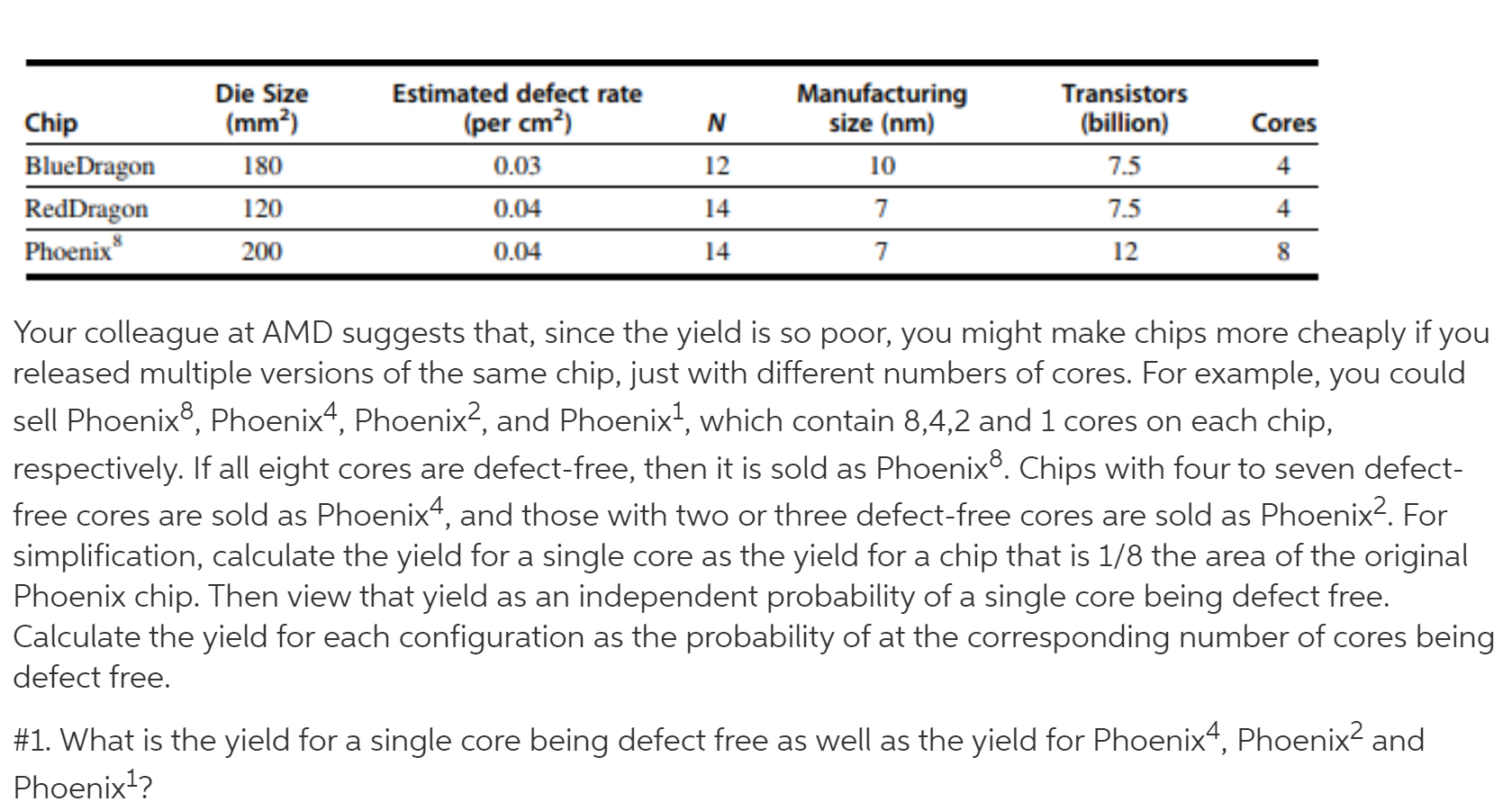
N Die Size (mm) 180 120 200 Estimated defect rate (per cm) 0.03 0.04 0.04 Chip Blue Dragon RedDragon Phoenix Manufacturing size (nm) 10 7 7 Transistors (billion) 7.5 7.5 Cores 4 12 14 14 12 8 Your colleague at AMD suggests that, since the yield is so poor, you might make chips more cheaply if you released multiple versions of the same chip, just with different numbers of cores. For example, you could sell Phoenix, Phoenix4, Phoenix>, and Phoenixt, which contain 8,4,2 and 1 cores on each chip, respectively. If all eight cores are defect-free, then it is sold as Phoenix. Chips with four to seven defect- free cores are sold as Phoenix4, and those with two or three defect-free cores are sold as Phoenix2. For simplification, calculate the yield for a single core as the yield for a chip that is 1/8 the area of the original Phoenix chip. Then view that yield as an independent probability of a single core being defect free. Calculate the yield for each configuration as the probability of at the corresponding number of cores being defect free. #1. What is the yield for a single core being defect free as well as the yield for Phoenix4, Phoenix2 and Phoenix1? N Die Size (mm) 180 120 200 Estimated defect rate (per cm) 0.03 0.04 0.04 Chip Blue Dragon RedDragon Phoenix Manufacturing size (nm) 10 7 7 Transistors (billion) 7.5 7.5 Cores 4 12 14 14 12 8 Your colleague at AMD suggests that, since the yield is so poor, you might make chips more cheaply if you released multiple versions of the same chip, just with different numbers of cores. For example, you could sell Phoenix, Phoenix4, Phoenix>, and Phoenixt, which contain 8,4,2 and 1 cores on each chip, respectively. If all eight cores are defect-free, then it is sold as Phoenix. Chips with four to seven defect- free cores are sold as Phoenix4, and those with two or three defect-free cores are sold as Phoenix2. For simplification, calculate the yield for a single core as the yield for a chip that is 1/8 the area of the original Phoenix chip. Then view that yield as an independent probability of a single core being defect free. Calculate the yield for each configuration as the probability of at the corresponding number of cores being defect free. #1. What is the yield for a single core being defect free as well as the yield for Phoenix4, Phoenix2 and Phoenix1
Step by Step Solution
There are 3 Steps involved in it

Get step-by-step solutions from verified subject matter experts
 Study Help