







Question: Read the scenario and do the tasks below: Task 1: Draw a high-level, network-layer network diagram for Glores entire existing (as-is) corporate physical IT infrastructure.
Read the scenario and do the tasks below:
Task 1: Draw a high-level, network-layer network diagram for Glores entire existing (as-is) corporate physical IT infrastructure.
Task 2: After completing the high-level model, you would now document details about LANs in each individual location. Lets begin with the Main Office LAN. Draw a low-level, data-link-layer network diagram for the existing (as-is) LAN of the Main Office.
Task 3: Draw a high-level, network-layer network diagram for Glores proposed (to-be) corporate IT infrastructure. The requirements of task 1 apply here.
Task 4: Draw a low-level, data-link-layer network diagram for the proposed (to-be) IT infrastructure of the Main Office. The requirements of task 2 apply here.
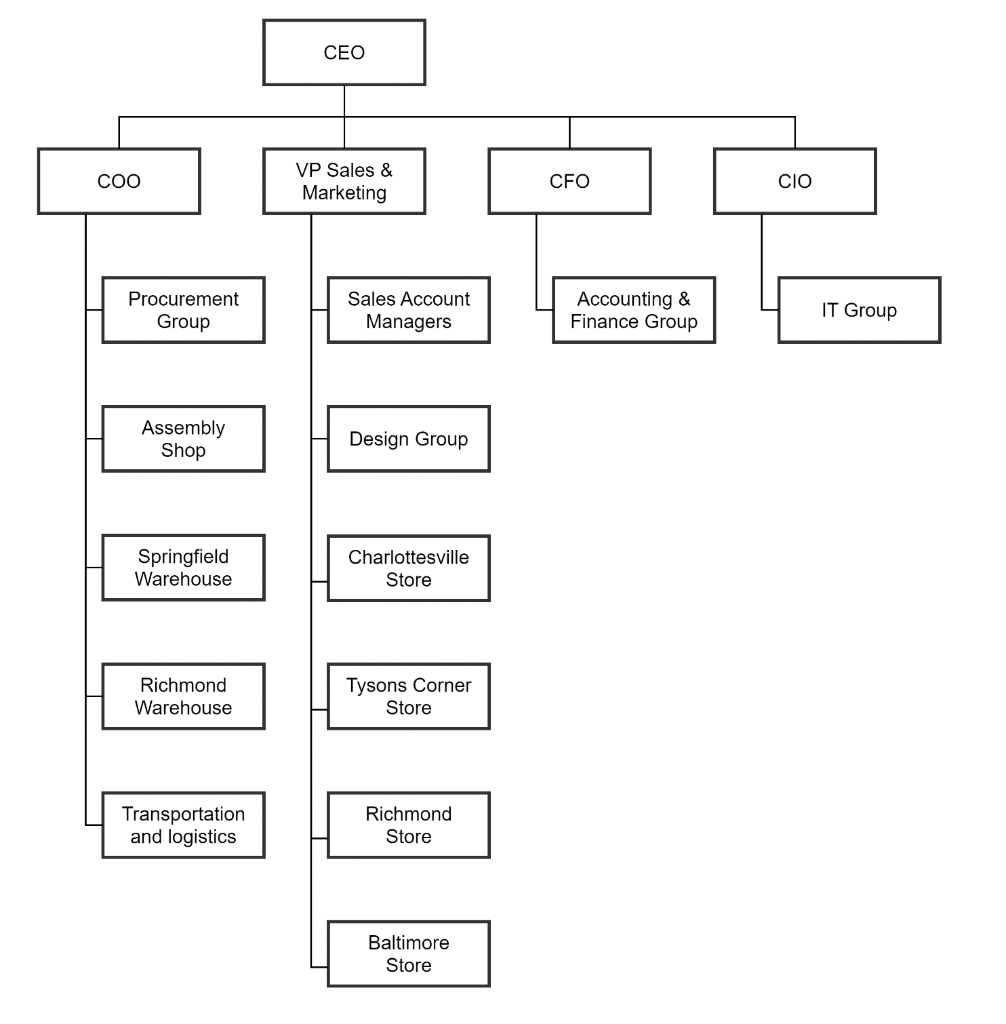
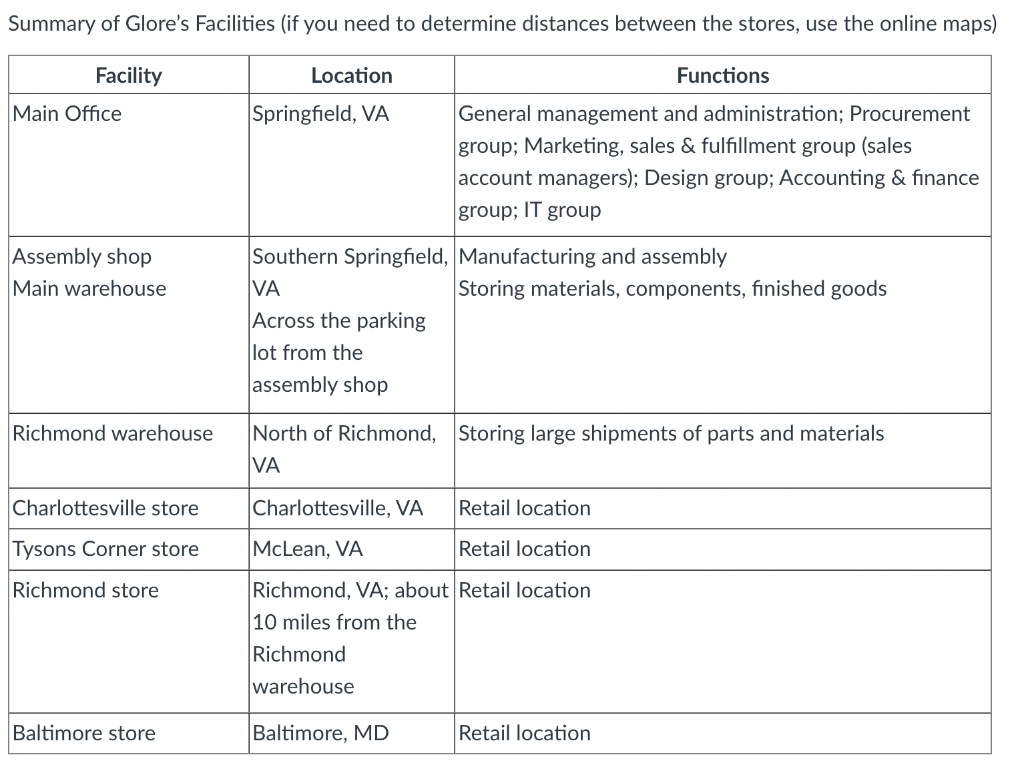
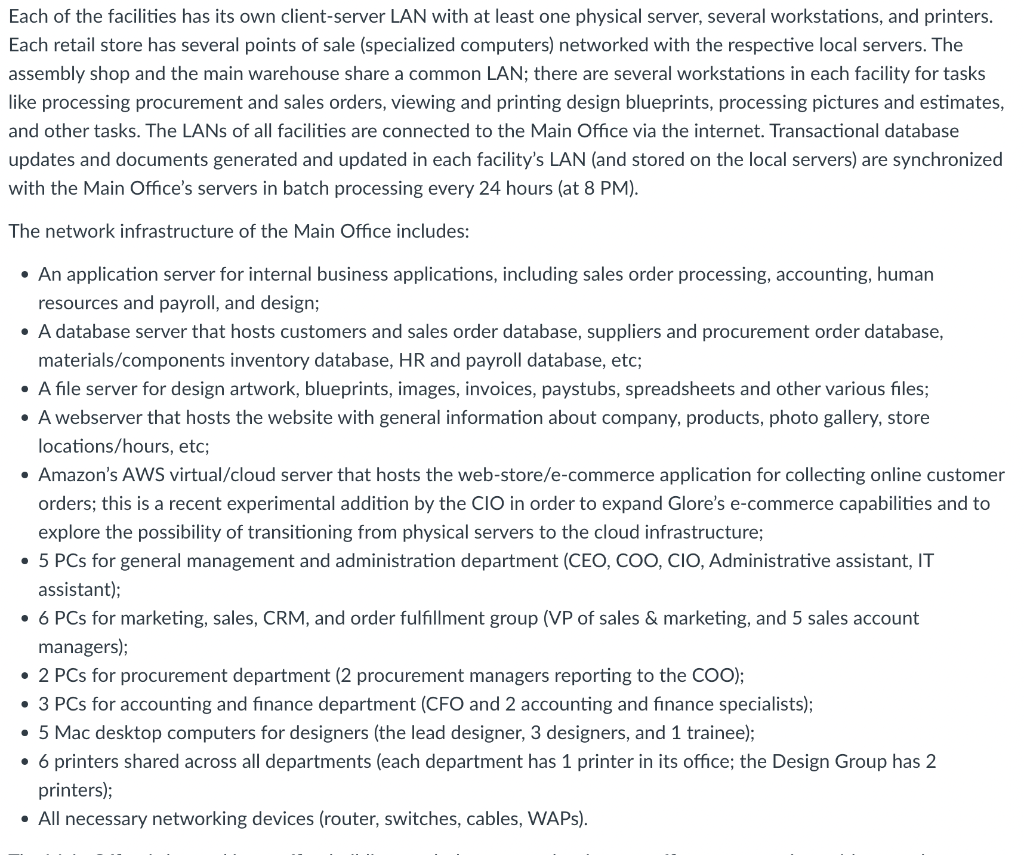
Glore Furniture LLC (Glore) is a medium-size family-owned company that manufactures to order, repairs, and refurbishes premium, high-end, home and office furniture, and sells its goods and services to individual and corporate customers in Virginia and Maryland. Its business model is based on receiving orders over the phone, via retail locations, or the website, making in-person on-site estimates, creating custom designs, manufacturing in its assembly shop, and delivering. Glore's Main Office is located in a professional park in Springfield, VA. About five miles away, in a single lot in an industrial park, Glore has two other facilities - an assembly shop and a warehouse for materials, components, finished goods (located across the parking lot from the assembly shop); attached to the warehouse is also a garage that houses a small fleet of trucks and vans for company's cargo transportation needs. Besides the Springfield warehouse, another warehouse is located just north of Richmond, VA, for receiving and storing large shipments of materials and parts. Glore has four "brick-and-mortar" retail stores with furniture exhibits and associates who consult customers and collect orders. Glore's Organizational Structure: Summary of Glore's Facilities (if you need to determine distances between the stores, use the online maps) \begin{tabular}{|l|l|l|} \hline \multicolumn{1}{|c|}{ Facility } & \multicolumn{1}{|c|}{ Location } & \multicolumn{1}{|c|}{ Functions } \\ \hline Main Office & Springfield, VA & General management and administration; Procurement group; Marketing, sales \& fulfillment group (sales account managers); Design group; Accounting \& finance group; IT group \\ \hline Assembly shop Main warehouse & Southern Springfield, VA Across the parking lot from the assembly shop & Manufacturing and assembly Storing materials, components, finished goods \\ \hline Richmond warehouse & North of Richmond, VA & Storing large shipments of parts and materials \\ \hline Charlottesville store & Charlottesville, VA & Retail location \\ \hline Tysons Corner store & McLean, VA & Retail location \\ \hline Richmond store & Richmond, VA; about 10 miles from the Richmond warehouse & Retail location \\ \hline Baltimore store & Baltimore, MD & Retail location \\ \hline \end{tabular} Each of the facilities has its own client-server LAN with at least one physical server, several workstations, and printers. assembly shop and the main warehouse share a common LAN; there are several workstations in each facility for tasks like processing procurement and sales orders, viewing and printing design blueprints, processing pictures and estimates. and other tasks. The LANs of all facilities are connected to the Main Office via the internet. Transactional database updates and documents generated and updated in each facility's LAN (and stored on the local servers) are synchronized with the Main Office's servers in batch processing every 24 hours (at 8 PM). The network infrastructure of the Main Office includes: - An application server for internal business applications, including sales order processing, accounting, human resources and payroll, and design; - A database server that hosts customers and sales order database, suppliers and procurement order database, materials/components inventory database, HR and payroll database, etc; - A file server for design artwork, blueprints, images, invoices, paystubs, spreadsheets and other various files; - A webserver that hosts the website with general information about company, products, photo gallery, store locations/hours, etc; - Amazon's AWS virtual/cloud server that hosts the web-store/e-commerce application for collecting online customet orders; this is a recent experimental addition by the ClO in order to expand Glore's e-commerce capabilities and to explore the possibility of transitioning from physical servers to the cloud infrastructure; - 5 PCs for general management and administration department (CEO, COO, CIO, Administrative assistant, IT assistant); - 6 PCs for marketing, sales, CRM, and order fulfillment group (VP of sales \& marketing, and 5 sales account managers); - 2 PCs for procurement department (2 procurement managers reporting to the COO ); - 3 PCs for accounting and finance department (CFO and 2 accounting and finance specialists); - 5 Mac desktop computers for designers (the lead designer, 3 designers, and 1 trainee); - 6 printers shared across all departments (each department has 1 printer in its office; the Design Group has 2 printers); - All necessary networking devices (router, switches, cables, WAPs). The Main Office is located in an office building; each department has its own office space section, with several workplaces. All servers, the router, and the main switch are located in a secure utility room. All workstations are connected to the physical servers via Ethernet cables connected to a switch, which is then wired to the main switch. Glore supports the BYOD policy: users (employees and customers) can connect their own laptops, smartphones, and tablets to the office network wirelessly (employees use secure, corporate WiFi, and customers and guest may use open, guest WiFi) Glore's current data communication network infrastructure was built in the mid-1990s, with a few later upgrades over the years and a recent experimentation with one cloud server. Glore's ClO realizes that its current architecture is outdated and needs to be upgraded. You and the ClO are working out a plan to "shift to the cloud" with the aims of (a) reducing cost of maintaining the infrastructure and (b) enabling more dynamic e-commerce-oriented business processes. Practically all physical servers and most desktops currently used are at the end of their lifecycle and are expected to be decommissioned and replaced over the next several years. You and the ClO are considering migrating all applications and data from all physical LAN servers to the AWS cloud server and move away from batch transaction processing to real-time processing (at which point all physical servers could be decommissioned). Data from Glore's various databases will be migrated into a single relational transactional database that will be used by various functional area applications. By launching an updated e-commerce application on the cloud server, Glore will be able to reduce the average order processing time. All outdated desktop workstations will be gradually replaced with laptops for management and sales account managers and up-to-date desktops for the rest of the employees; all retail stores' point-of-sale computers will be replaced with newer, slicker point-of-sale devices. The CIO wants to keep the BYOD policy in place. Glore Furniture LLC (Glore) is a medium-size family-owned company that manufactures to order, repairs, and refurbishes premium, high-end, home and office furniture, and sells its goods and services to individual and corporate customers in Virginia and Maryland. Its business model is based on receiving orders over the phone, via retail locations, or the website, making in-person on-site estimates, creating custom designs, manufacturing in its assembly shop, and delivering. Glore's Main Office is located in a professional park in Springfield, VA. About five miles away, in a single lot in an industrial park, Glore has two other facilities - an assembly shop and a warehouse for materials, components, finished goods (located across the parking lot from the assembly shop); attached to the warehouse is also a garage that houses a small fleet of trucks and vans for company's cargo transportation needs. Besides the Springfield warehouse, another warehouse is located just north of Richmond, VA, for receiving and storing large shipments of materials and parts. Glore has four "brick-and-mortar" retail stores with furniture exhibits and associates who consult customers and collect orders. Glore's Organizational Structure: Summary of Glore's Facilities (if you need to determine distances between the stores, use the online maps) \begin{tabular}{|l|l|l|} \hline \multicolumn{1}{|c|}{ Facility } & \multicolumn{1}{|c|}{ Location } & \multicolumn{1}{|c|}{ Functions } \\ \hline Main Office & Springfield, VA & General management and administration; Procurement group; Marketing, sales \& fulfillment group (sales account managers); Design group; Accounting \& finance group; IT group \\ \hline Assembly shop Main warehouse & Southern Springfield, VA Across the parking lot from the assembly shop & Manufacturing and assembly Storing materials, components, finished goods \\ \hline Richmond warehouse & North of Richmond, VA & Storing large shipments of parts and materials \\ \hline Charlottesville store & Charlottesville, VA & Retail location \\ \hline Tysons Corner store & McLean, VA & Retail location \\ \hline Richmond store & Richmond, VA; about 10 miles from the Richmond warehouse & Retail location \\ \hline Baltimore store & Baltimore, MD & Retail location \\ \hline \end{tabular} Each of the facilities has its own client-server LAN with at least one physical server, several workstations, and printers. assembly shop and the main warehouse share a common LAN; there are several workstations in each facility for tasks like processing procurement and sales orders, viewing and printing design blueprints, processing pictures and estimates. and other tasks. The LANs of all facilities are connected to the Main Office via the internet. Transactional database updates and documents generated and updated in each facility's LAN (and stored on the local servers) are synchronized with the Main Office's servers in batch processing every 24 hours (at 8 PM). The network infrastructure of the Main Office includes: - An application server for internal business applications, including sales order processing, accounting, human resources and payroll, and design; - A database server that hosts customers and sales order database, suppliers and procurement order database, materials/components inventory database, HR and payroll database, etc; - A file server for design artwork, blueprints, images, invoices, paystubs, spreadsheets and other various files; - A webserver that hosts the website with general information about company, products, photo gallery, store locations/hours, etc; - Amazon's AWS virtual/cloud server that hosts the web-store/e-commerce application for collecting online customet orders; this is a recent experimental addition by the ClO in order to expand Glore's e-commerce capabilities and to explore the possibility of transitioning from physical servers to the cloud infrastructure; - 5 PCs for general management and administration department (CEO, COO, CIO, Administrative assistant, IT assistant); - 6 PCs for marketing, sales, CRM, and order fulfillment group (VP of sales \& marketing, and 5 sales account managers); - 2 PCs for procurement department (2 procurement managers reporting to the COO ); - 3 PCs for accounting and finance department (CFO and 2 accounting and finance specialists); - 5 Mac desktop computers for designers (the lead designer, 3 designers, and 1 trainee); - 6 printers shared across all departments (each department has 1 printer in its office; the Design Group has 2 printers); - All necessary networking devices (router, switches, cables, WAPs). The Main Office is located in an office building; each department has its own office space section, with several workplaces. All servers, the router, and the main switch are located in a secure utility room. All workstations are connected to the physical servers via Ethernet cables connected to a switch, which is then wired to the main switch. Glore supports the BYOD policy: users (employees and customers) can connect their own laptops, smartphones, and tablets to the office network wirelessly (employees use secure, corporate WiFi, and customers and guest may use open, guest WiFi) Glore's current data communication network infrastructure was built in the mid-1990s, with a few later upgrades over the years and a recent experimentation with one cloud server. Glore's ClO realizes that its current architecture is outdated and needs to be upgraded. You and the ClO are working out a plan to "shift to the cloud" with the aims of (a) reducing cost of maintaining the infrastructure and (b) enabling more dynamic e-commerce-oriented business processes. Practically all physical servers and most desktops currently used are at the end of their lifecycle and are expected to be decommissioned and replaced over the next several years. You and the ClO are considering migrating all applications and data from all physical LAN servers to the AWS cloud server and move away from batch transaction processing to real-time processing (at which point all physical servers could be decommissioned). Data from Glore's various databases will be migrated into a single relational transactional database that will be used by various functional area applications. By launching an updated e-commerce application on the cloud server, Glore will be able to reduce the average order processing time. All outdated desktop workstations will be gradually replaced with laptops for management and sales account managers and up-to-date desktops for the rest of the employees; all retail stores' point-of-sale computers will be replaced with newer, slicker point-of-sale devices. The CIO wants to keep the BYOD policy in place
Step by Step Solution
There are 3 Steps involved in it

Get step-by-step solutions from verified subject matter experts
 Study Help