





Question: Read the Terms in column A and find the correct definition in Column D. In column B type in the corresponding number from column C
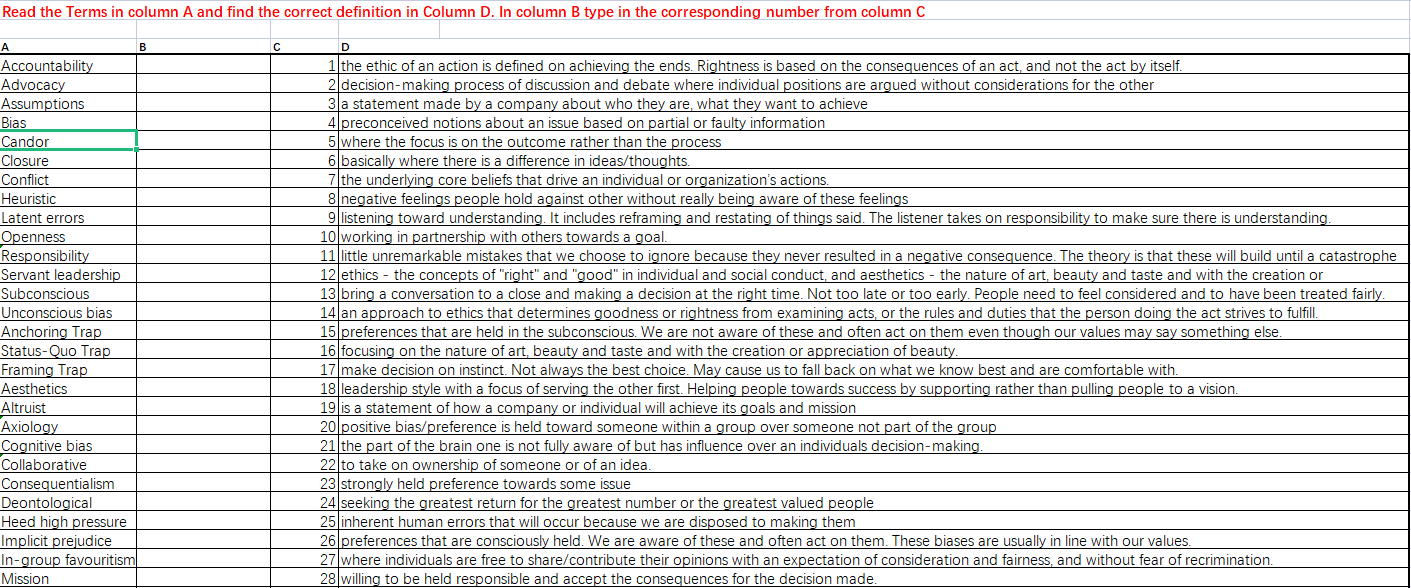

Read the Terms in column A and find the correct definition in Column D. In column B type in the corresponding number from column C

Read the Terms in column A and find the correctRead the Terms in column A and find the correct

Read the Terms in column A and find the correct definition in Column D. In column B type in the corresponding number from column C B Accountability Advocacy Assumptions Bias Candor Closure Conflict Heuristic Latent errors Openness Responsibility Servant leadership Subconscious Unconscious bias Anchoring Trap Status-Quo Trap Framing Trap Aesthetics Altruist Axiology Cognitive bias Collaborative Consequentialism Deontological Heed high pressure Implicit prejudice In-group favouritism Mission D 1 the ethic of an action is defined on achieving the ends. Rightness is based on the consequences of an act, and not the act by itself. 2 decision-making process of discussion and debate where individual positions are argued without considerations for the other 3 a statement made by a company about who they are, what they want to achieve 4 preconceived notions about an issue based on partial or faulty information 5 where the focus is on the outcome rather than the process 6 basically where there is a difference in ideas/thoughts. the underlying core beliefs that drive an individual or organization's actions. 8 negative feelings people hold against other without really being aware of these feelings 9 listening toward understanding. It includes reframing and restating of things said. The listener takes on responsibility to make sure there is understanding 10 working in partnership with others towards a goal. 11 little unremarkable mistakes that we choose to ignore because they never resulted in a negative consequence. The theory is that these will build until a catastrophe 12 ethics - the concepts of "right" and "good" in individual and social conduct, and aesthetics - the nature of art, beauty and taste and with the creation or 13 bring a conversation to a close and making a decision at the right time. Not too late or too early. People need to feel considered and to have been treated fairly. 14 an approach to ethics that determines goodness or rightness from examining acts, or the rules and duties that the person doing the act strives to fulfill. 15 preferences that are held in the subconscious. We are not aware of these and often act on them even though our values may say something else. 16 focusing on the nature of art, beauty and taste and with the creation or appreciation of beauty. 17 make decision on instinct. Not always the best choice. May cause us to fall back on what we know best and are comfortable with 18 leadership style with a focus of serving the other first. Helping people towards success by supporting rather than pulling people to a vision. 19 is a statement of how a company or individual will achieve its goals and mission 20 positive bias/preference is held toward someone within a group over someone not part of the group 21 the part of the brain one is not fully aware of but has influence over an individuals decision-making. 22 to take on ownership of someone or of an idea 23 strongly held preference towards some issue 24 seeking the greatest return for the greatest number or the greatest valued people 25 inherent human errors that will occur because we are disposed to making them 26 preferences that a consciously held. We are aware of these and often act on them. These biases are usually in line with our values. 27 where individuals are free to share/contribute their opinions with an expectation of consideration and fairness, and without fear of recrimination. 28 willing to be held responsible and accept the consequences for the decision made Mission Near misses Outcome bias Proactive listening Utilitarianism Virtues Vision Values 28 willing to be held responsible and accept the consequences for the decision made 29 where an idea is communicated in a way to create an image of what the situation is. This image influences your understanding of reality and becomes the basis for 30 those moral and intellectual characteristics that lead to "good" and prudent behaviour. 31 honesty with integrity. Being able to say what ordinarily is not said. 32 being influenced by the first bit of information that you hear. This information becomes the basis for your decision. 33 the unselfish concerned for the well-being of other people. 34 deferring your decision to what usually happens or to the norm. There is no change in the process. 35 To be aware when making decisions under high pressure. People tend to make heuristic decisions or go with the status quo when there are great pressures

Step by Step Solution

There are 3 Steps involved in it

1 Expert Approved Answer
Step: 1 Unlock blur-text-image

Question Has Been Solved by an Expert!

Get step-by-step solutions from verified subject matter experts

Step: 2 Unlock
Step: 3 Unlock

Students Have Also Explored These Related General Management Questions!