





Question: Read this case below and answer the long questions: A. J's Wildlife Emporium manufactures two unique bird feeders (Deluxe and Super Duper) that are manufactured
Read this case below and answer the long
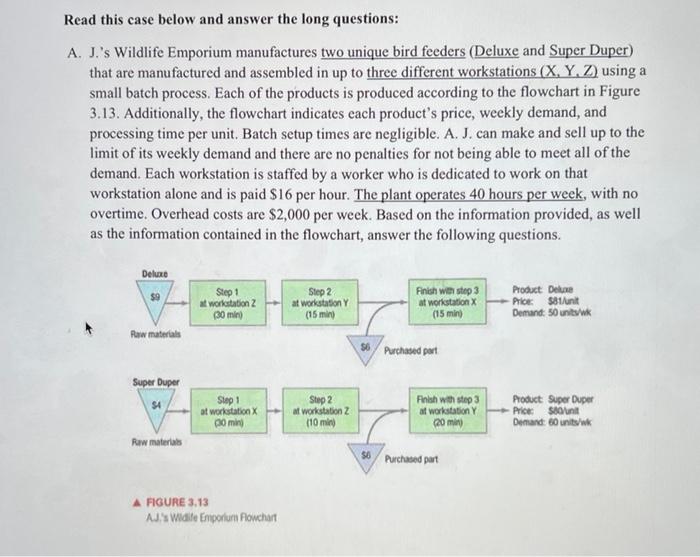
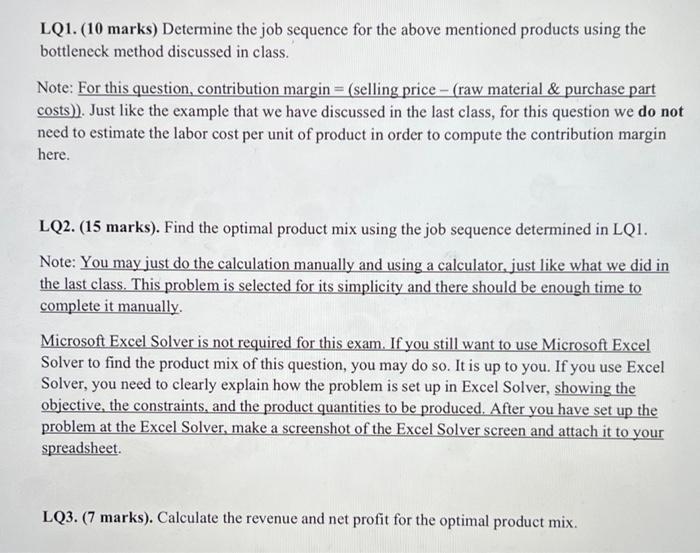
Read this case below and answer the long questions: A. J's Wildlife Emporium manufactures two unique bird feeders (Deluxe and Super Duper) that are manufactured and assembled in up to three different workstations (X, Y, Z using a small batch process. Each of the products is produced according to the flowchart in Figure 3.13. Additionally, the flowchart indicates each product's price, weekly demand, and processing time per unit. Batch setup times are negligible. A. J. can make and sell up to the limit of its weekly demand and there are no penalties for not being able to meet all of the demand. Each workstation is staffed by a worker who is dedicated to work on that workstation alone and is paid $16 per hour. The plant operates 40 hours per week, with no overtime. Overhead costs are $2,000 per week. Based on the information provided, as well as the information contained in the flowchart, answer the following questions. Deluxe Step 1 at workstation 2 (30 min) Step 2 at workstation Y (15 min) Finish with step 3 at workstation X (15 min Product Deluxe Prior $81unit Demand: 50 untuk Raw materials 56 Purchased port Super Duper $4 Step 1 at workstation X 00 min Step 2 at workstation 2 (10 min) Finish with step 3 af workstation Y (20 min) Product Super Duper -Price sunt Deniard: 60 untuk Raw materials 56 Purchased port A FIGURE 3.13 AJ's Widile Emporium Flowchart LQ1. (10 marks) Determine the job sequence for the above mentioned products using the bottleneck method discussed in class. Note: For this question, contribution margin = (selling price - (raw material & purchase part costs)). Just like the example that we have discussed in the last class, for this question we do not need to estimate the labor cost per unit of product in order to compute the contribution margin here. LQ2. (15 marks). Find the optimal product mix using the job sequence determined in LQ1. Note: You may just do the calculation manually and using a calculator, just like what we did in the last class. This problem is selected for its simplicity and there should be enough time to complete it manually. Microsoft Excel Solver is not required for this exam. If you still want to use Microsoft Excel Solver to find the product mix of this question, you may do so. It is up to you. If you use Excel Solver, you need to clearly explain how the problem is set up in Excel Solver, showing the objective, the constraints, and the product quantities to be produced. After you have set up the problem at the Excel Solver, make a screenshot of the Excel Solver screen and attach it to your spreadsheet. LQ3. (7 marks). Calculate the revenue and net profit for the optimal product mix

Step by Step Solution

There are 3 Steps involved in it

1 Expert Approved Answer
Step: 1 Unlock blur-text-image

Question Has Been Solved by an Expert!

Get step-by-step solutions from verified subject matter experts

Step: 2 Unlock
Step: 3 Unlock

Students Have Also Explored These Related General Management Questions!