







Question: Read this first TEXT from Children's Mathematical Learning (Feikes, Schwingendorf, Gregg, 2014) How Young Children Divide Your textbook may make several distinctions for types of
Read this first
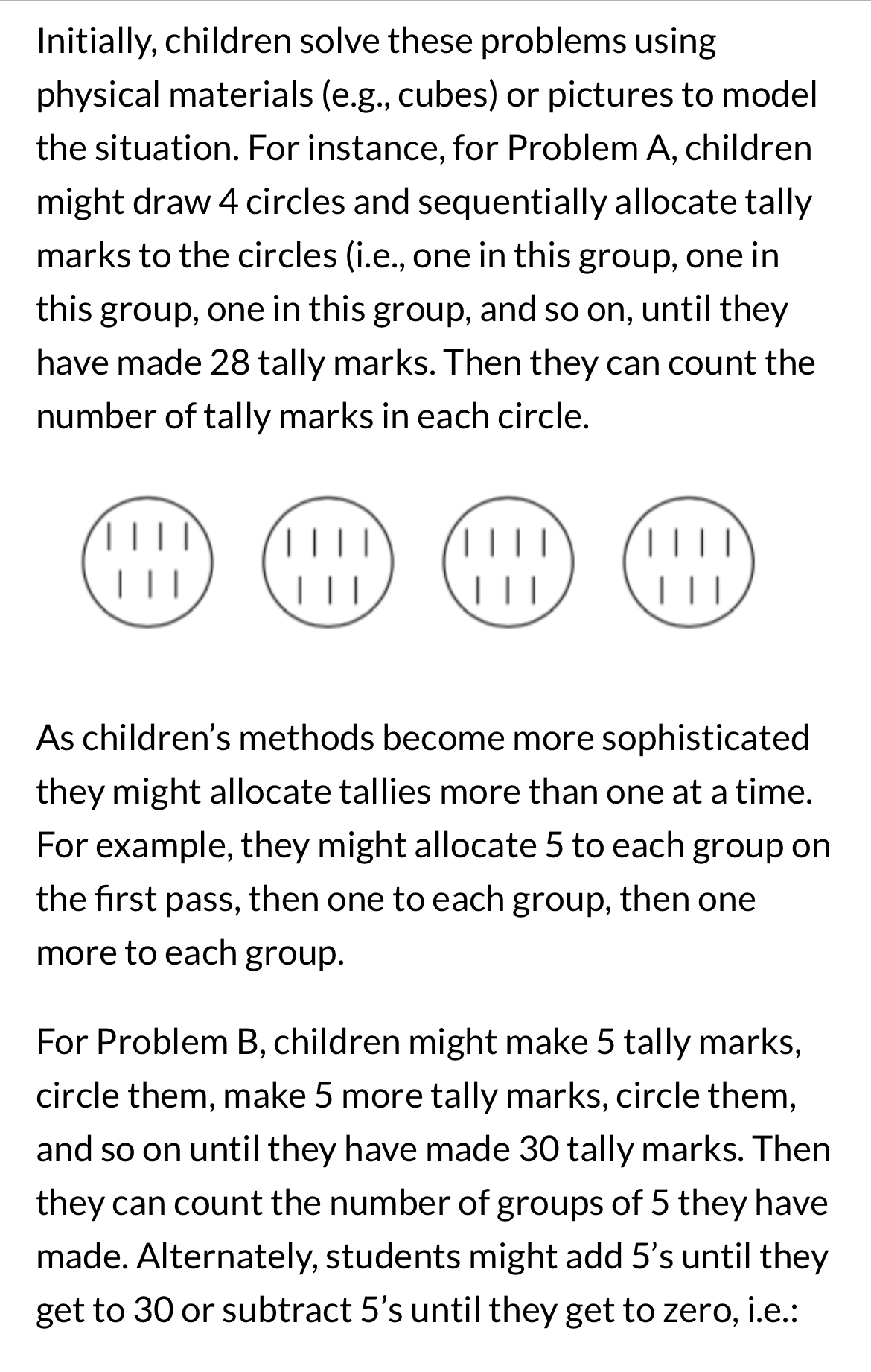
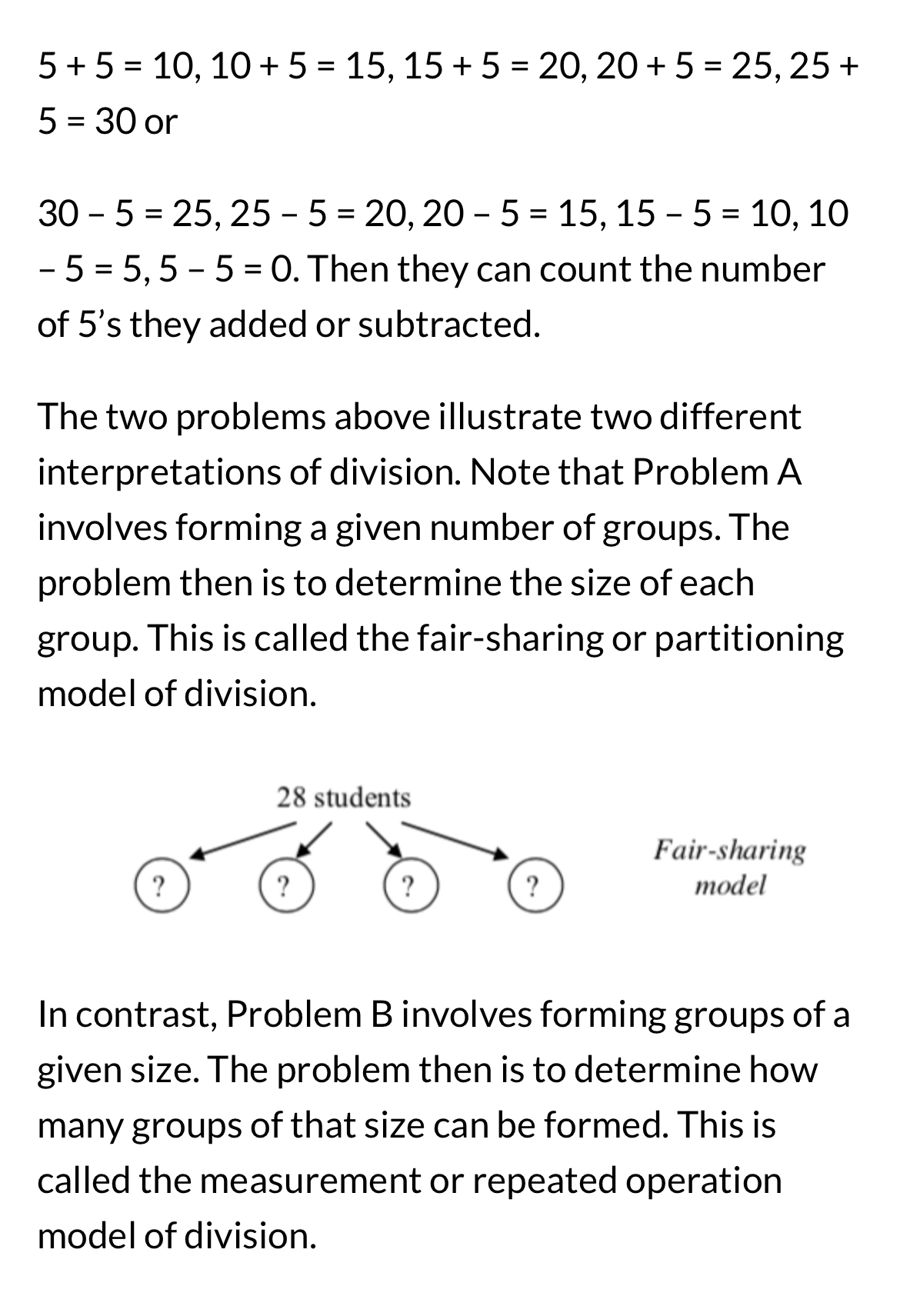
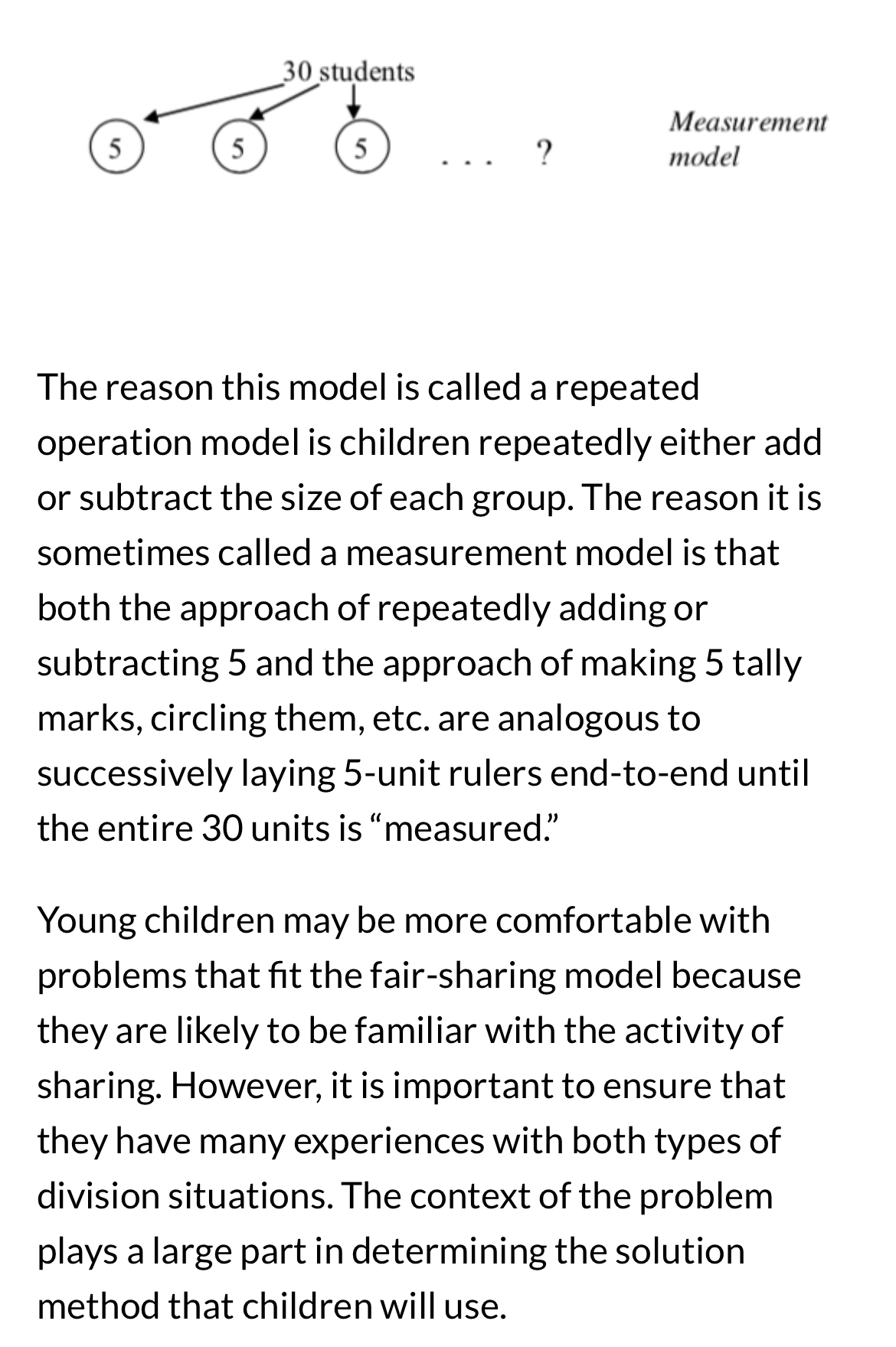
TEXT from Children's Mathematical Learning (Feikes, Schwingendorf, Gregg, 2014) How Young Children Divide Your textbook may make several distinctions for types of division problems. This supplement only makes two because children who do not know their division facts and who do not yet know that multiplication is the opposite of division predominantly solve division problems in two distinct ways. As early as second grade, children are capable of developing solution strategies for problems such as the following: 1. Mrs. Wright has 28 children in her class. If she wants to separate her class into 4 equal groups, how many children will be in each group? 2. Mrs. Davies has 30 children in her class. She wants to put them into groups of 5. How many groups will she have? Initially, children solve these problems using physical materials (e.g., cubes) or pictures to model the situation. For instance, for Problem A, children might draw 4 circles and sequentially allocate tally marks to the circles (i.e., one in this group, onein this group, one in this group, and so on, until they have made 28 tally marks. Then they can count the number of tally marks in each circle. As children's methods become more sophisticated they might allocate tallies more than one at a time. For example, they might allocate 5 to each group on the first pass, then one to each group, then one more to each group. For Problem B, children might make 5 tally marks, circle them, make 5 more tally marks, circle them, and so on until they have made 30 tally marks. Then they can count the number of groups of 5 they have made. Alternately, students might add 5's until they get to 30 or subtract 5's until they get to zero, i.e.: 5+5=10,10+5=15,15+5=20,20+5=2525+ 5=30o0r 30-5=25,25-5=20,20-5=15,15-5=10, 10 -5=5,5-5=0.Then they can count the number of 5's they added or subtracted. The two problems above illustrate two different interpretations of division. Note that Problem A involves forming a given number of groups. The problem then is to determine the size of each group. This is called the fair-sharing or partitioning model of division. 28 students / \\ Fair-sharing @ @ model In contrast, Problem B involves forming groups of a given size. The problem then is to determine how many groups of that size can be formed. This is called the measurement or repeated operation model of division. 30 students / Measurement @ @ ... ? model The reason this model is called a repeated operation model is children repeatedly either add or subtract the size of each group. The reason itis sometimes called a measurement model is that both the approach of repeatedly adding or subtracting 5 and the approach of making 5 tally marks, circling them, etc. are analogous to successively laying 5-unit rulers end-to-end until the entire 30 units is \"measured.\" Young children may be more comfortable with problems that fit the fair-sharing model because they are likely to be familiar with the activity of sharing. However, it is important to ensure that they have many experiences with both types of division situations. The context of the problem plays alarge part in determining the solution method that children will use
Step by Step Solution
There are 3 Steps involved in it

Get step-by-step solutions from verified subject matter experts
 Study Help