Question: Read through OB in Action on p. 167. Which needs would you say that Mitchell is driven by? Why? 11/1/21, 9:27 AM Reading Mode: Equity/Justice
Read through OB in Action on p. 167. Which needs would you say that Mitchell is driven by? Why?
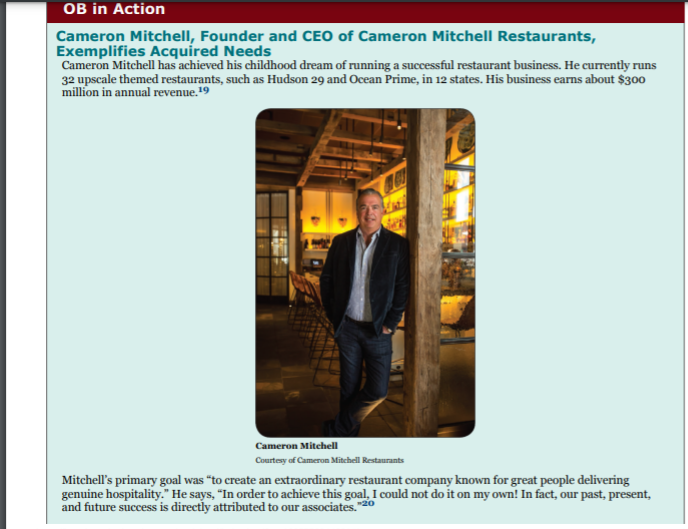
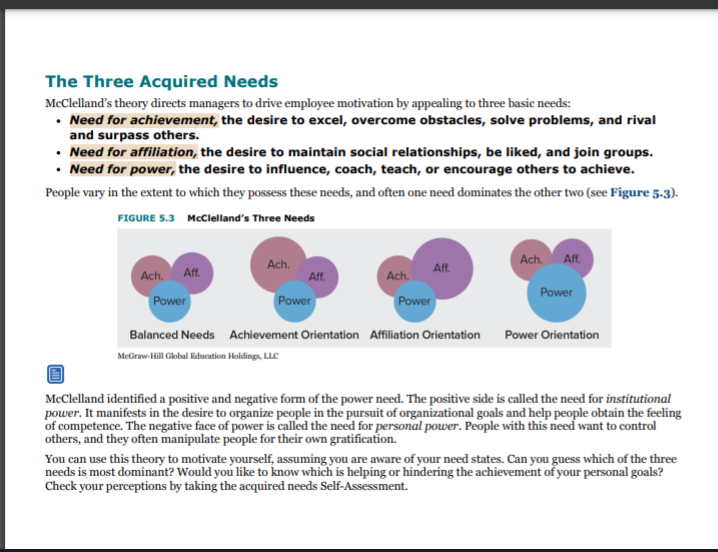
11/1/21, 9:27 AM Reading Mode: Equity/Justice Theory: Am I Being Treated Fairly? You might not have foreseen Mitchell's success based on his difficult childhood. His parents divorced when he was 9, and he began drinking alcohol and trying drugs in middle school. When he started dealing drugs in high school, his mom threatened to call child protective services. Mitchell decided to run away. He moved into a one-room apartment with other teens and sometimes went days without food. He decided to return home at 16 when he found himself thinking about suicide. He went back to high school and took a job as a dishwasher at a local steak house. He loved the job and concluded, The restaurant business was where I wanted to be the rest of my life." When Mitchell's application to the Culinary Institute of America was rejected due to his poor grades, he became more driven. He started working double shifts so he could pay for community college. He eventually graduated from culinary school and began working as a sous chef. Mitchell opened his first restaurant in 1993 in Columbus, Ohio. It was a success!21 Mitchell's business puts people first. Our associates are the core and foundation of our company," he says, and they are my number one priority. If they aren't happy at work, it will show in the food they produce, the way they treat our guests and the way they treat each other.... We treat them great and, in turn, they take great care of the company." The company's commitment to its employees shows in the wide array of benefits it offers, which exceed industry standards. It also rewards restaurant managers who support and develop their teams. Mitchell believes associates should have trusting, caring relationships with each other. He encourages managers' autonomy by allowing them to provide input on menu and wine selection decisions. The company further reinforces the value of autonomy and effective decision making with leadership training programs. Managers are taught "how to think (rather than 'how to do'). The goal is to encourage creative, appropriate problem-solving and idea generation, according to the company's website. "23 OB in Action Cameron Mitchell, Founder and CEO of Cameron Mitchell Restaurants, Exemplifies Acquired Needs Cameron Mitchell has achieved his childhood dream of running a successful restaurant business. He currently runs 32 upscale themed restaurants, such as Hudson 29 and Ocean Prime, in 12 states. His business earns about $300 million in annual revenue 19 Cameron Mitchell Courtesy of Cameron Mitchell Restaurants Mitchell's primary goal was to create an extraordinary restaurant company known for great people delivering genuine hospitality." He says, "In order to achieve this goal, I could not do it on my own! In fact, our past, present, and future success is directly attributed to our associates 20 The Three Acquired Needs McClelland's theory directs managers to drive employee motivation by appealing to three basic needs: Need for achievement, the desire to excel, overcome obstacles, solve problems, and rival and surpass others. Need for affiliation, the desire to maintain social relationships, be liked, and join groups. Need for power, the desire to influence, coach, teach, or encourage others to achieve. People vary in the extent to which they possess these needs, and often one need dominates the other two (see Figure 5-3). FIGURE 5.3 McClelland's Three Needs Ach. Aff. Ach. Af Ach. Aft Power Aff. Ach. Power Power Power Power Orientation Balanced Needs Achievement Orientation Affiliation Orientation McGraw-Hill Global Education Holdings, LLC McClelland identified a positive and negative form of the power need. The positive side is called the need for institutional power. It manifests in the desire to organize people in the pursuit of organizational goals and help people obtain the feeling of competence. The negative face of power is called the need for personal power. People with this need want to control others, and they often manipulate people for their own gratification. You can use this theory to motivate yourself, assuming you are aware of your need states. Can you guess which of the three needs is most dominant? Would you like to know which is helping or hindering the achievement of your personal goals? Check your perceptions by taking the acquired needs Self-Assessment









 Study Help